The hammer and sickle: what the USSR's main symbol really means
Two crossed tools recognized anywhere on the planet. Who designed the hammer and sickle, why Lenin struck the sword from the draft, what the star above them means — and why the symbol flies on some countries' flags while others have banned it.
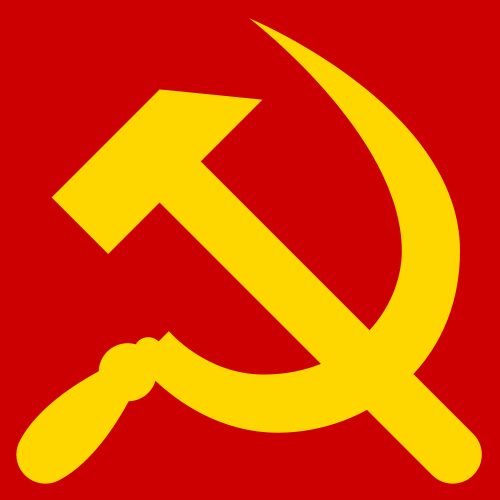
What the hammer and sickle means
The hammer and sickle is the principal emblem of the Soviet Union and of the world communist movement. The meaning is built into the composition itself: the hammer stands for industrial workers, the sickle for peasants; crossed, they signify the alliance of the two laboring classes on which, in the Bolsheviks' design, the new state rested. Lenin had a special word for that alliance — the smychka, the "bond" between town and village.
Together with the red field of the flag and the five-pointed star, the hammer and sickle formed the visual formula of the USSR — one so powerful that decades after the country's collapse it remains among the most recognizable graphic marks in history, alongside the cross and the crescent. The sign even has its own character in the Unicode computer standard — ☭.
Who created the symbol
The emblem is credited to the artist Yevgeny Kamzolkin. In the spring of 1918 he proposed the crossed hammer and sickle as a decoration for Moscow's Zamoskvorechye district for the first Soviet May Day. The sign proved perfect: simple, legible from a distance, and comprehensible to an illiterate peasant or worker without a single word.
Early drafts of the state seal also included a sword, but Lenin rejected it: by contemporary accounts he declared that a sword was not one of their symbols, unwilling to give the emblem a militarist edge. A telling detail: a state born of revolution and civil war chose the tools of peaceful labor for its official image. In the summer of 1918 the hammer and sickle entered the emblem of Soviet Russia; on July 6, 1923, the emblem of the USSR; and on April 18, 1924, the canonical flag was confirmed: a gold hammer and sickle on a red field, with a gold-bordered red star above them. In that form the flag lived until 1991.
The red field and the star: every element explained
Each element of the flag had its own biography and meaning.
- The color red is decades older than the USSR: the banner of uprisings since the French Revolution, the flag of the Paris Commune of 1871, and by the late 19th century the shared color of the world labor movement. The official Soviet reading: the blood shed in the struggle for the liberation of labor.
- The five-pointed star came from military symbolism: in Russia it had marked the army since the 19th century, and in 1918 the red star became the emblem of the new Red Army. On the flag it carried two readings: the Communist Party leading the worker-peasant alliance (the star stands above the hammer and sickle), and the future triumph of communism on the five continents of the globe. Both versions circulated officially — we give both.
- The state emblem of the USSR framed the hammer and sickle with sheaves of wheat wound with ribbons bearing the motto "Workers of the world, unite!" in the languages of all the union republics — one ribbon per republic. The hammer and sickle set against the globe declared openly: the symbol was designed not for one country but for the whole world.
The symbol in everyday life
Over seventy years as a state emblem, the hammer and sickle soaked through Soviet life: passports and banknotes, medals and soldiers' belt buckles, the fuselages of Aeroflot airliners and the bows of icebreakers, building facades and metro stations. The country's highest award for labor was literally called the Hammer and Sickle gold medal of the Hero of Socialist Labor. The sign stood on the Victory Banner raised over the Reichstag in May 1945, and the same red star shone on Gagarin's helmet.
In the 1930s the symbol stepped into art: Vera Mukhina's sculpture Worker and Kolkhoz Woman — a young man raising a hammer, a young woman a sickle — became the USSR's calling card at the 1937 Paris World's Fair and later the on-screen emblem of the Mosfilm studio. Western culture answered in its own way: from posters to Andy Warhol's series of works that turned the emblem into an object of pop art.
After 1991: flags and bans
After the collapse of the USSR the symbol's fate split in two — and that split is the best illustration of the wider argument over the Soviet legacy.
On one hand, the hammer and sickle remains in official use to this day: on the flags of the ruling communist parties of China, Vietnam and Laos, on the flags and arms of some Russian regions (Vladimir and Bryansk oblasts), in the symbols of unrecognized Transnistria, in the Aeroflot logo, and on the banners of communist parties worldwide. In Russia it is part of the Victory Banner flown on commemorative dates, and the chief emblem of nostalgia for the USSR.
On the other hand, for millions of people — above all in Eastern Europe and the post-Soviet space — the hammer and sickle means not the alliance of labor but the Gulag, the deportations and decades of unfreedom. A number of countries (among them Ukraine, Lithuania, Latvia and others) have legally restricted or banned public Soviet symbols, classing them with totalitarian ones; in Ukraine the ban became part of the decommunization laws of 2015. We do not smooth over this contradiction: one and the same sign is a symbol of labor and victory for some and a symbol of repression for others — and both memories are real.
Frequently asked questions
What does the hammer and sickle mean? The alliance of workers (the hammer) and peasants (the sickle) — the two classes on which the Soviet state was built. In its international sense — the solidarity of working people worldwide.
Who created the hammer and sickle, and when? The artist Yevgeny Kamzolkin, in 1918, for the May Day decoration of Moscow's Zamoskvorechye district. That same year the sign entered the emblem of Soviet Russia, and in 1923 the emblem of the USSR.
What does the star on the Soviet flag mean? The official readings: the Communist Party leading the worker-peasant alliance, or the future triumph of communism on the five continents. The red star itself had been the emblem of the Red Army since 1918.
Why is there no sword in the emblem? A sword appeared in early drafts of the state seal, but Lenin rejected it as a militarist symbol: the state wished to present itself through peaceful labor.
Where is the hammer and sickle used today? On the flags of the communist parties of China, Vietnam and Laos, in the symbols of Russian communist parties and some regions, on the Victory Banner, and in the Aeroflot logo.
In which countries is the hammer and sickle banned? Public use of Soviet symbols is restricted or banned in several Eastern European countries — including Ukraine (the 2015 decommunization law), Lithuania and Latvia, where they are classed with totalitarian symbols.
Related
- CCCP: what the four letters mean — the first symbol flagship of our encyclopedia.
- The October Revolution of 1917 — the event that produced both the state and its signs.
- Vladimir Lenin — the man who struck the sword from the emblem.
- The dissolution of the USSR (1991) — the moment the hammer-and-sickle flag came down over the Kremlin.
- The Soviet anthem: the melody that outlived its country — the third great symbol beside the flag and the acronym.
- The Moscow Metro — where the symbol appears most often of all.
Sources
The facts in this article can be verified against authoritative sources:
- Wikipedia, "Hammer and sickle": https://en.wikipedia.org/wiki/Hammer_and_sickle
- Wikipedia, "Flag of the Soviet Union": https://en.wikipedia.org/wiki/Flag_of_the_Soviet_Union
- Encyclopaedia Britannica, "Flag of Union of Soviet Socialist Republics": https://www.britannica.com/topic/flag-of-Union-of-Soviet-Socialist-Republics
- Russia Beyond, "The Soviet flag EXPLAINED": https://www.rbth.com/history/333914-soviet-flag-explained
- Russia Beyond, "5 main symbols of the Soviets EXPLAINED": https://www.rbth.com/history/334284-5-main-symbols-of-soviets
Where readings diverge (the meaning of the star, present-day attitudes to the symbol), we give both versions rather than one.