The Gulag: an archipelago of forced labor
Five letters that became the name of an entire system: hundreds of camps from the Solovetsky Islands to Kolyma, some 18 million people who passed through them, and cities that grew out of barracks. What the Gulag was — precisely, without myths.
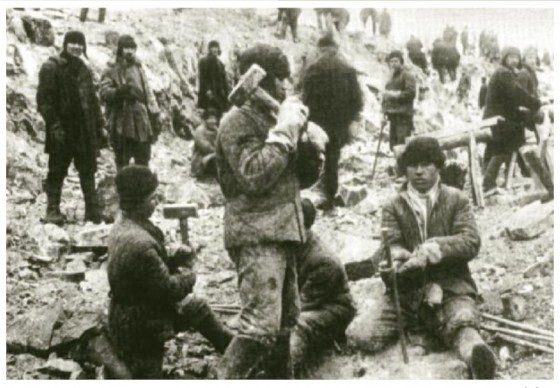
What the Gulag was
GULAG is an acronym: Glavnoye Upravleniye Lagerey — the Main Directorate of Corrective Labor Camps. Formally it was just a department within the OGPU, later the NKVD — the "office" that ran the camps. But the word long ago outgrew its bureaucratic meaning: "the Gulag" now stands for the entire Soviet system of forced labor — the hundreds of camps and colonies scattered across the country from the Solovetsky Islands to Kolyma, and the machinery of repression that kept them filled.
According to archival data opened after the collapse of the USSR, in 1930–1953 alone about 18 million people passed through the Gulag's camps and colonies, and roughly 6 million more were sent into exile and "special settlements." At its peak the system held up to 2.5 million prisoners at a time. The word owes its worldwide fame to Aleksandr Solzhenitsyn: his book The Gulag Archipelago (1973) likened the camps scattered across the country to a chain of islands — and the image became the name of an era.
Where the camps came from
Forced convict labor existed in tsarist Russia too — penal servitude, Siberian exile. But a system of a new type was born together with Soviet power. As early as 1918, under Lenin, at the height of the Red Terror, the first concentration camps for "class enemies" appeared; the decree on forced labor camps followed in April 1919. The symbol of the first decade was SLON — the Solovetsky Special Purpose Camp, set up inside an ancient monastery on the White Sea: it was there that the routines later replicated across the whole country were first worked out.
The Gulag proper, as a directorate, was established in 1930 within the OGPU — the predecessor of the NKVD and the KGB. The date was no accident: collectivization had begun, and hundreds of thousands of "dekulakized" peasants poured into the camps and exile. Under Stalin the camp system fused with the economy: the five-year plans needed coal, timber, gold and construction sites in places no one would go voluntarily. The prisoner became a planned unit of labor.
Who was sent there
The camps held ordinary criminals too, but the face of the Gulag became the "politicals" — those convicted under the notorious Article 58 on "counter-revolutionary crimes." Almost anything qualified: a joke about the leader, "failure to inform," kinship with an arrested person, "espionage" without a shred of evidence. A large share of sentences was passed without any trial at all — by NKVD "troikas," in absentia, by list. During the Great Terror of 1937–38 the secret police worked to arrest quotas — plans that local branches asked to have increased.
Peasants and ministers, scientists and priests, marshals and poets all served time. Through the camps and the sharashkas — prison design bureaus — passed the future creator of the space program Sergei Korolev and the aircraft designer Tupolev. Foreigners were imprisoned too: Poles, Germans, Hungarians, Czechs, Americans. After the war they were joined by hundreds of thousands of repatriated Soviet prisoners of war — many went straight from German captivity to a Soviet camp.
How the system worked
By 1940 the system counted 53 camp directorates and 423 colonies; over its whole history researchers count 476 camp complexes, each uniting dozens of individual camp sites. An average camp held 2,000 to 10,000 prisoners.
Life inside obeyed a single principle: food in exchange for the work quota. The working day ran up to 14 hours — felling timber, mining, building, in frosts of minus forty, with primitive tools. Miss the quota — a reduced ration; a reduced ration — less strength; less strength — the quota missed again. Prisoners had their own word for the men at the last stage of exhaustion — dokhodyagi, "goners." To hunger were added disease, the arbitrary power of the guards, and the rule of criminal gangs over the "politicals."
Prisoner labor built the White Sea–Baltic Canal (over 100,000 people worked on it), the Moscow–Volga Canal, the Kolyma Highway, railway lines, mines and factories. Entire cities — Magadan, Vorkuta, Norilsk, Ukhta, Inta — grew out of camp settlements. Yet economically the system never paid off: forced labor was monstrously inefficient, and in the end the camps drained more from the budget than they contributed.
How many people died
This is the hardest and most contested question, and we give the figures honestly.
- The archival consensus: according to documents declassified after 1991, between 1.5 and 1.7 million people died in the Gulag camps in 1930–1953; counting the labor colonies and special settlements, estimates rise to about 2.7 million. Roughly half of all deaths fell in 1941–43, when the camps met the war with famine.
- Why reality is higher than the documents: dying prisoners were routinely "written off" — released days before death so they would not spoil the camps' statistics. For this reason some historians consider even the archival figures undercounts.
- The higher estimates: before the archives opened, researchers and memoirists put the death toll at 6 to 12 million or more; Solzhenitsyn wrote of tens of millions passing through the "Archipelago." Those figures were built on indirect evidence and testimony rather than documents.
It is important to understand that the Gulag is only part of Stalin-era repression. Separate from the camp deaths stand some 800,000 people executed on political sentences, hundreds of thousands who died in the deportations of entire peoples, and the millions of victims of the famine of the early 1930s.
The end of the Gulag
The system began to crumble immediately after Stalin's death in March 1953: within three weeks a mass amnesty was declared — though it applied mainly to common criminals. The real turn came under Khrushchev: after his Secret Speech of 1956, millions of cases were reviewed, and political prisoners were released and rehabilitated en masse — many posthumously. In 1960 the Gulag as an institution was officially abolished.
The camps did not vanish entirely: political zones — now for dissidents — existed right up to perestroika. The last political camp, Perm-36, closed only in 1988–1990, under Gorbachev — himself the grandson of dekulakized peasants. Glasnost brought the subject into the open press: The Gulag Archipelago was published in the USSR in 1989, and in 1991 a law on the rehabilitation of victims of political repression was adopted.
Memory, and the argument over memory
The Gulag left its mark on almost every Soviet family — and yet an honest public conversation about it began only decades later. Today Moscow has a State Gulag History Museum, the Solovetsky Stone stands on Lubyanka Square, and October 30 is marked in Russia as the Day of Remembrance of the Victims of Political Repression.
The argument over memory continues. Some insist that without full acknowledgment and study of this chapter, the past will repeat itself; others prefer to speak of the "era of industrialization" and "complicated times." We hold to a simple principle: figures from the archives, testimony from documents and survivors' memoirs — and no great construction project justifies millions of broken lives.
Frequently asked questions
What does GULAG stand for? Glavnoye Upravleniye Lagerey — the Main Directorate of Corrective Labor Camps. Originally the name of a department within the OGPU/NKVD; over time the word came to denote the entire Soviet camp system.
When did the Gulag exist? The first Soviet camps appeared in 1918–19; the Gulag directorate was created in 1930. The mass system was wound down after Stalin's death in 1953 and officially abolished in 1960; individual political camps existed into the late 1980s.
How many people passed through the Gulag? According to archival data — about 18 million through the camps and colonies in 1930–1953, plus roughly 6 million exiles and special settlers.
How many people died in the Gulag? The archival consensus is 1.5–1.7 million deaths in the camps (up to about 2.7 million including colonies and settlements); a number of historians consider these figures undercounts because dying prisoners were released to keep them off the books. Pre-archival estimates ran to 6–12 million.
What were people sent to the Gulag for? Besides ordinary crimes — under the political Article 58: "anti-Soviet agitation" (jokes included), "espionage," "wrecking," kinship with an "enemy of the people." Many sentences were passed by extrajudicial "troikas."
What is The Gulag Archipelago? Aleksandr Solzhenitsyn's book (1973) — a literary investigation of the camp system based on his own sentence and the testimony of more than 200 survivors. It was this book that made the word "Gulag" known worldwide.
Related
- Joseph Stalin — the era in which the system reached its peak.
- The KGB: sword and shield of Soviet power — the lineage of the agency that ran the camps.
- Sergei Korolev — the creator of the space program, who survived Kolyma and a sharashka.
- Nikita Khrushchev — the Secret Speech and mass rehabilitation.
- The Khrushchev Thaw — the years when the camps began giving people back.
Sources
The facts in this article can be verified against authoritative sources:
- Encyclopaedia Britannica, "Gulag": https://www.britannica.com/place/Gulag
- Wikipedia, "Gulag": https://en.wikipedia.org/wiki/Gulag
- Gulag.online (museum project by Gulag.cz), "The history of the Gulag": https://gulag.online/articles/historie-gulagu?locale=en
- EBSCO Research Starters, "Gulag": https://www.ebsco.com/research-starters/history/gulag
- HISTORY, "Gulag: Meaning, Archipelago & Definition": https://www.history.com/articles/gulag
Where figures diverge (the death toll), we separate the archival consensus from higher estimates and explain the nature of each number.