Nikita Khrushchev: de-Stalinization, the Thaw and the Cuban crisis
He denounced Stalin, freed millions of prisoners and put the first man in space — and brought the world to the brink of nuclear war. An honest portrait of the most contradictory Soviet leader.
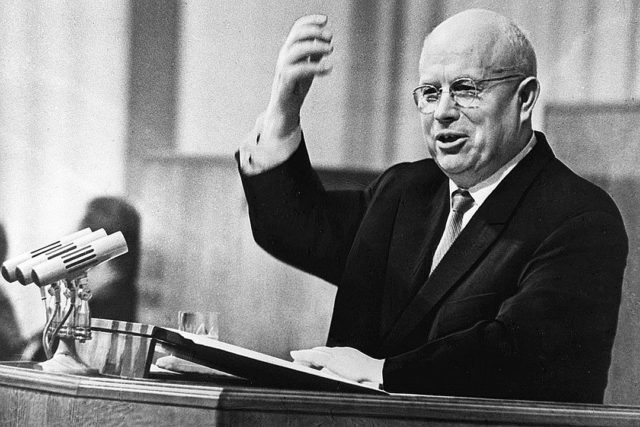
Who Khrushchev was
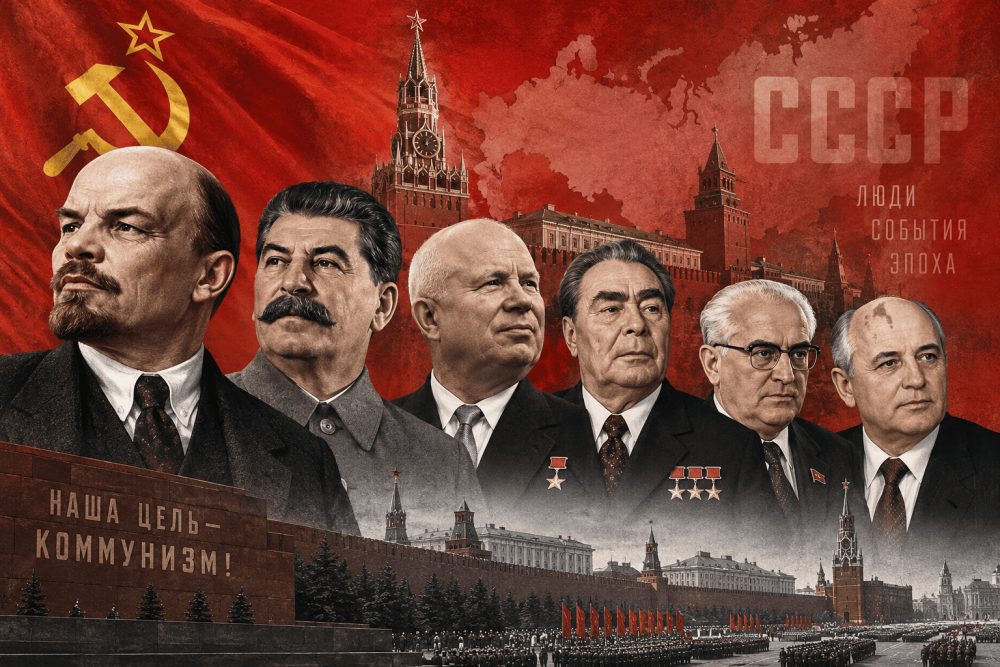
Nikita Khrushchev led the Soviet Union after Stalin's death — from 1953 to 1964. In a single decade he managed an astonishing amount: he exposed Stalin's cult and released millions from the camps, launched the "Thaw," sent the first satellite and the first human into space, moved millions of families into their own flats — and at the same time crushed the uprising in Hungary, built the Berlin Wall and very nearly brought the world to nuclear war over Cuba.
Khrushchev is a figure of pure contradictions: a reformer raised inside Stalin's system; a man who repented of a terror in which he himself had taken part. Let us tell his story honestly, without simplifying.
A miner's son
Nikita Sergeyevich Khrushchev was born on 15 April 1894 in the village of Kalinovka near Kursk, right on the border with Ukraine. Unlike most Soviet leaders, he genuinely came "from below": the son of a coal miner, the grandson of a serf. When he was 14 the family moved to the mining town of Yuzovka (now Donetsk), where the teenager went to work as a metal fitter.
In 1918 Khrushchev joined the Bolshevik party and went through the Civil War. He lacked formal education all his life — but energy and grit he had in abundance.
Rising under Stalin
Khrushchev made his career inside Stalin's machine. In the 1930s he ran the Moscow party organization (and the construction of the famous Metro), then headed the Communist Party of Ukraine. It must be said honestly: these were the years of the Great Terror, and Khrushchev, like other officials of his rank, took part in the repressions — signing documents that sent people to the camps and to their deaths. He later admitted as much himself.
During the war Khrushchev served as a political commissar at the front, including at Stalingrad. By the time of Stalin's death in March 1953 he was in the inner circle of power — but was not considered the favourite.
The struggle for power
After Stalin's death the battle of the heirs began. The most feared of them — state security chief Lavrentiy Beria — was arrested by his colleagues and executed as early as 1953. In September 1953 Khrushchev became First Secretary of the party; by 1955 he had pushed aside the head of government, Malenkov; in 1957 he crushed an attempt by the old guard (Molotov, Malenkov, Kaganovich) to remove him; and in 1958 he took over the government as well. He won with true apparatus cunning — the lessons of Stalin's school had not been wasted, though he no longer shot the losers: he sent them into retirement or to distant posts.
The Secret Speech: a blow at Stalin
Khrushchev's defining act came on 25 February 1956. At a closed session of the 20th Party Congress he delivered a four-hour report, "On the Cult of Personality and Its Consequences," and laid into Stalin: mass terror, torture, the execution of the innocent, the deportation of entire peoples, the failures at the start of the war, self-glorification.
The effect was like an explosion. The delegates listened in dead silence; by some accounts, several suffered heart attacks. The speech was called "secret" — the Soviet press said nothing about it (it would not be published in full in the USSR until 1989) — but it was read out at thousands of party meetings across the country, and by the summer of 1956 the text had been printed in the West.
So began de-Stalinization. Millions of political prisoners left the camps, and thousands of the dead were posthumously rehabilitated. In 1961 Stalin's body was removed from the Mausoleum, and Stalingrad was renamed Volgograd.
The Thaw — within limits
The era took its name, the "Thaw," from a novella by Ilya Ehrenburg. Censorship eased, new poets found their voices, the country opened slightly to the world. Khrushchev personally authorized the publication of Solzhenitsyn's "One Day in the Life of Ivan Denisovich" — the first book about the Gulag to appear in the Soviet press.
But the freedom came in measured doses. Boris Pasternak was hounded over "Doctor Zhivago" and forced to refuse the Nobel Prize (1958). At the Manege exhibition (1962) Khrushchev crudely tore into avant-garde artists. The persecution of religion intensified. The Thaw was precisely a thaw — not spring.
The dark side: Tbilisi, Hungary, Novocherkassk
Khrushchev's rule had bloody pages too, and they must be named plainly.
In March 1956 troops in Tbilisi fired on pro-Stalin demonstrators — dozens died. That autumn de-Stalinization shook Eastern Europe: Poland won concessions, but in Hungary a true uprising began. Khrushchev sent in the tanks: at least 2,500 Hungarians were killed in the suppression, about 13,000 were wounded, and hundreds of thousands fled to the West. And in 1962, in Novocherkassk, troops fired on a demonstration of workers protesting price rises — dozens died, and the tragedy was concealed for decades.
The man who exposed Stalin's terror could be ruthless himself — that is part of an honest portrait.
The Virgin Lands and the corn
Khrushchev bubbled with ideas, above all in agriculture — and here his greatest failures awaited. He ploughed up tens of millions of hectares of "virgin lands" in Kazakhstan and Siberia: after the first record harvests the soil began to give out. With an American's zeal he pushed corn everywhere — even where it would not grow, earning the nickname "kukuruznik," the corn man. By 1963 the country that had promised to "catch up with and overtake America" was forced to buy grain abroad. These failures badly undermined his position.
The khrushchyovkas: a housing revolution
One of his programmes, though, changed tens of millions of lives for the better: mass housing construction. The plain five-storey panel blocks — the khrushchyovkas — let millions of families move out of barracks and communal flats into homes of their own for the first time. For the ordinary person this may be Khrushchev's most tangible legacy.
Space and America
Under Khrushchev the USSR stunned the world: the first satellite (1957) and the first human in space — Yuri Gagarin (1961). The space triumphs became his trump card in the contest of systems.
With the West Khrushchev proclaimed "peaceful coexistence" — and became the first Soviet leader to visit the United States (1959). His "kitchen debate" with Vice President Nixon, over whose system fed and clothed people better, became famous.
"We will bury you" and the shoe at the UN
The two most famous "Khrushchev moments" deserve an honest look.
"We will bury you!" (1956) was taken in the West as a military threat. In fact Khrushchev meant the Marxist thesis that communism would outlive capitalism — "we will be present at your funeral." He later clarified it himself: "Of course we will not bury you with a shovel. Your own working class will bury you." The translation played a cruel trick.
The shoe at the UN (1960) really happened, but the details are disputed: by some accounts Khrushchev banged the shoe on his desk, by others he only brandished it in protest. No photograph of an actual blow exists. Either way, the episode fitted his image perfectly — hot-tempered, vivid, unpredictable.
Berlin and Cuba: on the brink
The Cold War under Khrushchev reached its most dangerous points. In 1961, with his approval, the Berlin Wall went up, cutting the city and Europe in two. And in 1962 he secretly placed nuclear missiles in Cuba — the Cuban Missile Crisis began, the closest the world has come to nuclear war. What saved it was that Khrushchev and Kennedy, at the decisive moment, chose compromise: the missiles were withdrawn in exchange for a US pledge not to invade Cuba (and the quiet removal of American missiles from Turkey).
Shaken by the experience, the two sides took a step towards détente: in 1963 the treaty banning nuclear tests in the atmosphere, in space and under water was signed.
Removed from power — alive, for the first time
By 1964 all the elites were fed up with Khrushchev: the failures in agriculture, the endless reorganizations, the quarrel with China, the humiliation over Cuba, his rudeness and wilfulness. In October 1964 his colleagues, led by Brezhnev, summoned him back from holiday, and a Central Committee plenum retired him "for reasons of health."
It was a historic moment: for the first time a Soviet leader was removed peacefully, not carried out of the Kremlin feet first — and he simply went on living. Khrushchev himself said that perhaps this was his real achievement: he was dismissed by a simple vote.
In retirement he secretly dictated his memoirs; they were smuggled abroad and published in the West (1970) — to the fury of the authorities.
Death and the black-and-white monument
Khrushchev died on 11 September 1971. He was buried without state honours — not by the Kremlin wall but at Novodevichy Cemetery. His monument was made by the sculptor Ernst Neizvestny — the very man Khrushchev had once publicly savaged at the Manege. The gravestone of black and white blocks became the perfect symbol: a man in whom darkness and light were inseparably entwined.
A contradictory legacy
Assessments of Khrushchev diverge — and both sides rest on facts.
- To his credit: the exposure of Stalin and the freeing of millions, the Thaw, housing for the people, the space triumphs, the fact that he ultimately stepped back from the brink in 1962, and the peaceful transfer of power.
- Against him: his own part in the terror of the 1930s, the blood of Hungary and Novocherkassk, the persecution of the church and of artists, his economic gambles, and the fact that it was he who brought the world to the Cuban crisis.
Perhaps his own monument says it best: black and white, fused without halftones in a single figure.
Frequently asked questions
Who was Nikita Khrushchev? The leader of the USSR in 1953–1964: First Secretary of the Communist Party (from 1953) and head of government (from 1958). The author of de-Stalinization and the "Thaw."
What was Khrushchev's Secret Speech? The report "On the Cult of Personality and Its Consequences," delivered at a closed session of the 20th Party Congress on 25 February 1956, in which Khrushchev exposed Stalin's crimes. It was not published in full in the USSR until 1989.
Did Khrushchev really bang his shoe at the UN? The 1960 episode is real, but the details are disputed: by some accounts he banged it on the desk, by others he only brandished it. No photograph of the blow itself exists.
What did "We will bury you" mean? Not a military threat, but the Marxist thesis that communism would outlive capitalism. Khrushchev later explained: "Your own working class will bury you."
How did Khrushchev lose power? In October 1964 his colleagues, led by Brezhnev, removed him — the first peaceful dismissal of a leader in Soviet history. He died in retirement in 1971.
Related
- Joseph Stalin — the predecessor whose cult Khrushchev exposed.
- The Cuban Missile Crisis of 1962 — Khrushchev's most dangerous gamble.
- Khrushchyovki: how the country got its own flats — his housing revolution.
- Yuri Gagarin — the great triumph of the Khrushchev era.
- The Berlin Wall: 28 years of the Cold War's greatest symbol — the border closed with his approval in 1961.
Sources
The facts in this article can be verified against authoritative sources:
- Encyclopædia Britannica, "Nikita Khrushchev": https://www.britannica.com/biography/Nikita-Sergeyevich-Khrushchev
- Encyclopædia Britannica, "Khrushchev's secret speech": https://www.britannica.com/event/Khrushchevs-secret-speech
- Wikipedia, "Nikita Khrushchev": https://en.wikipedia.org/wiki/Nikita_Khrushchev
- Wikipedia, "On the Cult of Personality and Its Consequences": https://en.wikipedia.org/wiki/On_the_Cult_of_Personality_and_Its_Consequences
- Wikipedia, "We will bury you": https://en.wikipedia.org/wiki/We_will_bury_you
- HISTORY, "Nikita Khrushchev": https://www.history.com/articles/nikita-sergeyevich-khrushchev
Where the details are contested (the shoe episode, the verdict on his legacy), we give different versions rather than a single one.