The Berlin Wall: 28 years of the Cold War's greatest symbol
In a single August night in 1961, a city was cut in half. Twenty-eight years, at least 140 dead, over 5,000 successful escapes — and one botched press conference that brought it all down in an evening.
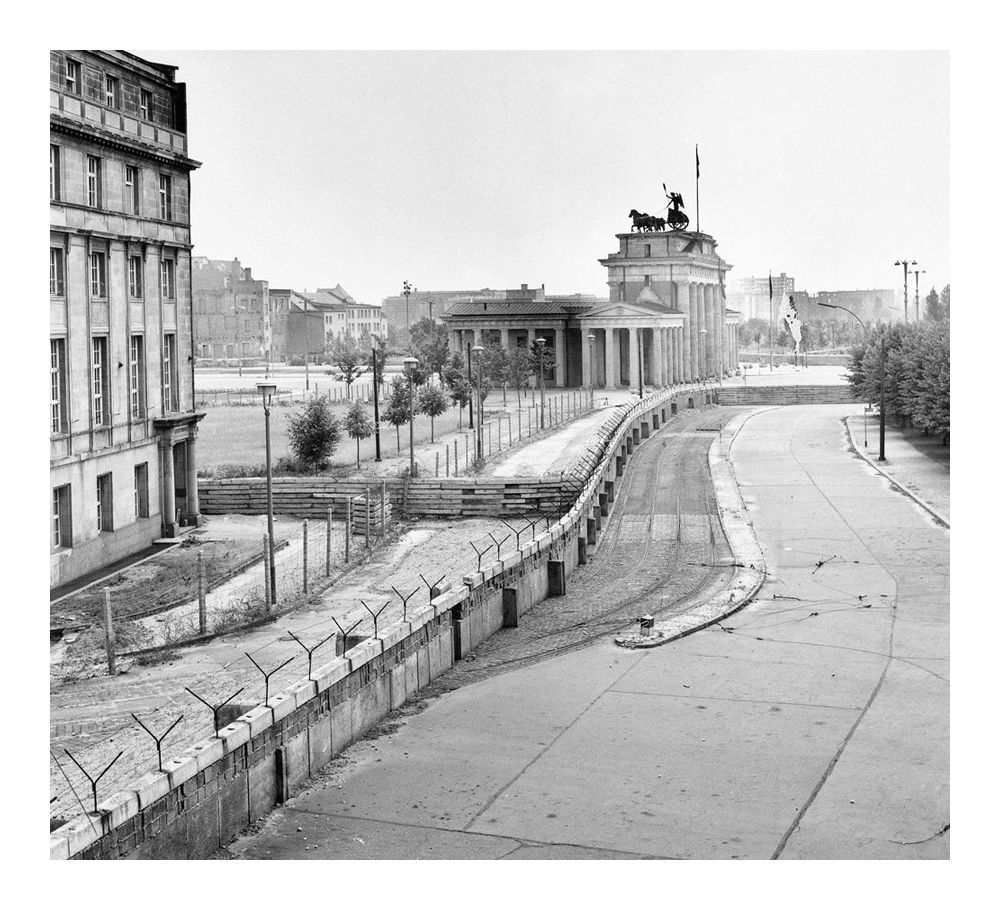
What the Berlin Wall was
The Berlin Wall was the fortified border with which East Germany (the GDR) sealed off West Berlin from August 1961 to November 1989. Officially it was called the "Anti-Fascist Protection Rampart," supposedly shielding the GDR from "Western saboteurs." In reality the Wall faced the other way: its true purpose was to keep the GDR's own citizens from leaving for the West.
The fortifications around West Berlin ran for about 155 kilometers (96 miles), nearly 44 of them cutting straight through the city — through streets, squares, cemeteries and even apartment houses. Over 28 years the Wall evolved from barbed wire into an elaborate system of two walls, watchtowers, alarm fences and a "death strip" between them. It became the most tangible embodiment of the Cold War: the Iron Curtain politicians spoke of could here be touched with your hand.
Why it was built
After the Second World War, Germany — and Berlin itself — was divided into occupation zones. The Western zones became West Germany; the Soviet zone became the GDR. West Berlin remained an island of capitalism 160 kilometers deep inside socialist Germany — and that island was a hole in the Iron Curtain: the border between the city's sectors stayed effectively open. Crossing it took a short walk or a subway ride.
People left in droves. Between 1949 and 1961 some 3.5 million people fled the GDR — roughly 20% of the country's population. The young and educated left first: doctors, engineers, teachers, skilled workers. The East German economy was bleeding out, and in the summer of 1961 the exodus became an avalanche: 30,000 people in July, and 2,400 on August 12 alone — the single-day record in the country's history.
On June 15, 1961, East German leader Walter Ulbricht uttered a phrase that entered history: "No one has the intention of erecting a wall." It was the first public mention of the word "wall" — two months before it appeared. The decision ran through Moscow: according to published transcripts, Khrushchev approved closing the border, calculating that the young US President Kennedy would not go to war over Berlin.
The night of August 13, 1961
The operation was prepared in total secrecy — only a handful of officials knew the date. In the night of August 12–13, GDR soldiers, police and "workers' militias" blocked every crossing between East and West Berlin and began stringing barbed wire. Berliners woke up in a bisected city: families, friends and lovers found themselves on opposite sides — many for decades.
The first days still left loopholes. People jumped from the windows of houses standing directly on the border (the windows were soon bricked up), swam canals, rammed the barriers with trucks. One photograph became world-famous: 19-year-old border guard Conrad Schumann leaping over the barbed wire — a soldier fleeing the country he had been posted to guard.
The West responded with protests — and nothing more. Kennedy put it bluntly in private: "A wall is a hell of a lot better than a war." In October 1961, at Checkpoint Charlie, American and Soviet tanks faced each other muzzle to muzzle for 16 hours — one of the most dangerous moments of the confrontation before the Cuban Missile Crisis — but both sides pulled back. The Cold War's unwritten rule held: each superpower runs its own half of the world.
The death strip
Over 28 years the Wall was upgraded four times. By the 1980s it was no longer a wall but a system: an outer concrete wall up to 3.6 meters high with a smooth rounded top, behind it a "death strip" 30 to 60 meters wide with alarm fencing, anti-vehicle obstacles, a raked control strip that recorded footprints, a patrol road and floodlights, then an inner wall. Around 300 watchtowers, guard dogs, and standing orders to shoot to kill.
According to the Berlin Wall Foundation, at least 140 people died at the Wall — most shot by GDR border guards while trying to escape; some counts put the toll at 200 or more. The last victim of the shooting order was 20-year-old Chris Gueffroy, killed in February 1989 — nine months before the Wall fell.
And yet people kept escaping. More than 5,000 made it over, under or around the Wall during its existence — including some 600 border guards themselves. The methods became legend: tunnels (57 people escaped through one dug by students in 1964), hiding places built into cars, a homemade hot-air balloon that carried two families across in 1979, scuba gear, cable slides from rooftops, even a hijacked train that smashed through the barriers.
"Ich bin ein Berliner"
The Wall quickly became the Cold War's main stage. In June 1963, before a crowd of more than a hundred thousand at the Schöneberg city hall, Kennedy delivered his famous speech with the words "Ich bin ein Berliner" — "I am a Berliner": nowhere, he said, was the difference between the free world and the communist world clearer. In June 1987, at the Brandenburg Gate, President Reagan addressed the Soviet leader directly: "Mr. Gorbachev, tear down this wall!"
History's irony is that the Wall was torn down neither by Reagan nor even by Gorbachev — it was brought down by East Germans themselves, once the system stopped fighting back.
November 9, 1989: the night the Wall fell
By the autumn of 1989 the socialist bloc was coming apart. Hungary opened its border with Austria, and East Germans fled through it by the thousands; mass demonstrations swept the GDR's cities under the slogan "We are the people!" Gorbachev, unlike his predecessors, made one thing plain: Soviet tanks would not come to the rescue.
The finale was almost accidental. On the evening of November 9, 1989, GDR politburo member Günter Schabowski read out new travel regulations at a press conference — and, asked when they would take effect, replied uncertainly: "As far as I know... immediately, without delay." In fact the rules were meant to start later, with visa procedures, but the words went out on live television. Tens of thousands of Berliners surged toward the crossings. The border guards, with no orders and no instructions, opened the gates around 10:30 that night.
That same night strangers embraced on top of the Wall, danced on it and attacked it with hammers. The word "Mauerspecht" — "wall woodpecker" — entered the German language for the hunters of concrete souvenirs. Less than a year later, on October 3, 1990, Germany was reunified; a year after that, the Soviet Union itself was gone.
Two truths about the Wall
We give both frames historians use to describe the Wall.
- The Eastern logic: by 1961 the GDR genuinely stood on the edge of collapse — the country was losing a fifth of its population, and precisely its most productive part. Cynically but effectively, the Wall stopped the hemorrhage and "stabilized" both the GDR and the Berlin flashpoint for three decades: after 1961, the recurring Berlin crises ceased.
- The Western — and Germans' own — logic: a state that must build a wall to hold its citizens in, and shoot them when they try to leave, has passed sentence on itself. The Wall was unique in history: a fortress aimed not at an enemy outside, but at its own people.
Both assessments belong to an honest history; the second, however, proved final: the Wall fell, and with it fell exactly the system it was built to protect.
What remains of the Wall today
Only fragments survive. The most famous is the East Side Gallery: 1.3 kilometers of the Wall along the Spree, painted in 1990 by artists from 21 countries (including the celebrated "Fraternal Kiss" of Brezhnev and Honecker). The Berlin Wall Memorial on Bernauer Strasse preserves a section of the fortifications intact, and a double row of cobblestones with plaques reading "Berliner Mauer 1961–1989" traces the Wall's path across the city center — a scar that is no longer a wound. Pieces of the Wall have scattered across the globe, standing everywhere from CIA headquarters to a Moscow park.
Frequently asked questions
Why was the Berlin Wall built? To stop the mass flight of East Germans to the West: between 1949 and 1961 about 3.5 million people — a fifth of the population — left the country. The official story about "protection from Western fascists" was propaganda.
When was the Berlin Wall built and when did it fall? Construction began in the night of August 12–13, 1961. The Wall fell on the evening of November 9, 1989; official demolition of the main sections was completed by the end of 1990. It stood for 28 years.
How many people died at the Berlin Wall? According to the Berlin Wall Foundation, at least 140; some studies count more than 200. Most were shot by GDR border guards while attempting to escape.
Did the Wall separate East and West Germany? No — that is a common myth. The Wall surrounded only West Berlin, an island deep inside the GDR. The border between the two Germanys was a separate, even longer fortified line.
Why did the Wall fall on November 9, 1989, of all days? Because of a press-conference blunder: GDR spokesman Schabowski announced that new free-travel rules were effective "immediately," although they were meant to start later. Crowds surged to the crossings, and the guards opened them without orders from above.
Where can you see the Berlin Wall today? The main sites are the East Side Gallery (1.3 km of murals), the Berlin Wall Memorial on Bernauer Strasse and the museum at Checkpoint Charlie. The Wall's path is marked in cobblestones across central Berlin.
Related
- The Cold War: half a century of confrontation — the conflict the Wall came to symbolize.
- Nikita Khrushchev — the Soviet leader who approved closing the border.
- The KGB: sword and shield of Soviet power — the invisible front of the same border.
- Mikhail Gorbachev — the man who did not send the tanks in 1989.
- The dissolution of the USSR (1991) — how the era the Wall opened came to an end.
- The Iron Curtain — the system of which the Wall was part.
Sources
The facts in this article can be verified against authoritative sources:
- Berlin Wall Foundation (Stiftung Berliner Mauer), "The Berlin Wall": https://www.stiftung-berliner-mauer.de/en/topics/berlin-wall
- Encyclopaedia Britannica, "Berlin Wall": https://www.britannica.com/topic/Berlin-Wall
- Wikipedia, "Berlin Wall": https://en.wikipedia.org/wiki/Berlin_Wall
- HISTORY, "Berlin Wall": https://www.history.com/articles/berlin-wall
- Imperial War Museums (IWM), "What Was The Berlin Wall And How Did It Fall?": https://www.iwm.org.uk/history/cold-war/germany/berlin-wall
Where figures differ (the death toll ranges from 136–140 to 200+), we give the range and identify the source of the official count.