The kommunalka: life behind a shared door
Five doorbells on one door, a cleaning schedule on the wall and a morning line for the bathroom. How apartments confiscated from the "former people" became the country's main housing for half a century — and a school of life for three generations.
What a kommunalka is
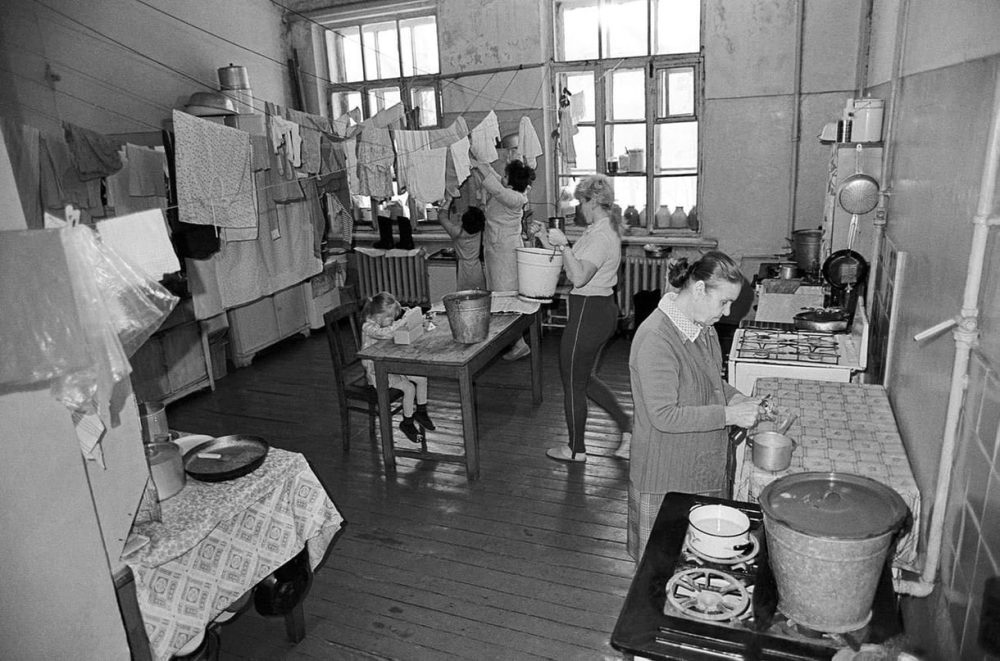
A kommunalka is a communal apartment in which several unrelated families live in separate rooms while sharing the kitchen, bathroom, toilet and hallway. Each family has its own room (very rarely two), its own doorbell on the front door, its own electricity meter, its own light bulbs in the common areas — and its own burner on the shared stove.
The phenomenon is specifically Soviet: the kommunalka was born of the revolution, served for decades as the principal form of urban housing, and shaped the daily life, psychology and folklore of several generations. At times, up to 80% of the country's urban population lived in communal apartments. It is impossible to understand Soviet everyday life without understanding the kommunalka — it was not merely crowding, but a distinct way of living in which the private and the common were permanently intermixed.
Uplotneniye: how apartments became communal
It all began immediately after the October Revolution. The cities were overflowing, housing was catastrophically short, and the Bolsheviks found a solution in the spirit of the age: in August 1918 private ownership of urban real estate was abolished, and the spacious apartments of the "bourgeoisie" began to be filled with new tenants. The process received an official name — uplotneniye, "densification": the norm was one room per family, and the former owners (if not arrested) were left one room of their own apartment.
Lenin supplied an ideological frame as well: the cohabitation of different classes was seen as a step toward communist brotherhood — a professor at the same stove as a former maid, all equal. In practice, ideology quickly gave way to simple arithmetic: the countryside, driven by collectivization and industrialization under Stalin, poured into the cities by the millions, and every room was subdivided again and again. The kommunalka was conceived as a temporary measure — and became the norm for half a century.
The order of the world behind one door
Communal life developed an entire civilization of rules familiar to every Soviet city dweller.
- The door and the bells. On the front door, a column of nameplates and doorbells: "Ivanovs — 2 rings, Petrovs — 3." Ringing the wrong number of times was already a conflict.
- The kitchen. Each family had its own table and its own burner; families cooked in turn and never left pots unattended. Kerosene stoves and primuses gave way to gas, but the crowding remained: in a large kommunalka up to ten housewives cooked in one kitchen at once.
- The bathroom and toilet. The morning line ran by schedule or by turn; many families kept their own toilet seats hanging on the wall, and their own washbasins. A bath was an event to be planned.
- The cleaning schedule. Washing the common areas rotated among families, in proportion to the number of household members. The schedule sheet on the wall was the apartment's constitution.
- Electricity. Separate meters, separate switches and separate bulbs: in the evening, when everyone used the kitchen, it blazed like a banquet hall.
The telephone — one for all, in the hallway, every conversation with witnesses. Private life was transparent: the walls were thin and there were no secrets. That is why scholars describe the kommunalka as a world of "forced intimacy" — people knew everything about one another, whether they wanted to or not.
The dark side: feuds and denunciations
The kommunalka cannot be told only as comedy. Crowding bred "kitchen wars" — years-long feuds over a burner, a shelf, noisy children; folklore is full of neighbors planting garbage and spitting into each other's soup. And there was worse: in the years of repression, the communal apartment became the perfect medium for denunciations. The cultural theorist Svetlana Boym called it "a breeding ground of police informants": the neighbors heard every word, and denouncing a neighbor could free up his room. The KGB and its predecessors had no need to install listening devices where the walls already listened.
In fairness, the same closeness had another face: neighbors minded each other's children, lent money until payday, nursed the sick and celebrated holidays at a common table. The kommunalka was both a hell and a village commune in the middle of the city — every family had its own proportion of the two.
The kitchen as club and stage
Paradoxically, the kommunalka's chief curse — the shared kitchen — became its chief cultural gift. It was in kitchens, first communal and later khrushchyovka ones, that the country held its real conversations: about life, politics and literature, in half-voice, among one's own. The kommunalka soaked through Soviet culture: Zoshchenko mocked it, Ilf and Petrov immortalized it (the unforgettable "Crow's Nest" flat), Bulgakov coined the formula about Muscovites spoiled by the housing question, Vysotsky sang of it, and the movies returned to it again and again. For foreigners the kommunalka remains one of the most unfathomable Soviet phenomena: how can one live a whole life with strangers behind a single door?
The long goodbye
Deliverance began under Khrushchev: the mass construction of five-story apartment blocks from the late 1950s gave millions of families separate apartments for the first time — the move from a kommunalka to one's own flat became the happiest storyline of the era. But the kommunalka did not disappear: the cities grew faster than the construction sites, and even in 1990 roughly a third of Leningrad's population still lived communally.
It has not disappeared today either. St. Petersburg remains the world capital of the kommunalka: hundreds of thousands of people still live in the subdivided apartments of the old center — resettling enormous flats with a dozen owners is a legal puzzle with no easy solution. Some old kommunalkas have turned into fashionable co-living spaces and museums of everyday life, and the word itself has gone international: historians and sociologists study the kommunalka as a unique seventy-year experiment in enforced communal living.
Frequently asked questions
What is a kommunalka, in simple terms? An apartment where each family occupies its own room while the kitchen, bathroom and toilet are shared by all residents. For decades it was the main form of urban housing in the USSR.
Where did kommunalkas come from? After the 1917 revolution the Bolsheviks abolished private ownership of urban housing and "densified" large apartments: one family per room. Kommunalkas then multiplied because of the chronic housing shortage.
How many people lived in kommunalkas? At peak periods, up to 80% of the urban population; even in 1990 roughly a third of Leningrad's residents lived communally. Tens of millions of people passed through the kommunalka.
How was daily life divided in a kommunalka? By rules: a cleaning schedule on the wall, each family's own burner and table in the kitchen, separate doorbells, separate meters and bulbs, and a morning line for the bathroom.
Do kommunalkas still exist? Yes — above all in St. Petersburg, where hundreds of thousands of people still live in the communal apartments of the city center: resettling the large flats is slow and difficult.
How is a kommunalka different from a dormitory? A dormitory houses people temporarily and usually singly; a kommunalka housed families for decades, each with its own room in what was essentially a private apartment — but with a shared household.
Related
- The khrushchyovkas: how the country got separate apartments — where the country moved when it left the kommunalka.
- Shortages and queues — the other constant of Soviet daily life.
- The October Revolution of 1917 — the event that began the "densification."
- The KGB: sword and shield of Soviet power — why the kommunalka's walls "listened."
Sources
The facts in this article can be verified against authoritative sources:
- Wikipedia, "Communal apartment": https://en.wikipedia.org/wiki/Communal_apartment
- "Communal Living in Russia" — a virtual museum of Soviet everyday life (Colgate University): https://kommunalka.colgate.edu/
- Russia Beyond, "The most important room in the Soviet apartment": https://www.rbth.com/history/333323-most-important-room-russian-apartment-kitchen
- GlobalSecurity.org, "Housing / Kommunalkas": https://www.globalsecurity.org/military/world/russia/housing-kommunalkas.htm
- Russian Life, "Close Quarters: The Rise and Fall of the Kommunalka": https://www.russianlife.com/magazine/apr-may-1999/close-quarters-the-rise-fall-of-the-kommunalka/
Where assessments diverge (the kommunalka as misery or as a school of solidarity), we present both sides of the experience.