The 1980 Moscow Olympics: the party half the world skipped
The first Games ever held in a socialist country, the largest boycott in Olympic history, and a bear cub that made a stadium of one hundred thousand people cry. What actually happened in Moscow in the summer of 1980.
What these Games were
The 1980 Summer Olympics took place in Moscow from July 19 to August 3. They were the first Games held in a socialist country and, at the same time, the emptiest in a quarter century: after the Soviet invasion of Afghanistan, a boycott announced by the United States kept 67 countries away. Eighty nations took part, the fewest since 1956.
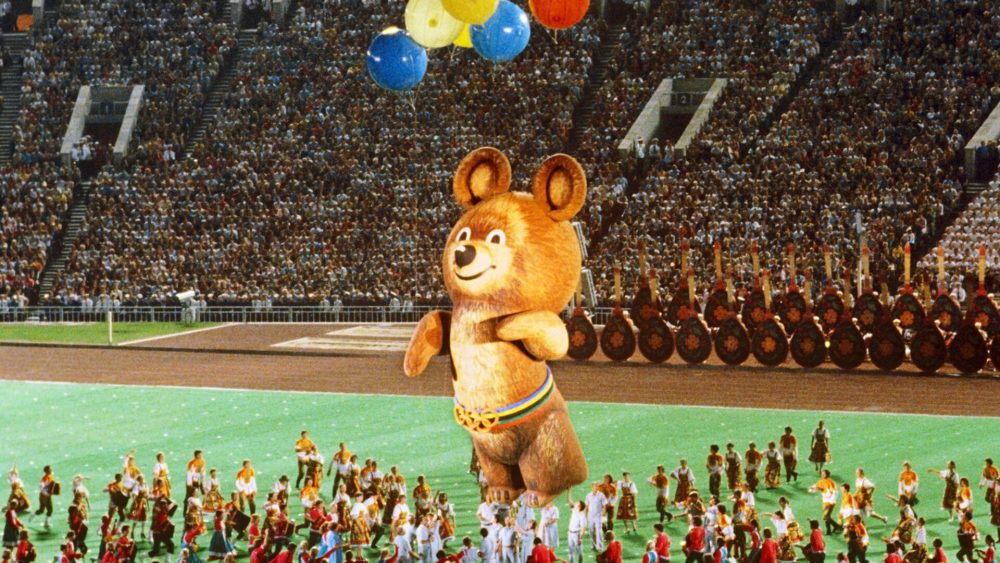
Two images survive from these Games, and they sit together awkwardly. One is political: gaps in the standings, teams under a neutral flag, speeches about the boycott. The other is Misha the bear cub, floating up into the night sky over Luzhniki stadium while the crowd wept. Both pictures are true, and both need telling.
The boycott
In January 1980 President Jimmy Carter gave Moscow an ultimatum: withdraw from Afghanistan within a month, or America stays home. Nobody was withdrawing anything. The United States declared a boycott and set about persuading its allies; Carter went as far as threatening to revoke the passports of American athletes who tried to travel on their own.
The world split unevenly. West Germany, Japan, Canada and China stayed away. Britain and Australia formally backed the boycott but let their athletes decide, and some competed in Moscow under the Olympic flag; these "neutral" athletes from over a dozen countries took home 26 gold medals. France, Italy and Spain came. For hundreds of athletes from the boycotting countries, Moscow 1980 remained a stolen dream: four years of training erased by a political decision. Four years later the USSR and the socialist bloc answered in kind and skipped Los Angeles. Sport lost twice.
A city on its best behavior
Moscow was groomed as a showcase. The Olimpiysky sports complex went up, along with the Sheremetyevo-2 airport terminal, the Kosmos hotel and the Olympic Village, whose buildings later became an ordinary residential district. The city was also scrubbed and thinned out: Muscovites recall that Moscow was closed to out-of-towners for the Games, children were shipped off to summer camps en masse, and "undesirable elements" were removed beyond the notorious 101st kilometer.
The shops, meanwhile, witnessed a miracle: Finnish salami, juice boxes with straws, imported beer and the never-before-seen Fanta. For many Muscovites the shelves of July 1980 were the strongest memory of the entire Olympics, a two-week window into a world without shortages. The window closed with the Games.
The opening on July 19 filled Luzhniki with a hundred thousand spectators. Basketball star Sergei Belov lit the flame, Brezhnev declared the Games open, and cosmonauts Popov and Ryumin greeted the stadium from orbit, the first space greeting in Olympic history. The famous "living pictures" in the stands were made by thousands of soldiers flipping colored panels. That card-stunt technique would soon matter again.
The sport that happened anyway
The boycott thinned several tournaments, and the Soviet and East German dominance of the medal table (80 golds for the USSR, 47 for the GDR) has to be read honestly with that correction. But writing the Games off as a contest without contestants is wrong too. The records and the stories of Moscow 1980 are real.
- Gymnast Alexander Dityatin medaled in every one of the eight men's events, eight medals at a single Games, which no one had ever done.
- Swimmer Vladimir Salnikov became the first man to swim 1,500 meters in under 15 minutes, a barrier many considered physiological.
- Zimbabwe's women's field hockey team, assembled a week before the Games to replace boycotting favorites, unexpectedly took gold, one of the strangest fairy tales in the history of sport.
- In the coxless pairs rowing final, gold and silver went to two sets of identical twins: the Landvoigt brothers of East Germany against the Pimenov brothers of the USSR.
- Cuba's Teófilo Stevenson won his third straight Olympic boxing title, matching a record that still stands.
Dozens of world and Olympic records fell. The athletes who did come to Moscow competed in earnest.
Misha, and the stadium's tear
The mascot was chosen by the whole country. Television asked viewers which animal should represent the Games, and of 45,000 letters the bear won by a wide margin. The drawing was entrusted to Viktor Chizhikov, an illustrator of children's books. He went through more than a hundred sketches before arriving at a smiling cub wearing a belt of Olympic rings. His fee was two thousand rubles, roughly a year's salary, with no royalties from the enormous runs of toys, badges and T-shirts, a fact he later recalled with more irony than bitterness.
Misha became the first Olympic mascot the whole world genuinely loved, and arguably the most successful ever. His farewell on August 3 became the defining image of the entire Games: an eight-meter rubber Misha on a cluster of balloons was led into the center of Luzhniki, the card-stunt stands drew a tear rolling down his cheek, the stadium sang Pakhmutova's farewell song, and the cub rose slowly into the night sky. The stands cried, the television audience cried, and this may be the only Olympics remembered more for the tears at its closing than for its records.
What remains
The Olympic venues still serve Moscow, from the Olimpiysky complex to the rowing canal at Krylatskoye. Misha lives a life of his own: the 1980 toys are collectors' items, and the image belongs to the shared memory of the generation that grew up in the late USSR.
The verdict on the Games is double, and we will not straighten it out. For Soviet people this was a sincere, warm, superbly organized celebration, a rare summer of openness. For the world it was an Olympics with a hole in the middle, hostage to the Politburo's Afghan decision. Moscow 1980 showed both things at once: how well the country could welcome guests, and how much it paid for a war it was fighting far from home.
Frequently asked questions
When were the 1980 Olympics held? From July 19 to August 3, 1980, in Moscow; sailing was held in Tallinn, and some football matches in Leningrad, Kyiv and Minsk.
Why were the 1980 Olympics boycotted? In protest against the Soviet invasion of Afghanistan in December 1979. The United States led the boycott; 67 countries stayed away and 80 took part.
Who created Misha the Olympic bear? Children's book illustrator Viktor Chizhikov. The bear itself was chosen by television viewers: it won most of the 45,000 letters sent in.
What records were set at the 1980 Games? Dityatin took eight medals at a single Olympics, Salnikov swam 1,500 meters in under 15 minutes for the first time in history, and dozens of world records fell. The USSR won 80 gold medals.
What happened at the closing ceremony? A giant balloon-borne Misha floated away from Luzhniki stadium while the card-stunt stands drew a tear on his cheek. The scene, set to a farewell song, became the most famous moment of the Games.
Did the USSR retaliate for the boycott? Yes: in 1984 the USSR and most socialist countries skipped the Los Angeles Games, citing security concerns, and held the alternative Friendship Games instead.
Related
- The Soviet-Afghan War: the cause of the boycott.
- Leonid Brezhnev: the host of the 1980 Games.
- The Cold War: the backdrop that turned sport into politics.
- Shortages and queues: why Fanta on the shelves is remembered as vividly as the records.
- The Red Machine: Soviet hockey — the era's greatest sporting pride.
Sources
The facts in this article can be verified against authoritative sources:
- Olympics.com (official IOC site), "Moscow 1980 Summer Olympics": https://www.olympics.com/en/olympic-games/moscow-1980
- Wikipedia, "1980 Summer Olympics": https://en.wikipedia.org/wiki/1980_Summer_Olympics
- Wikipedia, "Misha": https://en.wikipedia.org/wiki/Misha
- Russia Beyond, "On this day: Moscow's 1980 Olympic Games began": https://www.rbth.com/arts/history/2017/07/19/on-this-day-moscows-1980-olympic-games-began_802870
- Armstrong Undergraduate Journal of History (Georgia Southern University), "The 1980 Moscow Olympics and the USSR's Final Golden Moment": https://digitalcommons.georgiasouthern.edu/cgi/viewcontent.cgi?article=1292&context=aujh
Where assessments diverge (a celebration or a showcase against the background of a war), we give both sides.