The Soviet-Afghan War: nine years that broke the USSR's back
A decision made by a narrow circle of Politburo old men, a palace stormed in 43 minutes — and nine years of a war the country waged without calling it a war. The story of the "bleeding wound" that hastened the Union's end.
How the decision was made
In April 1978 Afghan communists seized power in Kabul and set about building socialism at forced pace in a deeply traditional Muslim country: land reform, an assault on Islam, mass repression. The country answered with revolts, while the ruling party devoured itself — to the point that in the autumn of 1979 the faction leader Hafizullah Amin had President Taraki strangled. Kabul begged Moscow for military help more than a dozen times — and for a long time the Kremlin refused.
The turn came by December 1979. A narrow circle of the Politburo — above all KGB chairman Andropov, defense minister Ustinov and foreign minister Gromyko — persuaded the ailing Brezhnev: Amin was unreliable, might reorient toward the United States, and losing Afghanistan would mean a hostile regime on the southern border. The logic was that of the Brezhnev Doctrine — a socialist country could not be "let go." The decision to send in troops was made without the Supreme Soviet, without experts, and over the objections of the General Staff.
On December 25, 1979, the 40th Army crossed the Amu Darya. On December 27, KGB special forces and army units stormed the Tajbeg Palace in 43 minutes: Amin was killed, and Moscow installed its own man in Kabul — Babrak Karmal. The plan was to "go in, stabilize and leave" within months. It took nine years.
A war that could not be won
The Soviet army, trained for tank battles on the plains of Europe, found itself in a mountain guerrilla war. The contingent controlled the cities and the roads — the mujahideen controlled everything else: the villages, the mountains and the night. Punitive operations against guerrilla bases devastated villages and drove the population into resistance; the more casualties there were, the wider the war became.
An external coalition also worked against the USSR: the United States (the CIA's Operation Cyclone — the largest covert program in its history), Pakistan, whose intelligence service distributed the aid, Saudi Arabia, and China. From 1986 the mujahideen had American Stingers — shoulder-fired anti-aircraft missiles that ended Soviet air impunity. The world reacted politically as well: the UN General Assembly condemned the invasion, and dozens of countries boycotted the 1980 Moscow Olympics.
The hidden war
At home the war led a strange half-existence. Television showed soldiers planting trees and handing out flour; the words "war" and "combat" were banned, and casualties went unpublished. The zinc coffins — "Cargo 200" — arrived at night, and for years the gravestones of the fallen could not say where a soldier had died. Academician Sakharov, who publicly condemned the invasion, was exiled to Gorky without trial in January 1980 — the war began with the silencing of its chief critic.
The country learned the truth from letters, rumors and the accounts of those who returned — the afgantsy, young veterans whom the motherland met with awkward silence and a phrase that became emblematic of the era: "I didn't send you there." Glasnost broke the dam: from 1987 the newspapers began to speak of the war, and Svetlana Alexievich's book Zinky Boys made the voices of mothers and soldiers heard around the world.
The withdrawal
Coming to power in 1985, Gorbachev inherited a war the military already considered hopeless. In 1986 Karmal was replaced by Najibullah and a "policy of national reconciliation" was proclaimed, but it could not change the course of the war. In April 1988 the Geneva Accords on the withdrawal were signed.
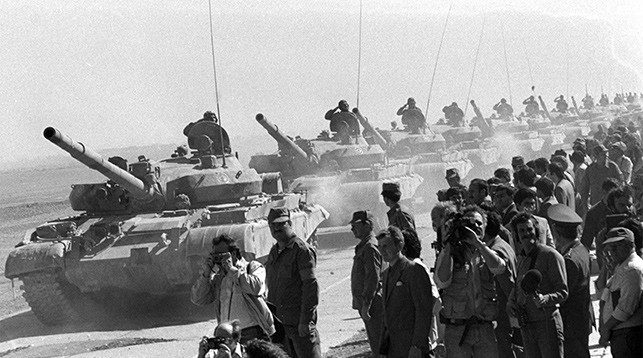
The withdrawal began on May 15, 1988, and was completed on February 15, 1989. The final image entered every textbook: General Boris Gromov, commander of the 40th Army, walking last across the Friendship Bridge over the Amu Darya — officially, not a single Soviet soldier remained behind him. The USSR's war was over; Afghanistan's was not. Najibullah's regime, defying predictions, held out for three more years and fell in 1992, after which the country collapsed into a warlords' civil war — out of which, in 1996, rose the Taliban.
The price, and the legacy
We give the figures honestly. Soviet losses: 13,310 dead by the official count at the time of withdrawal; about 15,000 including those who died of wounds and disease (some researchers argue for higher numbers); tens of thousands wounded, thousands disabled. The Afghan losses are incomparably more terrible: one to two million dead, most of them civilians, and over five million refugees — then the largest refugee flow in the world.
For the USSR the war was a slow-acting poison: it ate the budget, destroyed faith in the leadership's infallibility, brought zinc coffins into Soviet homes and produced the "Afghan syndrome" — the trauma of a generation. The argument over it continues: some insist the army lost no major battle and left in good order, having carried out its orders; others answer that a war without an attainable goal could not be won in principle, and that the December 1979 decision was a criminal blunder by a narrow circle. Both positions rest on facts; one thing is beyond dispute — the price of the decision was paid by people other than those who made it. February 15, the day the withdrawal ended, remains a day of remembrance of this war across the post-Soviet countries.
Frequently asked questions
When was the Soviet-Afghan War? From December 25, 1979, to February 15, 1989 — nine years and nearly two months, the longest war in Soviet history.
Why did the USSR invade Afghanistan? To save an allied communist regime from insurrection and to prevent what the Politburo feared would be Kabul's reorientation toward the United States. The decision was made by a narrow leadership circle without public debate.
How many Soviet soldiers died in Afghanistan? Officially 13,310; including deaths from wounds and disease, the established estimate is about 15,000. Some 620,000 servicemen passed through the war.
How many Afghans died in the war? By various estimates, one to two million people, most of them civilians; over five million became refugees.
Who were the mujahideen and who supported them? Islamic insurgents fighting the Soviet forces and the Kabul regime. They were supplied by the United States, Pakistan, Saudi Arabia and China; from 1986 they received American Stinger missiles.
Did the USSR lose the war in Afghanistan? The army suffered no military rout and withdrew in good order, but the war's political goals were never achieved, and its cost became one of the factors in the USSR's crisis and collapse. That is why the war is called a defeat — and the argument over that verdict continues.
Related
- Leonid Brezhnev — the leader under whom the fateful decision was made.
- Yuri Andropov — one of the chief architects of the invasion.
- Mikhail Gorbachev — the leader who pulled the army out of the "bleeding wound."
- Andrei Sakharov — exiled for protesting against this war.
- The dissolution of the USSR (1991) — the ending the war brought closer.
Sources
The facts in this article can be verified against authoritative sources:
- Encyclopaedia Britannica, "Afghan War": https://www.britannica.com/event/Afghan-War
- Encyclopaedia Britannica, "Soviet invasion of Afghanistan": https://www.britannica.com/event/Soviet-invasion-of-Afghanistan
- Wikipedia, "Soviet–Afghan War": https://en.wikipedia.org/wiki/Soviet%E2%80%93Afghan_War
- New World Encyclopedia, "Soviet-Afghan War": https://www.newworldencyclopedia.org/entry/Soviet-Afghan_War
- TheCollector, "1979 Soviet Invasion of Afghanistan": https://www.thecollector.com/soviet-ussr-invasion-afghanistan/
Where figures diverge (Soviet and Afghan losses), we give ranges and explain the nature of each estimate.