Yuri Andropov: the KGB man's fifteen months in power
For fifteen years he ran the KGB; for fifteen months, the country. The persecutor of dissidents with a reputation as an intellectual, who began restoring order with police raids on cinemas — and opened the door for Gorbachev.
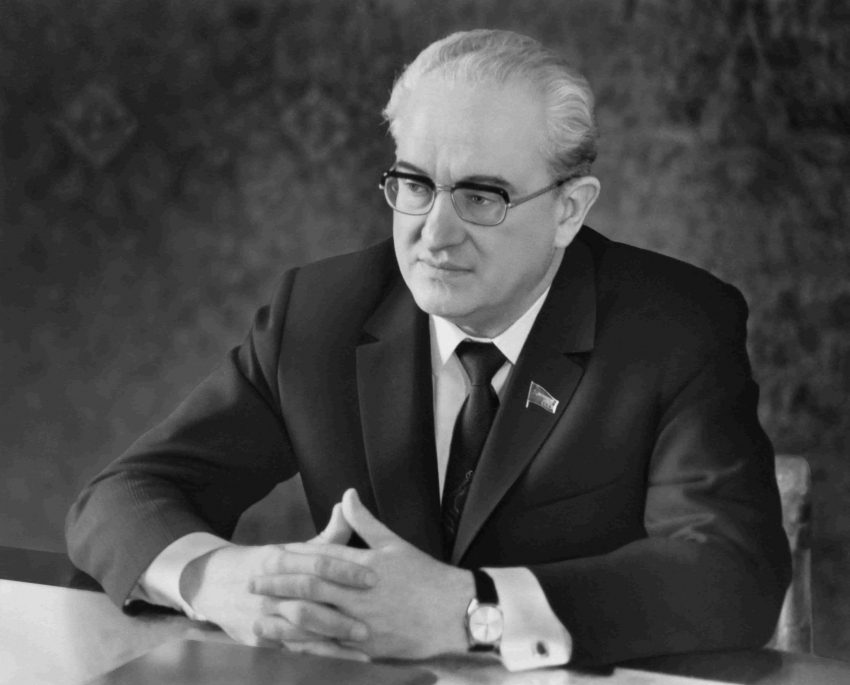
Who Andropov was
Yuri Vladimirovich Andropov (1914–1984) was the leader of the USSR from November 1982 until his death in February 1984, and the most influential chairman of the KGB in the committee's history, which he headed for a record fifteen years. His rise marked the first time in Soviet history that a professional chief of state security came to lead the country.
His rule was among the shortest in Soviet history: about fifteen months, half of which he spent tethered to a dialysis machine. Yet Andropov's imprint is out of all proportion to the term: he opened the assault on Brezhnev-era corruption, drove the Cold War to its most dangerous point since the missile crisis — and lifted Mikhail Gorbachev to the top, not knowing he was choosing the system's gravedigger.
The way up: from Volga boatman to the Lubyanka
Andropov's biography began in a distinctly un-nomenklatura way. The son of a railway worker from the Stavropol region (Gorbachev's home ground too), orphaned early, he worked as a telegraph operator, a cinema projectionist and a boatman on Volga river craft, and graduated from a water-transport technical college in Rybinsk. The Komsomol carried him upward: at 26 Andropov headed the Komsomol of the entire Karelo-Finnish republic.
Budapest decided his fate. After Stalin's death Andropov was posted to the Soviet embassy in Hungary — in effect an honorable exile — and found himself at the epicenter of the 1956 uprising. Ambassador Andropov sent alarmed dispatches to Moscow, urged the Kremlin to send in troops and, according to Hungarian accounts, kept assuring Prime Minister Imre Nagy of the USSR's peaceful intentions to the last — while the tanks were already rolling toward Budapest. What he saw — a crowd hanging state security officers from lampposts — left him with what historians would call his "Hungarian complex": the conviction that any thaw must be crushed before it becomes a flood.
Fifteen years at the head of the KGB
In 1967 Andropov was put in charge of the KGB — ironically, perhaps, to bury his career: an unwritten rule held that the chief of state security could not become head of the party. It worked out the other way around.
Within two months, at his proposal, the Fifth Directorate was created — dedicated to fighting "ideological subversion." Files were opened on every prominent dissenter, including Sakharov and Solzhenitsyn; arrests, exile, punitive psychiatry and pressure to emigrate became a system, and the samizdat Chronicle of Current Events, which had documented the repressions for years, was strangled by 1982. In 1968 Andropov was among the chief hawks of the crushing of the Prague Spring — to the point of fabricating intelligence reports for his own Politburo. Yet in 1980–81 it was he who persuaded the Kremlin not to send troops into Poland against Solidarity — not out of softness but out of calculation: Afghanistan had already shown the price of interventions.
Andropov's paradox is that the persecutor of free thought enjoyed a reputation as an intellectual: he wrote poetry, surrounded himself with clever consultants, and knew the country's real condition better than any Politburo member — precisely because he read KGB reports rather than ceremonial statistics. In May 1982, six months before Brezhnev's death, he left the Lubyanka for the Central Committee — clearing his path to the throne. On November 12, 1982, two days after Brezhnev died, Andropov became general secretary.
Fifteen months in power
Andropov formulated his diagnosis of the country with a candor unusual for its leaders: we do not know the society we live in. The prescription, though, was not a reformer's but a chekist's: discipline.
- Order. The famous labor-discipline campaign began — with police raids on shops, bathhouses and cinemas, where citizens were stopped in the middle of the working day and asked why they were not at work. The country answered with jokes, but absenteeism genuinely fell. The cheap vodka released in those months was forever nicknamed "Andropovka."
- The purge. For the first time in decades the Brezhnev nomenklatura was hit in earnest: high-profile corruption cases, the dismissal of dozens of ministers and regional secretaries, an investigation against the once-untouchable interior minister Shchelokov, and the unwinding of the "cotton case" in Central Asia.
- Cadres. A new generation moved up — Ryzhkov, Ligachev and above all Gorbachev, to whom Andropov delegated ever more authority. The team of the future perestroika was assembled by him.
The system itself, however, was never in question: Andropov wanted to make socialism work through strictness without changing its foundations — "authoritarian modernization," as historians would call it.
1983: the most dangerous year of the Cold War
Abroad, Andropov's months became the peak of confrontation. In March 1983 Reagan called the USSR an "evil empire" and announced the SDI "Star Wars" program. On September 1 a Soviet fighter shot down Korean Air Lines flight KAL 007, which had strayed into Soviet airspace: 269 people died. Moscow first denied everything, then insisted on an espionage version; the recovered black boxes were concealed — their existence would be admitted only by Yeltsin in 1992. In the autumn, against the backdrop of American Pershing deployments in Europe, the NATO exercise Able Archer was very nearly read in Moscow as cover for a real strike — by historians' assessments, the world then came closer to the nuclear line than at any time since the Cuban Missile Crisis.
There was one thawing note in that frozen era: receiving a letter from ten-year-old American Samantha Smith asking whether he wanted war, Andropov replied personally and invited the girl to the USSR — her visit in the summer of 1983 became a world sensation and a rare human gesture across the blocs.
Death and legacy
Andropov came to power already gravely ill. From August 1983 the country never saw its leader again: his kidneys failed, and the general secretary ruled from a hospital ward. He died on February 9, 1984, after 15 months in power. His successor was not his protégé Gorbachev but the 72-year-old Brezhnevite Chernenko — who himself died a year later; only then, in March 1985, did the Gorbachev era begin.
The argument over Andropov continues, and we give both frames. One memory: a sober pragmatist who understood the depth of the crisis, launched the purge and raised the reformers — "had he been given ten years," the country might have taken the Chinese path. The other memory: the architect of the most sophisticated machine for suppressing dissent in the post-Stalin USSR, the man of Budapest '56, Prague '68 and punitive psychiatry, whose "modernization" amounted to discipline and fear. Both frames rest on the facts of a single biography — and that is the Andropov phenomenon.
Frequently asked questions
Who was Yuri Andropov? Chairman of the KGB from 1967 to 1982 and leader of the USSR from November 1982 to February 1984 — the first man from state security to head the country.
How long did Andropov rule the USSR? About 15 months: from November 12, 1982, until his death on February 9, 1984 — and from August 1983 he never appeared in public because of kidney failure.
What did Andropov accomplish in power? The discipline campaign (including raids on absentees), the first serious anti-corruption cases against the Brezhnev nomenklatura, and a sweeping renewal of cadres — it was he who raised Gorbachev to the top.
What was Andropov's role in the persecution of dissidents? Central: the KGB's Fifth Directorate was created at his initiative, and under him the system of persecution — arrests, psychiatry, forced emigration — reached peak efficiency.
What is "Andropovka"? The popular nickname of the cheap vodka released during his discipline campaign — one of the most durable everyday mementos of his rule.
Who came to power after Andropov? Konstantin Chernenko, who ruled just 13 months. After his death in March 1985, the general secretary became Mikhail Gorbachev — Andropov's protégé.
Related
- The KGB: sword and shield of Soviet power — the committee he headed for 15 years.
- Leonid Brezhnev — the era whose legacy he tried to discipline.
- Mikhail Gorbachev — his protégé and the system's unwitting gravedigger.
- Andrei Sakharov — the most famous target of his Fifth Directorate.
- The Soviet-Afghan War — the invasion he helped decide.
Sources
The facts in this article can be verified against authoritative sources:
- Encyclopaedia Britannica, "Yury Andropov": https://www.britannica.com/biography/Yury-Andropov
- Wikipedia, "Yuri Andropov": https://en.wikipedia.org/wiki/Yuri_Andropov
- Encyclopedia.com (Encyclopedia of Russian History), "Andropov, Yuri (1914–1984)": https://www.encyclopedia.com/history/encyclopedias-almanacs-transcripts-and-maps/andropov-yuri-1914-1984
- Wilson Center Digital Archive, "Andropov, Yuri Vladimirovich": https://digitalarchive.wilsoncenter.org/people/andropov-yuri-vladimirovich
- Alpha History, "Yuri Andropov": https://alphahistory.com/coldwar/yuri-andropov/
Where assessments diverge (pragmatic modernizer or architect of repression), we give both positions and the facts behind each.