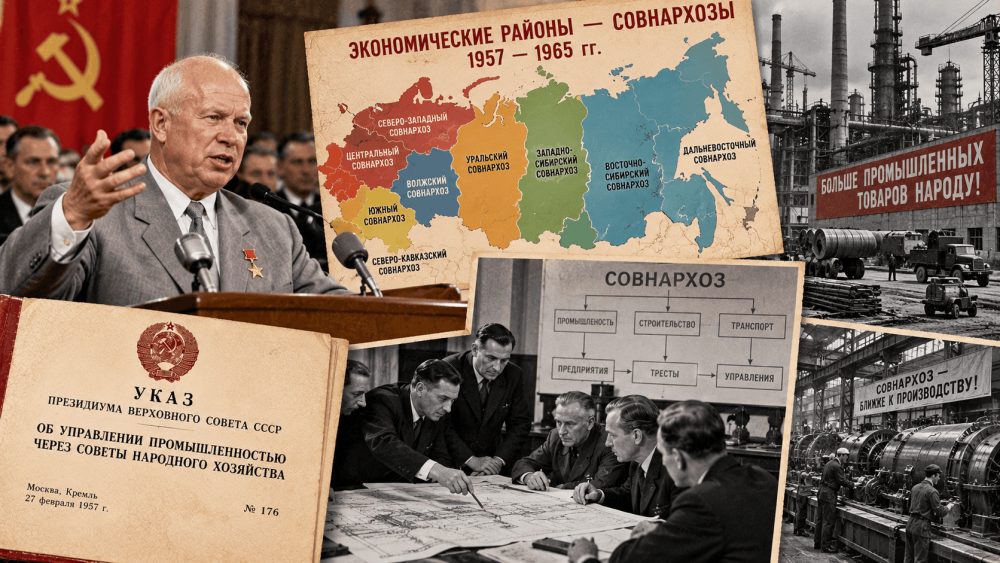
Bratsk Hydroelectric Station: First Power and Completion
Why Bratsk has several commissioning dates: its first units, acceptance in 1967, generating capacity and relocation around the new reservoir.
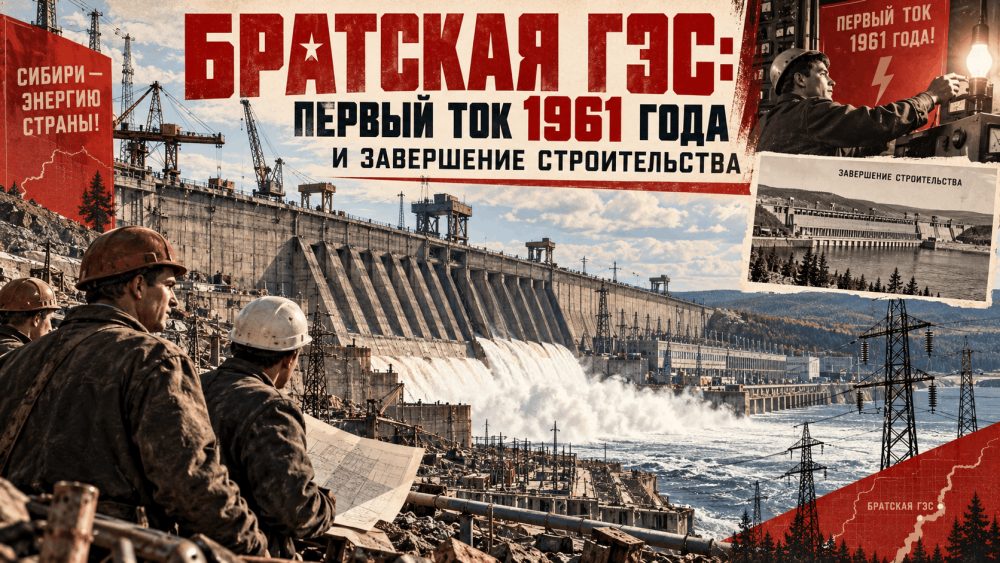
No single date explains the construction of the Bratsk hydroelectric station. Its first generating unit began operating on 28 November 1961. The last entered industrial service on 14 December 1966, and the state commission accepted the hydroelectric complex on 8 September 1967. These milestones describe different stages in turning a construction site on the Angara into an operating power station.
First electricity was not the end of construction
A hydroelectric complex contains multiple structures and generating units. Bringing one machine into service does not prove that the remaining units, construction work and acceptance procedures are complete. The years 1961 and 1967 in reference works therefore need not contradict each other.
The Hydropower of Russia Association records the first unit's start on 28 November 1961 and industrial commissioning in 1967. The System Operator adds the intermediate milestone of the eighteenth and final unit entering service on 14 December 1966. A photograph caption or short historical note should identify which event its date refers to.
The same distinction is useful when reading about Dneproges. First generation, the attainment of a specified capacity and completion of the overall project answer different questions. Comparing construction projects requires matching equivalent milestones rather than selecting whichever date happens to appear first.
A station within an industrial project
Bratsk stands on the Angara in Irkutsk Region. The decision to build it was taken in 1954. The industry association's account describes planning that considered the station together with a new energy and industrial complex. Its economic role depended on connections with consumers and transmission infrastructure.
This provides a useful way of understanding the project's scale. Generators alone do not create an industrial region: electricity must reach users, and the development of large loads has to be coordinated with power supply. A factory, transmission line and power station may have different construction timetables while belonging to the same economic undertaking.
The earlier GOELRO electrification plan offers a comparison in connecting energy with economic development. That comparison is about an approach to planning. It does not mean that Bratsk was one of the stations in GOELRO's original programme.
Capacity is not annual generation
Reference descriptions give Bratsk an installed capacity of 4,500 MW, with eighteen units rated at 250 MW each. The multiplication produces the stated total. Those figures should not simply be assigned to the first day of operation, however: equipment entered service in stages and its performance developed over time.
Power measures the rate at which energy is produced. Generation measures an amount over a period. As an illustrative calculation, a 250 MW unit operating at that output for one hour would produce 250 MWh. This explains the units; it is not a measurement of an actual hour at Bratsk.
Consequently, saying that the station “generated 4,500 megawatts in a year” confuses two quantities. Annual generation requires an energy unit, such as megawatt-hours or kilowatt-hours, and an identified year. Installed capacity alone cannot establish actual production: operating conditions, equipment availability and water conditions also matter.
This distinction is valuable when comparing promotional accounts, technical descriptions and historical records. A large number may describe a machine's rating, the whole station's capacity or production over many years. Without its unit and time period, it cannot support a meaningful comparison.
Understanding the Angara cascade
Bratsk is the second stage of the Angara cascade after Irkutsk. A cascade describes a sequence of hydroelectric installations along a river. It does not imply that all of them were built at the same time or had identical characteristics.
A reader looking at a map should distinguish the river, reservoir and generating station. The river establishes the geographical connection. The reservoir changes water storage and the shoreline. The machinery converts the energy of flowing water into electricity. The surface area of a reservoir is not the station's electrical capacity and cannot replace a description of its equipment.
Our account of the planned economy provides the wider administrative context. General statements about planning do not explain every engineering choice at an individual site; those questions require the specific project's documentation.
The reservoir also meant relocation
The construction chronology intersects with the history of settlements. Bratsk district's administration has published an account of the relocation of old Tangui, drawing partly on material held by the local museum. It identifies a district executive committee decision of 20 April 1955 and records a village meeting on 10 June 1960.
Residents at that meeting asked about roads, building materials, water supply and school capacity at the new location. Relocation involved more than transporting a house. Daily connections and access to services had to be re-established as well.
One village's experience cannot stand for every displaced household. It nevertheless allows two aspects of the project to be considered together: the creation of a major energy source and the loss of an established setting for everyday life. Neither cancels the other. Assessing the consequences requires both technical indicators and records concerning the people whose surroundings changed.
A construction anniversary and a family memory can therefore organise the same period around very different events. A generating unit's start may be the key date in an engineering chronology, while a household's departure or the opening of a new school may be central to local memory.
Preserving the history of the Angara region
The regional Culture 38 portal describes Russian and Evenki sections at the Angara Village museum. Such displays help present a territory whose history extends beyond a dam and turbine hall. A museum reconstruction and a settlement preserved on its original site are different forms of evidence, however, and should be identified accordingly.
The Baikal-Amur Mainline offers another comparison with a large regional infrastructure project. Comparable scale does not make the projects equivalent: a railway and a hydroelectric complex reshape economic geography and settlements in different ways.
Bratsk's history is most clearly understood as several connected processes. Generating units entered service progressively, the power system acquired a new resource, a reservoir transformed the shoreline and residents moved. The dates 1961, 1966 and 1967 are useful because they distinguish stages within that history, rather than compressing it into a single ceremonial opening.