Dneproges: From Construction in 1927 to 560 MW in 1939
Why Dneproges opened in 1932 but reached 560 MW in 1939: the project, imported equipment, construction infrastructure and its role in regional industry.
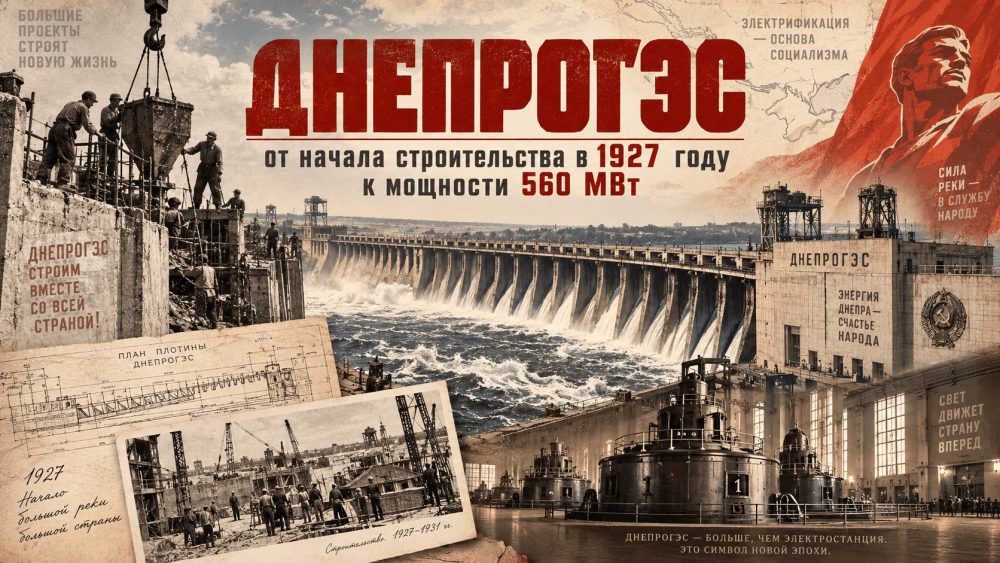
The Dnieper Hydroelectric Station, widely known as Dneproges, was ceremonially opened in Zaporizhzhia on 10 October 1932. That date did not mean that every part of its original generating programme was complete. Construction began in 1927, the first units operated in 1932, and the station reached its design capacity of 560 MW in 1939.
Separating those milestones explains how an impressive construction site became a functioning source of power for an industrial region. The opening ceremony was one stage in that process.
A power station planned together with industry
Dneproges was built on the Dnieper below its rapids. Engineer Ivan Alexandrov was responsible for the project, while Viktor Vesnin was associated with its architectural design. The station became a major practical expression of the ideas behind the GOELRO electrification plan.
The objective extended beyond adding another source of electricity. Energy-intensive industries were to develop in the surrounding area. Ukrhydroenergo's historical account presents Alexandrov's concept as a combination of a hydroelectric station and an industrial complex.
The relationship worked in both directions. Factories needed power, but a large station also needed consumers capable of using its output. A generating plant without the associated network, enterprises and transport connections would not create the same economic result.
This is one reason such projects matter to the history of the Soviet planned economy. A dam can be shown in a single photograph. An industrial district needs to be understood through the connections between several kinds of activity.
Why the station has more than one opening date
Beginning construction, testing an individual machine, entering operation, holding a ceremony and reaching design capacity are different events. The Presidential Library dates the formal opening to 10 October 1932. Both its account and the System Operator's historical note place the attainment of 560 MW in 1939.
Ukrhydroenergo gives the first stage in 1932 as five generating units with a combined capacity of 310 MW. The station was therefore already operating before the whole original generating programme had been completed.
A short chronology should distinguish:
- 1927: construction begins;
- 1932: the first units operate and the formal opening takes place;
- 1939: the station reaches its design capacity of 560 MW.
Historical summaries give differing dates for early trial runs and operational starts. These should not be merged with the October ceremony. “The opening of Dneproges” usually identifies a public milestone, rather than every technical operation involved in bringing the station into service.
Capacity is not annual production
A megawatt measures power. Energy production also depends on the length of time that power is supplied. A hypothetical machine operating at 1 MW for one hour produces 1 MWh of energy.
The figure of 560 MW consequently cannot be read as 560 million kilowatt-hours per year, or as an unchanging amount of actual output. A hydroelectric station's operation depends on its operating regime and the available water resources. Distinguishing the units prevents misleading comparisons even before any detailed calculations are attempted.
The date attached to a number matters too. Here, 560 MW refers to the station's prewar design capacity. Later reconstruction and expansion belong to other stages of its history. Their figures should not be inserted into an account of 1932 as if the same configuration had existed throughout.
This distinction is useful beyond one station. An announcement of installed capacity and a report of electricity generated answer different questions. Both can be accurate while describing quite different aspects of a power system.
Foreign equipment in a Soviet construction project
The Presidential Library records purchases of equipment from the United States and the presence of American consultants. Its account identifies five supplied generators, followed by a generator manufactured by the Elektrosila works in Leningrad.
This evidence complicates a picture of industrialization taking place without external connections. A state-directed project could use foreign machinery and technical experience. At the same time, imported equipment did not make the whole undertaking a foreign enterprise. Project organization, design, machine manufacture, delivery and installation were distinct responsibilities.
The Electronic Library of Historical Documents provides a concrete archival reference: a letter dated 30 September 1927 from Amtorg chairman Samuil Bron to Dneprostroi chairman Emmanuil Kviring. Its catalogue description concerns American business attitudes towards the construction project.
That record identifies a source through which the international dimension can be investigated. The catalogue entry alone should not be turned into a claim that every foreign participant shared the same motives or expectations.
The infrastructure behind the construction site
Building a hydroelectric station required workshops, concrete production, transport and temporary electricity supplies. The operator's historical account also describes housing and everyday facilities for workers and their families.
These supporting systems rarely dominate commemorative images, but they help explain how construction could continue. Concrete had to be produced and delivered; machinery had to be received and installed; workers needed places to live and services for daily life.
The main structure was therefore only part of the undertaking. A finished dam can hide the sequence of supporting activities that made it possible. Looking at those activities brings logistics and the organization of labour back into the story.
The later history of the Baikal-Amur Mainline offers a useful comparison in the questions it raises about large projects: how did the principal structure relate to settlements, supply routes and services? This does not imply identical working conditions across different decades. It explains why the history of a major construction project cannot end with its ceremonial image.
A changed river and a public symbol
The reservoir submerged the Dnieper rapids and altered navigation conditions. Generating power was thus connected with a physical transformation of the river. Dneproges was more than a powerhouse and a dam considered in isolation; it changed an existing landscape.
The opening also gave industrialization a highly visible public form. A structure, a date and electric lights could represent a complex programme in a memorable scene. The Stakhanovite movement later offered another way of presenting industrial growth, through the individual production record.
Both kinds of image need to be supplemented by evidence about production, work and measurable results. An effective symbol does not explain its own operating system.
Dneproges can therefore be understood as a generating station, an element of an industrial district and a public symbol of transformation. These roles were connected without being identical. Keeping them distinct clarifies what was achieved in 1932 and why the station's development continued after the opening ceremony.
Sources
- Presidential Library. The ceremonial opening of Dneproges.
- System Operator of the Unified Energy System. The first Dneproges generating unit in 1932.
- Ukrhydroenergo. The Dnieper Hydroelectric Station at 87: a 2019 historical account.
- Electronic Library of Historical Documents. Bron's letter to Kviring, 30 September 1927: archival catalogue record.