The Stakhanovites: the record that raised everyone's quota
A night shift, 102 tons of coal, and the party organizer with a newspaper editor down in the same pit. How one record became an all-Union cult, why fellow workers often hated the record-setters, and how the word Stakhanovite entered the world's dictionaries.
What the Stakhanovite movement was
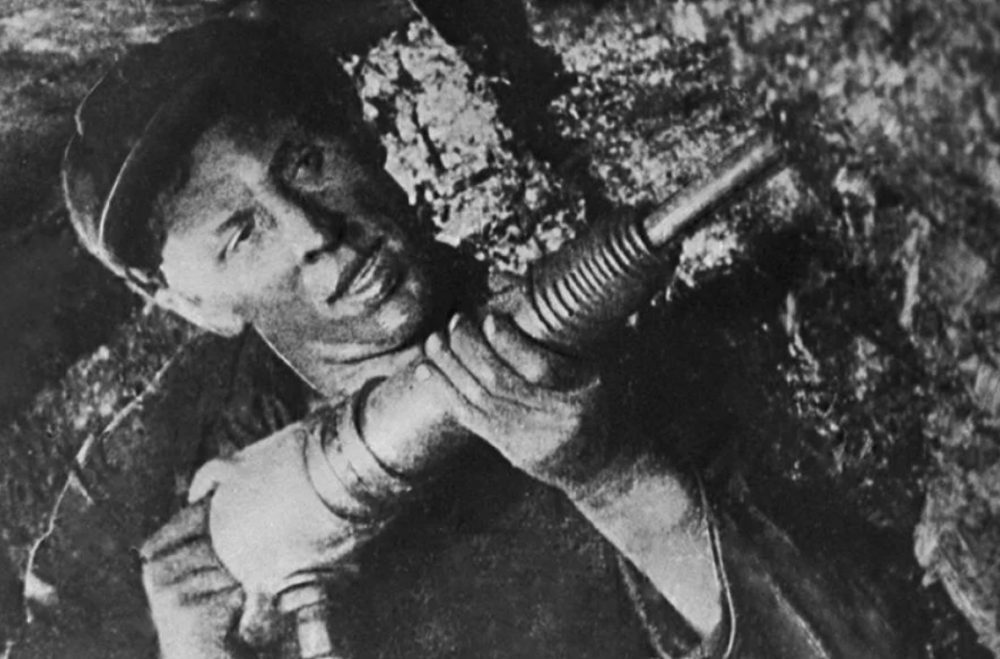
The Stakhanovite movement was a campaign of labor productivity records that swept the USSR from the autumn of 1935. The title of Stakhanovite went to workers and collective farmers who exceeded their quotas many times over, and it quickly displaced the older word "shock worker." For the state, the movement was a way to accelerate industrialization without new machines, at the expense of the human being himself; for the participants it was a rare Soviet elevator to money, apartments and fame; for the rest of the workforce it was a standing threat of higher quotas. All three sides of the story are true at once, and it has to be told whole.
The word outlived both the movement and the country: in the world's languages a "Stakhanovite" still means a person working with superhuman intensity, usually with an irony that Stakhanov himself never asked for.
The night of August 31
The Donbass, the Tsentralnaya-Irmino mine, the night shift of August 30 to 31, 1935. Alexei Stakhanov, a thirty-year-old coal hewer of peasant origin, goes down with a pneumatic pick, and with him, remarkably, the mine's party organizer, a district committee secretary and the editor of the pit newspaper. In 5 hours 45 minutes Stakhanov cuts 102 tons of coal: fourteen quotas. Within days Pravda proclaims the result a world record, and the country has a new hero.
The record's secret lay not in muscle but in organization, and this was admitted openly: an ordinary hewer cut the coal, timbered the roof and loaded the trucks himself, losing time at every change of task. Stakhanov only cut; the timberers and loaders worked behind him. Division of labor plus a pneumatic pick instead of a hand tool produced a fourteenfold result, which was then presented as the norm of the possible. The composition of the party that went down that night has fed a decades-long argument: was this the miner's own initiative or a performance planned from above? The documents support both readings, and we leave the question open, as scholarship does.
For that one night Stakhanov earned about 320 rubles, nearly two months of an average worker's wages.
The avalanche of records
The country then plunged into a record fever, stoked daily by the press. The smith Busygin at the Gorky auto plant forged crankshafts faster than Ford's norms. The weaver sisters Vinogradova went from 70 looms to 144. Mining records fell one after another, and Stakhanov's own achievement was soon dwarfed: in the winter of 1936 Nikita Izotov delivered 640 tons in a shift. The movement spread to the collective farms as well: the beet grower Maria Demchenko became famous across the Union for five hundred centners per hectare.
In November 1935 the best Stakhanovites were gathered for a conference in the Kremlin. From the podium, workers told how they had broken quotas and their bosses' skepticism; it was there that Stalin pronounced the phrase that became the era's slogan: "Life has become better, life has become merrier." The Stakhanovites were showered with rewards unheard of for working people: bonuses, apartments, gramophones, automobiles. Posters with their faces hung across the country: the movement was also a grand propaganda product, a showcase of socialism in which labor conquered every norm.
The record's other side
Now for what the conferences did not mention. Every record had a sequel: quotas were raised for everyone afterward. One man's record became a cut in piece rates for thousands, and the workers understood this perfectly: on the shop floor, Stakhanovites were often met with silent hostility, from damaged tools to outright assaults, and such cases are documented. The staging of records also broke production itself: a model shift was prepared for weeks, drawing off the best resources, and the aftermath was cleared for weeks more, with quality collapsing. Historians (Siegelbaum, Thurston) have shown a third dimension: the campaign became an instrument of pressure on engineers and directors, fail to deliver a Stakhanovite his record and you were a saboteur, and in the late 1930s the word "saboteur" meant arrest. The record fever fed into the machinery of the Great Terror on the factory floor.
Historians judge the movement's economic results with restraint: brief spikes in output stood beside quota chaos, storming and falling quality. As a method of industrialization Stakhanovism worked worse than it did as a method of propaganda; as propaganda it worked brilliantly, all the way to the cover of the American Time magazine bearing the face of a Donbass miner.
Afterlives: the man and the word
Stakhanov's own fate was unheroic. He was raised to Moscow, the Industrial Academy, ministry offices, a deputy's seat, and severed from the one work he knew and loved. The former hewer did not withstand the capital's life: he drank, fell gravely ill and died in 1977 in a hospital in a Donbass town that was renamed after him a year later. Orwell, meanwhile, had already written him into world literature: the Stakhanovite cult is considered the model for Boxer in Animal Farm, the horse whose answer to everything was to work harder.
The word, though, lives a life of its own. "Stakhanovite" stands in English dictionaries, and the Western press still applies it to workaholics from bankers to athletes. Few Soviet phenomena received so precise a posthumous monument: the name of a man whose record was arranged by an entire system became, worldwide, the word for someone who works for ten. An irony worthy of the movement's own history.
Frequently asked questions
Who was Stakhanov and what did he do? The Donbass miner Alexei Stakhanov cut 102 tons of coal in one shift on the night of August 31, 1935, fourteen times the quota. The record, declared a world record by Pravda, gave its name to an all-Union movement.
What was the secret of Stakhanov's record? Division of labor: Stakhanov only cut coal with a pneumatic pick, while assistants handled timbering and loading. An ordinary hewer did everything himself, losing time.
What did the title of Stakhanovite bring? Bonuses, housing, scarce goods, fame and careers: a rare social elevator. The flip side was resentment from workmates, since records were followed by higher quotas for all.
Why did workers dislike the Stakhanovites? Because one man's record meant raised quotas and cut piece rates for everyone. Cases of harassment and assaults on Stakhanovites are documented.
Was the record staged? The question is open. The party organizer and a newspaper editor went down with Stakhanov, and the shift was prepared in advance; at the same time, the result itself was real given that organization of labor. We present both readings.
What does Stakhanovite mean today? In the world's languages, a person working with exceptional intensity, often ironically. The term is fixed in English dictionaries as Stakhanovite.
Related
- The planned economy: the system that needed records in place of machines.
- Joseph Stalin: "life has become merrier" and the era that bred the movement.
- The Soviet poster: the showcase on which the Stakhanovites' faces lived.
- The kolkhoz: the rural front of the record campaign.
Sources
The facts in this article can be verified against authoritative sources:
- Encyclopedia.com (Encyclopedia of Russian History, article by historian Lewis Siegelbaum), "Stakhanovite Movement": https://www.encyclopedia.com/history/encyclopedias-almanacs-transcripts-and-maps/stakhanovite-movement
- Seventeen Moments in Soviet History (Michigan State University), "Year of the Stakhanovite": https://soviethistory.msu.edu/1936/year-of-the-stakhanovite/
- Wikipedia, "Stakhanovite movement": https://en.wikipedia.org/wiki/Stakhanovite_movement
- Wikipedia, "Alexei Stakhanov": https://en.wikipedia.org/wiki/Alexei_Stakhanov
- The Moscow Times, "On This Day in 1935 the 'Stakhanovite' Movement Was Born": https://www.themoscowtimes.com/2019/08/31/otd-in-1985-the-stakhanovite-movement-was-born-a67092
The staging dispute is presented with both readings; economic assessments follow academic studies.