Arktika at the North Pole: The Icebreaker’s 1977 Voyage
How Arktika reached the North Pole on 17 August 1977, what scientists studied and why a successful voyage did not establish a regular shipping route.
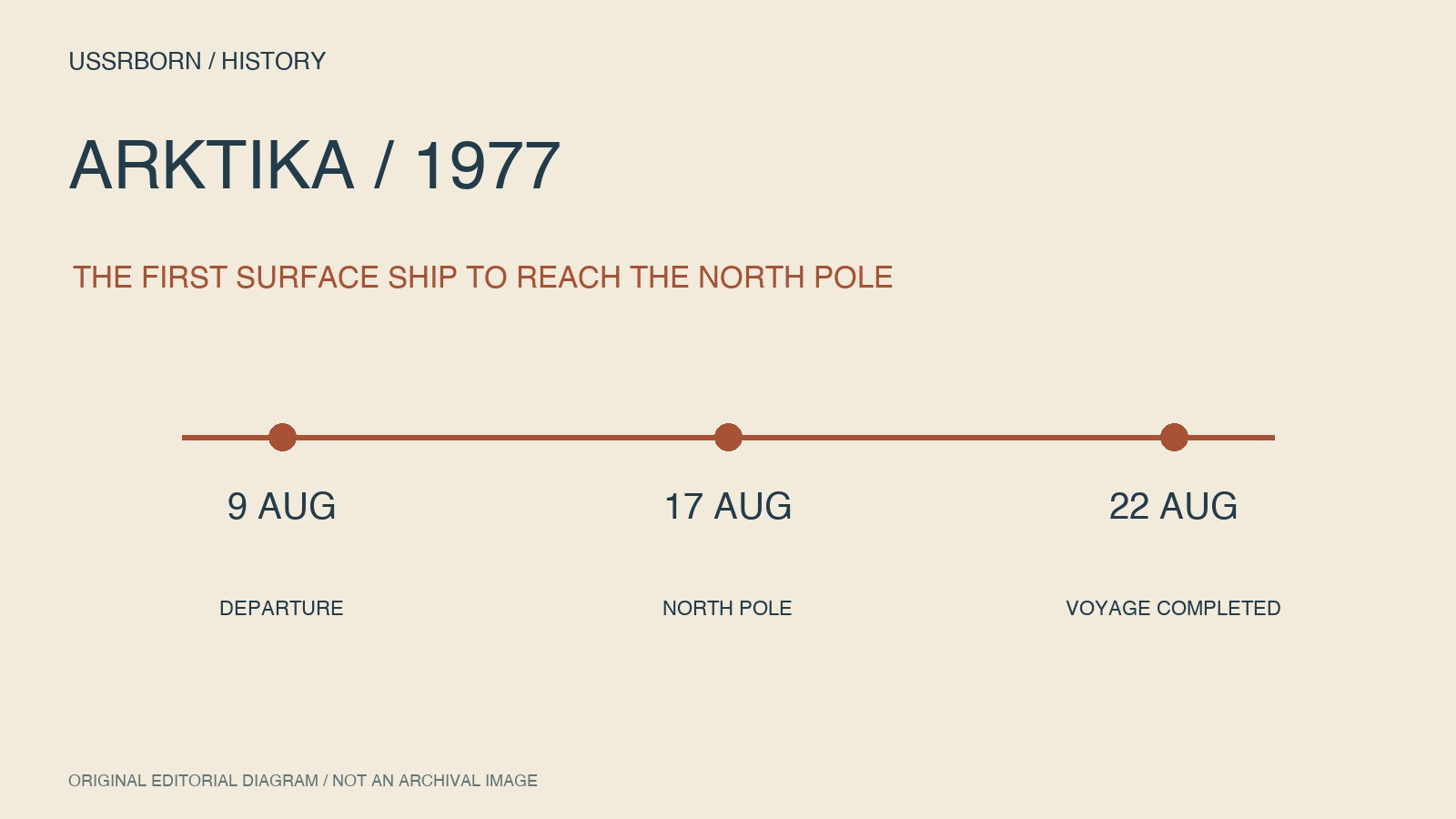
On 17 August 1977, the nuclear-powered icebreaker Arktika reached the geographic North Pole. It was the first surface ship to arrive there under its own power. That qualification matters: this was an achievement of icebreaking navigation, not the first human presence at the Pole.
Behind the familiar flag-raising episode was an experimental voyage. It tested the vessel's capabilities and gathered evidence for future high-latitude navigation.
Which Arktika reached the Pole?
This was the Soviet icebreaker laid down at the Baltic Shipyard in Leningrad in 1971 and commissioned in 1975. It should not be confused with the later Project 22220 icebreaker of the same name, whose construction began in 2013. Rosatom's historical chronology distinguishes the two generations.
The voyage's economic context was the Northern Sea Route. Icebreakers supported the movement of other vessels through ice, while potential new routes required practical testing. Reaching the Pole did not, by itself, establish a regular freight service along that route.
From Murmansk to 90 degrees north
According to the Presidential Library, Arktika left Murmansk on 9 August 1977 under Captain Yuri Kuchiev. Merchant Marine Minister Timofey Guzhenko led the expedition, which carried more than two hundred people.
The ship travelled through the Kara Sea and Vilkitsky Strait into the Laptev Sea before turning north. It reached the Pole at 04:00 Moscow time on 17 August, after covering 2,528 nautical miles in seven days and eight hours. That distance describes the outward passage, not the entire expedition.
What scientists studied in the ice
The Arctic and Antarctic Research Institute, a participant in Expedition A-77, reports that ten of its staff worked aboard. They observed ice conditions, the vessel's ability to advance and the interaction between its hull and the ice. The resulting material contributed to improved structural-strength calculations for icebreakers and transport ships.
The institute also makes a revealing qualification: favourable conditions in 1977 prevented the expedition from fully establishing the possibilities of high-latitude routes in more difficult ice. The successful voyage should therefore not be treated as proof that the same passage would be equally manageable in every season.
The stop and the return
Rosatom's historical library records a fifteen-hour stay at the Pole. Researchers carried out observations, while divers inspected the propellers. The return route differed from the outward passage, and the expedition ended on 22 August.
The voyage produced two kinds of achievement. One is easy to mark on a map: a surface icebreaker had reached the North Pole under its own power. The other was less spectacular but valuable to shipbuilding and transport: evidence about the vessel's behaviour in ice. The ceremony celebrated the achievement, while the engineering observations helped establish its practical limits.
Related articles
- The nuclear icebreaker Lenin
- The Obninsk nuclear power plant
- The planned economy
- The transpolar flight of 1937