GAZ-21 Volga: Three Series and Production from 1956 to 1970
How the first Volga changed: early engines, three styling series, automatic transmission and replacement by the GAZ-24 in 1970.
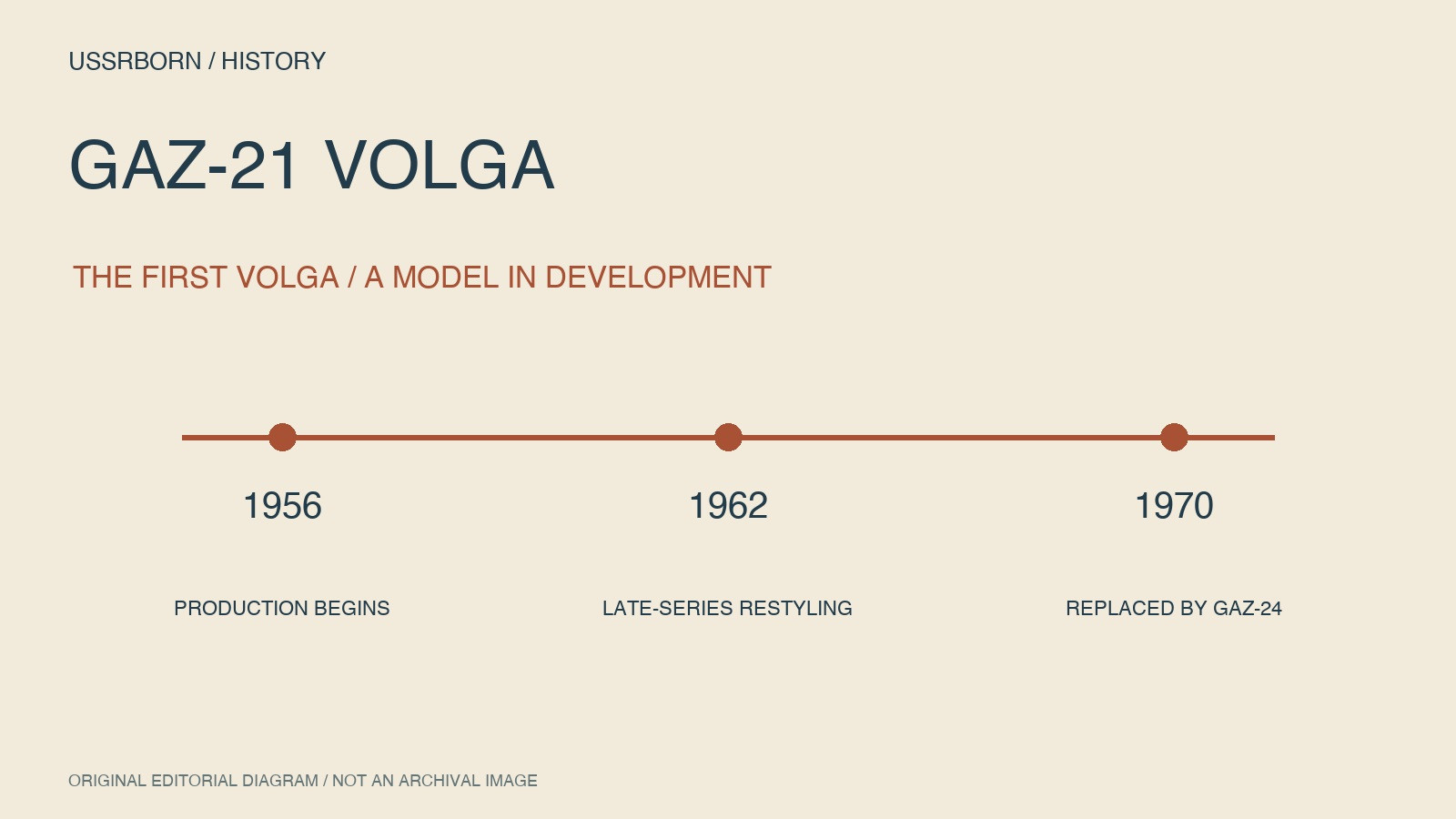
The first Volga, the GAZ-21, was produced from 1956 to 1970. Its familiar silhouette can make the fourteen-year production run seem more uniform than it was. The early star-front car, the version with broad vertical grille openings and the later fine-grille model are commonly grouped into three series.
Introducing a new model
The first production cars appeared in October 1956. Historical accounts give differing precise dates. It is more useful to distinguish prototypes, initial production examples and the expansion of manufacturing than to treat these stages as interchangeable descriptions of one day.
Za Rulem's retrospective also describes a mechanical transition. While the new engine was being introduced, some early Volgas used a side-valve engine derived from the Pobeda unit. The intended overhead-valve engine followed. Specifications associated with a later GAZ-21 should therefore not be applied automatically to every car from the start of production.
Understanding the three series
The Special Purpose Garage Museum uses the three-series classification in presenting the GAZ-21. It is a useful introduction, but it does not replace the factory's variant designations. Styling, engines and equipment changed along overlapping paths.
The star at the front is the most conspicuous sign of the first series. A subsequent design used broad vertical grille openings. The 1962 update brought a finer pattern, commonly nicknamed the baleen grille in Russian. Other trim changed too, and the deer mascot was no longer fitted to the bonnets of later cars.
One visible part cannot establish the production year of a surviving example. A grille, bonnet or ornament may have been replaced during repair or restoration. Dating an individual car requires its documents and several consistent features. A photograph can suggest an identification without settling it conclusively.
Did the GAZ-21 have an automatic transmission?
Yes. Automatic transmission was offered on early GAZ-21s, but it did not become the normal specification across the family. Za Rulem associates its withdrawal from widespread use with quality and operating difficulties. Manual transmission became the familiar arrangement.
The episode illustrates a distinction between a feature that was developed and a solution that became established in production. An automatic appearing in an early brochure does not mean that every car built that year, or most Volgas overall, had one. Identifying the particular variant matters more than relying on the model name alone.
Replacement by the GAZ-24
The GAZ-24 succeeded the GAZ-21. A report from the GAZ History Museum dates the full production-line changeover to 15 July 1970 and notes that it occurred without a manufacturing shutdown. That was a generational replacement. The three GAZ-21 series, by contrast, describe the development of one model.
The first Volga is therefore more than a recognisable shape in Soviet motoring history. Its production story shows a factory introducing a new design, revising initial choices and updating a car over many years. Thinking of it as an unchanging car with a deer ornament hides that development. The family shared a common basis while differing considerably across years and versions.