Building VAZ: Fiat, the First Zhiguli Cars and the Factory Launch
Trace VAZ from the 1966 decision and Fiat agreement to the first VAZ-2101s and the 1973 plant acceptance, distinguishing capacity from cumulative output.
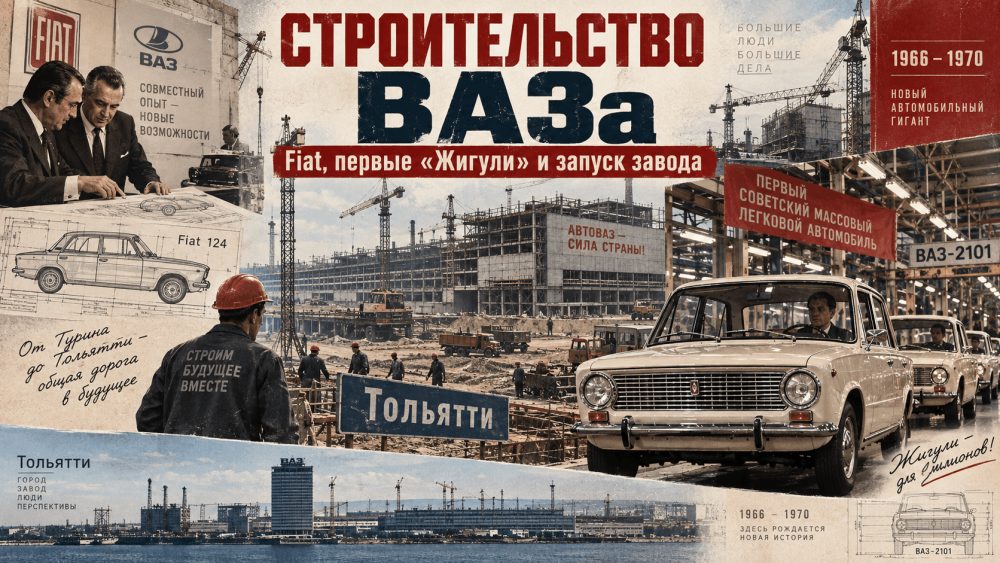
The Volga Automobile Plant began with a decision to establish large-scale production, rather than with a single finished car. In 1966, the Soviet government approved a factory at Togliatti and an agreement was concluded with Fiat. The first six VAZ-2101 cars were assembled on 19 April 1970. Those dates mark the beginning of the project and the arrival of its product. Between them lay the work of creating a factory, mastering production and developing the vehicle.
More than one beginning
The chronology maintained by Togliatti's Avtograd cultural centre library distinguishes several milestones. The construction decision was adopted on 20 July 1966. A general agreement with Fiat followed on 15 August, covering the vehicle design, the factory project and its construction. On 14 January 1967, the first earth was excavated for the auxiliary workshops building.
These dates describe different events. Approval, an agreement with a partner and the beginning of work on a particular building are not interchangeable. Asking when VAZ was built therefore requires a more precise question: when was it authorised, when did construction begin, or when did it start making cars?
This also resolves an unnecessary choice between 1966 and 1970. A large industrial project takes shape in stages. An administrative decision cannot immediately produce finished vehicles, while the first vehicles do not prove that every part of the project has been completed.
Fiat's place in the project
The Italian company supplied a central foundation for the undertaking. The Fiat 124 became the base model, and cooperation extended to the production system. Fiat's historical account, published by Stellantis, places the Soviet vehicle alongside other licensed versions manufactured outside Italy.
That international setting matters. The transfer of designs and manufacturing knowledge was not a process unique to the Soviet Union. For the receiving enterprise, the challenge was to establish repeatable production and adapt the product to the market and operating conditions it would serve.
Buying completed cars and acquiring the ability to make them are different industrial choices. An imported vehicle fulfils one delivery. A factory must keep producing subsequent batches, obtain components, maintain equipment and control quality. Even an excellent initial design cannot perform those tasks on its own.
The distinction also changes what counts as evidence of success. A photograph of the first car demonstrates that a vehicle was assembled. To evaluate an industrial system, one would additionally need records of output, rejected parts, equipment availability, costs and supply interruptions. The opening ceremony is a milestone, not a complete production history.
A shared design, adapted for use
The VAZ-2101 clearly belonged to the Fiat 124 family. Accounts of the model also describe adaptation for local operating conditions, including roads and climate. Its history cannot be reduced to changing a badge.
The purpose of adaptation is easier to understand without competing claims about exactly how many parts were altered. A car operates as a system. A change in the load on one component calls for checks elsewhere; a choice made for difficult roads may affect durability, comfort or servicing. Similar body shapes therefore do not establish that two vehicles are mechanically identical.
The opposite simplification is equally unhelpful. A shared platform remains a substantial part of the story. Italian foundations and the work of mastering and adapting them can both be acknowledged. A detailed engineering comparison would require documentation for the particular versions being compared, not simply photographs of cars that look alike.
Six cars and a complete industrial complex
The first six VAZ-2101s were assembled on 19 April 1970. The cars were called Zhiguli on the domestic market, while LADA was used for exports. A factory model index, a domestic name and an export brand describe different aspects of the same product history. They should not automatically be treated as three unrelated cars.
Another milestone came in December 1973, when the complete plant complex, with an annual capacity of 660,000 cars, was accepted for industrial operation. The millionth car, a VAZ-2103, was also assembled at that time. These later events show why the first batch and the completion of the entire complex need separate dates.
Annual capacity and cumulative production must also remain distinct. The figure of 660,000 describes a yearly production capacity. A millionth vehicle records a running total since the start. It does not mean that the factory made one million cars during 1973.
This distinction is useful well beyond automobile history. A planned capacity describes what a production system is designed to deliver. A year's output describes what it actually delivered during that interval. A cumulative total covers a longer period. Combining the three without labels can produce a dramatic but misleading account of an industrial achievement.
The factory and the consumer economy
VAZ belongs within the history of the Soviet planned economy. Its establishment shows that state industrial policy could include substantial cooperation with a foreign company. Such a contract did not, by itself, change the whole economy into a market system. The organisation of production, allocation of resources and conditions under which goods were sold remain separate questions.
Mass production also does not establish that every prospective buyer can obtain a product immediately. Assessing the position of a household requires evidence about supply, earnings, prices, purchasing arrangements and waiting times. A new assembly line alone cannot answer those questions. The wider context is explored in our accounts of Soviet cars, shortages and queues, and wages and prices.
For the same reason, dividing a car's price by an average monthly wage does not tell us how long a real family had to save. Living expenses, multiple earners and existing savings all affect the calculation. Access to a purchase could depend on more than possessing the required sum. Factory history and the experience of ownership are connected, but neither can stand in for the other.
Common questions
When did VAZ begin? The construction decision dates to 1966; the first cars were assembled in 1970. Both stages belong in a precise industrial chronology.
Was the VAZ-2101 a Fiat 124? It was developed on that foundation through cooperation with Fiat and adapted for its intended conditions. Calling it entirely independent or merely a rebadged car loses part of the history.
What happened in 1973? The complete complex, with an annual capacity of 660,000 cars, was accepted into operation, and cumulative production reached one million. That is not a claim of one million cars produced in a single year.
The cover is an original editorial timeline. It is neither a factory engineering drawing nor an archival photograph.