Perestroika Cooperatives: What the 1988 Soviet Law Changed
Explore the 1988 Soviet cooperative law, membership, autonomy, prices and income, and how cooperatives differed from individual work and state enterprises.
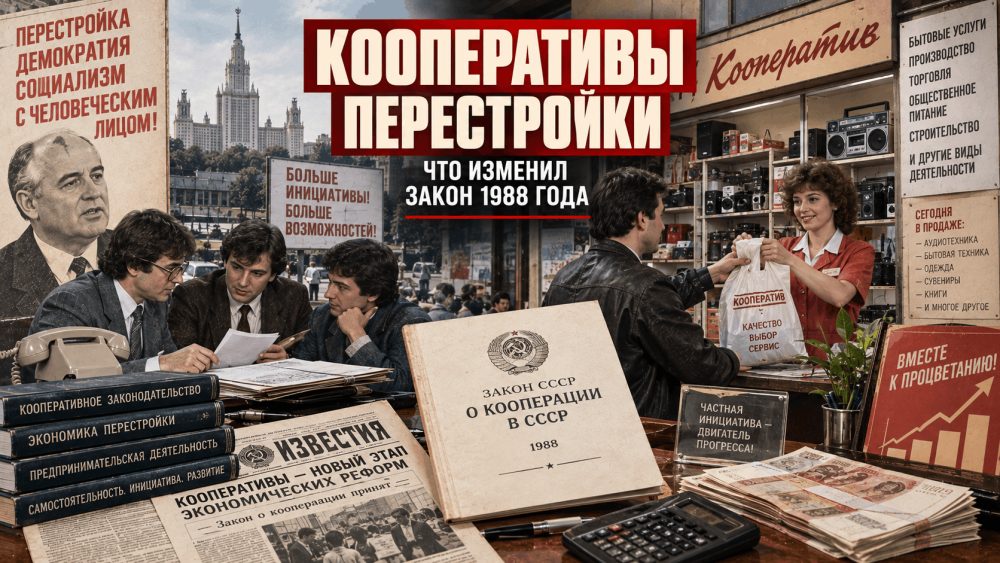
A cooperative cafe or repair workshop became a visible feature of perestroika in the late 1980s. Yet cooperation did not begin in the Soviet Union in 1988. Collective farms, consumer cooperatives and other cooperative organisations already existed. The new development was an expansion of opportunities for independent economic activity within an economy still dominated by the state sector.
The Law on Cooperation in the USSR was adopted on May 26, 1988, with July 1 as its main commencement date. It provided a broad legal framework for cooperative activity. Understanding its significance requires distinguishing a membership organisation from an individual's own work and from a state enterprise.
What had been allowed before 1988?
The law of November 19, 1986, on individual labour activity permitted specified activities based on the personal labour of citizens and their families. These included crafts and everyday services. It was not a general authorisation to employ a workforce and conduct any commercial activity a person chose.
A further step can be seen in Council of Ministers Resolution No. 160 of February 5, 1987, concerning catering cooperatives. It provided for small organisations with economic autonomy. Its model charter described collective work, a general meeting and an elected chair.
Consequently, it is incorrect to assume that every cooperative cafe first became possible after July 1988. Earlier measures already provided a legal basis. The 1988 law broadened and systematised an approach developing through separate decisions. It belongs within the sequence of perestroika reforms, rather than marking an overnight transition to an entirely new economy.
The dates help distinguish several processes often compressed into one story: allowing certain individual activities, authorising particular cooperative forms and adopting a general cooperative law.
A cooperative was not simply a business with one owner
The law defined a cooperative through voluntary membership, joint activity, self-government and self-financing. It had legal personality and its own balance sheet. It could operate with property it owned, rented or had been permitted to use.
That framework differs from the everyday description of one person opening a private firm. A cooperative had members, a charter and governing bodies. Members had rights to participate in its affairs, elect management bodies and obtain information about its activities. Studying a particular enterprise requires asking how those rules operated, rather than inferring the answer from its sign above the door.
Production cooperatives and consumer cooperatives also had different functions. The former engaged in production, work and paid services; the latter served the needs of members and other citizens. The law's scope extended well beyond restaurants, clothing and appliance repairs. The history of collective farms is one reminder that Soviet cooperation was broader than the entrepreneurial wave of the late 1980s.
These distinctions matter because the same general label can cover organisations with very different purposes. A housing-related consumer organisation and a workshop selling its output should not automatically be treated as identical businesses.
What economic autonomy meant
In the state sector, many enterprise decisions were connected to planned targets and the allocation of resources. The cooperative model envisaged a more direct relationship between an organisation's activity, its income and its ability to continue operating. Self-financing meant relating expenditure to earnings and funds obtained from other permitted sources.
Consider a hypothetical repair workshop. It needs premises, tools, replacement parts, customers and skilled people. A legally available organisational form does not, by itself, provide a reliable stock of spare parts or a queue of customers able to pay. Autonomy creates room for decisions while leaving the organisation exposed to economic risk.
This is an explanatory example, not a description of a particular Soviet cooperative. It separates the legal opportunity to operate from the material conditions required to do so. A law can specify rights and obligations, but cannot create machinery, skills and dependable supplier relationships by wording alone.
The distinction also guards against assuming that every new permission produced an immediate practical result. Implementation depended on circumstances that a general legal text could not fully describe.
Why prices became a central issue
The law's pricing provisions allowed cooperative prices to be set independently or agreed with customers while retaining special rules and exceptions. Saying that cooperatives could charge absolutely any price for everything is therefore inaccurate. The product, source of inputs, type of order and applicable version of the rules all mattered.
The potential tension in such an arrangement can be explained without inventing statistics. If neighbouring organisations acquire materials under different conditions and set selling prices in different ways, their decisions depend on the boundary between those systems. A retail price alone does not establish how the seller obtained the goods or produced the service.
This connects with shortages in Soviet retailing, but does not prove that cooperatives were either the sole cause of scarcity or a universal solution to it. Those claims would require evidence about specific markets, deliveries, production and customer demand.
The legal permission to supply a service and the economic consequences of supplying it are separate subjects. A careful historical account should not silently substitute one for the other.
Revenue was not the same as a member's earnings
Sales receipts cannot all be treated as a cooperative member's personal income. The organisation had to pay for materials, rent and other costs, meet obligations and decide how much to devote to continuing its activities. The law dealt separately with cooperative income and its distribution.
Any comparison of earnings therefore needs a clear definition. Is the figure total sales, organisational income after specified costs or a payment to one person? Does it cover a month, a year or one order? Without those questions, a dramatic comparison with Soviet wages can easily mislead.
Membership and work under an employment agreement were also distinct relationships in the published law. Participation in governance was associated with membership, while performing paid work did not by itself describe a person's entire legal position. A particular organisation's charter, contracts and payment records would be needed to reconstruct those relationships.
That distinction helps explain why the word cooperator cannot always answer who made decisions, who provided labour and who received which part of the income. Those are questions for evidence, not assumptions.
Was the law an announcement of capitalism?
The law's official language framed the reform as part of a socialist economy alongside the state sector. Describing the text itself as an explicit declaration of a transition to capitalism would therefore be historically inaccurate.
At the same time, the framework widened opportunities for initiative, material incentives and independent decisions. The political justification of a reform and its later consequences need not be identical. Historians can investigate how the new opportunities contributed to subsequent forms of business, but that is a further question requiring additional evidence.
The law should not be read as a guarantee that every enterprise succeeded. Rights written into a document and actual dealings with administrators, suppliers and customers are established through different sources. Neither an idealised picture of universal prosperity nor a claim that all cooperative participants were wrongdoers follows from the legislation itself.
A membership-based organisation could be a vehicle for initiative without becoming institutionally identical to every later private company. Preserving that distinction makes the transition easier to understand.
Why the version of the text matters
The legal publication linked below incorporates amendments made after 1988, including changes from 1990 and 1991. Its amendment notices are an important part of the source. The entire consolidated text cannot automatically be attributed to the situation on July 1, 1988.
This article separates the adoption and commencement dates from an explanation of the law's general organisational model. Establishing precise registration, taxation or employment rules for a particular month requires the relevant version and related legislation. This is a historical account, not present-day guidance for starting a business.
The cooperative reform becomes easier to understand when framed around a concrete question: which economic decisions could citizens make together, and under what conditions? That approach reveals both the wider opportunities and the continuing relationship between new initiatives and the state economy around them.
Sources
- USSR Law No. 8998-XI of May 26, 1988, on cooperation: publication incorporating subsequent amendments, in Russian.
- Resolution No. 8999-XI of May 26, 1988, bringing the law into force, in Russian.
- Law of November 19, 1986, on individual labour activity, with subsequent changes, in Russian.
- Resolution No. 160 of February 5, 1987, and the model charter for a catering cooperative, in Russian.