The New Economic Policy: Why Private Trade Returned
How the NEP changed the relationship between the Soviet state, peasants and private businesses during the 1920s.
What changed in 1921?
The New Economic Policy began in Soviet Russia in 1921, before the Soviet Union was established. A decision at the Tenth Party Congress led to a different system for collecting food. The decree of March 21 replaced requisitioning with a tax in kind. Once peasants met their obligations to the state, they could sell the produce that remained. Markets therefore became part of rebuilding exchange between town and countryside.
Why did Lenin accept a retreat?
In his October 1921 report, Lenin connected the crisis with the attempt to move too quickly toward communist production and distribution. He acknowledged the importance of giving producers a personal incentive. His speech is evidence of how he defended the policy, rather than an independent assessment of everything the NEP achieved.
Permitting trade did not mean abandoning the Bolsheviks' socialist objective. Lenin wanted the state to direct the private activity it now allowed. The immediate problem was how to rebuild the economy using arrangements that had recently been treated as politically undesirable.
Why stable money mattered
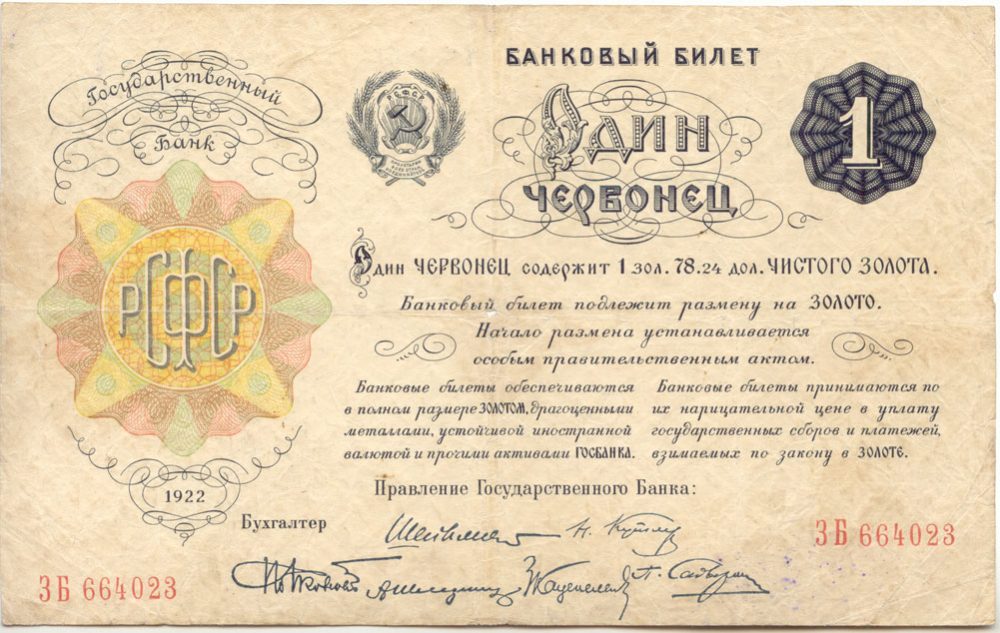
Permission to trade was only part of the change. Buyers and sellers also needed money in which they could set prices and settle accounts. Monetary reform began in 1922 and continued until 1924. Banknotes denominated in chervontsy were introduced. The Bank of Russia's historical account describes successive stages of reform, so imagining a single overnight replacement of all the old currency misses how the transition worked.
A policy with regional differences
Regional evidence also complicates a simple national story. The Tatar Encyclopedia describes state, cooperative and private businesses operating alongside one another, followed by increasing pressure on the private sector. Its local figures should not be treated as statistics for the whole Soviet Union. The NEP was a changing economic arrangement, with different conditions across places and years, rather than one fixed set of rules throughout the 1920s.
Economic permission was not political freedom
In The Tax in Kind, Lenin described an economy in which different forms of production existed together. A peasant household, a small producer and a state enterprise could not be made identical simply by issuing an order. Exchange was supposed to connect them. He therefore defended concessions to the market as a transitional route toward socialism, rather than a return to the social order that had existed before the revolution.
Economic concessions also coincided with stricter party discipline. The Tenth Congress banned factions inside the ruling party. Permission to trade did not give citizens freedom to challenge the party's authority. Keeping those two developments separate helps explain why the NEP should not be equated with political democratization. Our biography of Vladimir Lenin places the policy within his wider political career.
The grain problem at the end of the decade
By late 1927, the state was finding it difficult to buy the quantities of grain it wanted. A harvest and a procurement total measure different things: grain might remain on farms without reaching state buyers on the terms they offered. Historians Carol Gayle and William Moskoff connect the crisis with procurement prices, the relationship between agricultural and industrial prices, and the political anxiety of 1927.
James Hughes treats the January 1928 crisis as the culmination of tensions that had been building between the state and the countryside. He also stresses regional differences. Explaining the crisis solely through accusations that peasants were sabotaging the government repeats a political charge instead of examining how economic incentives worked.
How the NEP came to an end
In 1928 the leadership turned to emergency measures to obtain grain. Renewed coercion undermined the principle of voluntary exchange on which the policy depended. Rapid industrialization and collectivization subsequently became the dominant direction. This transition connects the NEP to the history of the Five-Year Plans and the collective farm system.
It is more accurate to describe the end of the NEP as a process in the late 1920s than as a single switch being flipped. Historians draw the boundary differently depending on whether they are examining trade, grain procurement or political decisions. Claims that the NEP would certainly have remained successful also require caution. They concern an alternative course of history, not an outcome that can be directly observed.
Frequently asked questions
Did the NEP begin in the Soviet Union?
It began in Soviet Russia in 1921. The Soviet Union was established in December 1922, when the policy was already in operation.
Did the tax in kind remove peasants' obligations to the state?
No. A compulsory payment remained. What changed was the method of collecting produce and the ability to dispose of what remained afterward.
Was the NEP abolished by a single decree?
Its dismantling involved a sequence of economic and political decisions. The crisis of 1927 and 1928 was a major turning point, but different parts of the earlier arrangement disappeared at different times.
Further reading on this site
- The Soviet ruble and its later history.
- Vladimir Lenin.
- Five-Year Plans and the planned economy.
- The collective farm system.
Sources
- Tatar Encyclopedia: New Economic Policy (Russian).
- V. I. Lenin: The New Economic Policy and the Tasks of the Political Education Departments, October 17, 1921.
- Bank of Russia: History, entries for 1922 to 1924 (Russian).
- V. I. Lenin, The Tax in Kind (1921).
- James Hughes, The crisis of NEP: chapter summary, Cambridge University Press.
- Matthew Lenoe, New Economic Policy (NEP), Encyclopedia of Modern Europe.
- Carol Gayle and William Moskoff, Grain Crisis of 1928, Encyclopedia of Russian History.
Cover: one-chervonets banknote, 1922. Scan and collection of Anton Kitaycev. Wikimedia Commons, public domain (PD-RU-exempt).