The GAZ-M1 Emka: Design Changes Behind the 1936 Car
Where the Emka came from, how its running gear differed from Ford and what 1940 technical consultations reveal about maintaining the GAZ-M1.
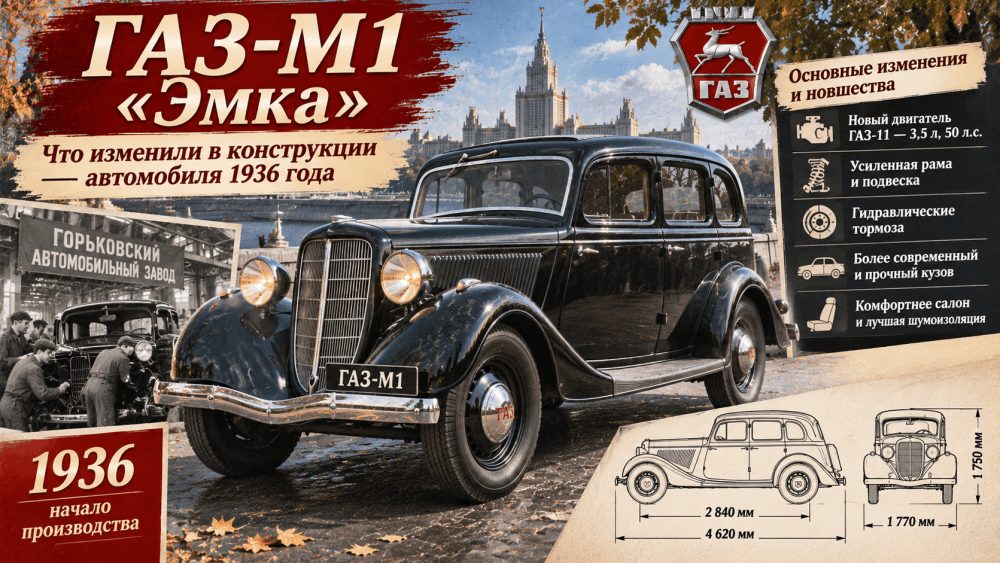
The GAZ-M1, commonly called the Emka, entered production in 1936. Its visual relationship to Ford is apparent, but understanding the car requires looking beneath the body. The frame, suspension and powertrain were adapted for Soviet operating conditions. It is an example of an imported foundation becoming a distinct production design.
Where the Emka came from
The GAZ-M1 entry on the Busmuseum website connects the model with the 1929 agreement between the Soviet side and Ford. The arrangement provided access to documentation for new cars. The museum dates the M1's arrival on the production line to 16 March 1936.
The letter M referred to Molotov, whose name the factory bore, and supplied the basis for the nickname. It did not describe the engine type or seating capacity. The car served organizations and taxi fleets, so its history cannot be reduced to its use by a single agency.
Changes beneath the body
The Museum of National Military History in Padikovo describes a strengthened frame, four longitudinal leaf springs replacing two transverse ones, revised steering and pressed-steel wheels. These features provide a more useful engineering comparison than similarities between radiator grilles in photographs.
A leaf spring is an elastic suspension component. Longitudinal placement means running along the vehicle; transverse placement runs across it. That explanation makes the descriptions easier to follow, but orientation alone cannot establish that one arrangement is always superior. Performance depends on the whole design and its operating conditions.
Engine and enclosed body
Za Rulem's technical comparison describes an engine of approximately 3.3 litres producing 50 horsepower, against the GAZ-A predecessor's 40. Compression, the carburettor and ignition advance arrangements changed. The M1 used a revised three-speed gearbox while retaining mechanically operated brakes.
Its enclosed four-door body looked more modern than the earlier open car. The magazine also notes the non-metallic insert in the roof. The term “all-metal body” should therefore not be interpreted as meaning that every part was made from metal. This detail helps when examining a museum vehicle or a period photograph.
Drivers' questions in 1940
A 1940 technical consultation in the Za Rulem archive discussed GAZ suspension and running gear. Questions covered spring lubrication, the function of rubber-bushed joints and differences between the M1 and the M-415 pickup.
The answers explained that the pickup used the M1's front springs but stiffer rear springs. This is a concrete example of why a shared chassis lineage does not guarantee complete interchangeability of parts. Loading and the vehicle's intended job affected component selection.
The consultation is valuable evidence of everyday maintenance. It presents the car as machinery requiring inspection, lubrication and knowledge, rather than as a ceremonial exhibit. Historical instructions, however, cannot substitute for the documentation and examination of a particular restored vehicle.
Why the version matters
The Emka family produced related designs. The Padikovo museum mentions the BA-20 armoured car built on its chassis, while the contemporary consultation allows comparison with the pickup. Specifications for one version should therefore not be transferred automatically to the entire family.
Modern accounts also differ in their final production totals. An explanation of the design is better served by established changes than by selecting an exact total without reconciling what has been counted. The beginning of production, suspension arrangement and types of service provide clearer reference points.
The M1 shows that industrial development involved more than introducing wholly unprecedented cars. It also meant revising established designs and learning from their operation. Its Ford connection and its Soviet modifications belong in the same account; neither makes the other disappear.
The cover identifies body, suspension and engine as three areas of comparison. It is an original editorial diagram, not a factory drawing or an archival photograph.