GAZ in 1932: Factory Startup, Ford and the First Truck
Why GAZ has two January milestones: commissioning, the first truck, Ford cooperation, earlier assembly and the change from NAZ-AA to GAZ-AA.
The Gorky Automobile Plant's history does not begin with a single date. The enterprise entered service on 1 January 1932, while its first truck followed on 29 January. That four-week interval helps distinguish the opening of a factory from the appearance of its first finished vehicles.
GAZ later became associated with many models. Its early story, however, is best approached through a particular industrial task: moving from technical cooperation and vehicle assembly towards operation of a large manufacturing complex. Soviet industrialization, American expertise and transport requirements came together in that process.
Ford cooperation involved more than a vehicle design
The Henry Ford museum describes the 1929 agreement between Ford Motor Company and the Soviet government. Cooperation concerned facilities in Nizhny Novgorod and Moscow. Ford supplied drawings for buildings and equipment and sent engineers and foremen to assist with construction and startup.
This was broader than purchasing a finished truck to examine. Designing a vehicle and organizing its manufacture are distinct activities. Even with an accurate component drawing, a factory must select machinery, arrange operations and maintain consistency across repeated production.
The arrangement can be considered within the wider history of the planned economy. State objectives and foreign technical assistance addressed different sides of an industrial project; one did not automatically exclude the other.
Assembly preceded the new factory complex
The history published by today's Popov communications equipment plant recalls automobile assembly on the former Molot factory's premises. While preparations for the larger automobile plant were under way, that site was already assembling Fords and Ford-type vehicles.
Consequently, a statement about a factory's first vehicle should not automatically become a claim about the first vehicle assembled in the city, still less the first Soviet automobile. Each claim requires a different comparison. The enterprise, location and date must be identified together.
A photograph of a Moscow assembly line in 1930, preserved by The Henry Ford, also concerns a different location. It documents the broader cooperation but should not be presented without explanation as a photograph of the Nizhny Novgorod plant in 1932.
Two January milestones
The Great Soviet Encyclopedia entry dates the laying of the plant's foundation to 2 May 1930 and its entry into service to 1 January 1932. The National Museum of the Republic of Tatarstan identifies 29 January as the date of the first truck.
These are compatible milestones. Bringing an enterprise into service marks a stage of organizational and production readiness. Completing the first vehicle is a separate step in establishing output. Sustained production then depends on supplies, repeatable operations and inspection.
The distinction is useful well beyond GAZ. A decision to build, foundation ceremony, commissioning, first product and achievement of planned output are not interchangeable events. One anniversary need not describe an entire industrial process.
Why NAZ-AA became GAZ-AA
The first vehicles appeared when the enterprise was called the Nizhny Novgorod Automobile Plant, hence NAZ-AA. GAZ-AA became the established designation after the factory's renaming. The Tatarstan museum draws attention to this distinction when discussing the NAZ inscription on its own vehicle.
The familiar Russian nickname polutorka refers to its 1.5-tonne payload. That is the intended load, not the weight of the truck itself. The American Ford AA provided the model. GAZ-A and GAZ-AA should also be distinguished: the former was a passenger car, the latter a truck.
Within the broader story of Soviet automobiles, such details are more useful than treating all early vehicles as one interchangeable design. An additional letter can identify a different type of transport.
A surviving truck has its own history
A museum vehicle cannot be interpreted from appearance alone. The National Museum of Tatarstan records that its damaged truck was found in the Leningrad region in 1984 and restored using components recovered from battle sites. That is evidence about the provenance and reconstruction of a particular exhibit.
Its present appearance need not reproduce every detail of its condition on leaving the factory. When using an old photograph or a restored machine, check the date, modification and restoration history separately. The object remains valuable evidence, but it needs a biography of its own.
This approach also helps keep wartime service separate from the initial production story. Later construction changes should not be projected backwards onto January 1932, and a restored vehicle should not automatically be described as an untouched example of the first batch.
Understanding the factory's economic role
An automobile plant produces equipment used by other activities. Its importance therefore extends beyond a count of vehicles leaving an assembly line: freight movement, maintenance and spare parts matter too. This explains an industrial relationship without claiming that one truck model can measure the entire outcome of Soviet industrialization.
Useful comparisons include Dneproges, whose principal output was electricity, and the later VAZ project with Fiat. The involvement of foreign expertise does not make these projects identical. Their periods, products and manufacturing tasks differed.
Three distinctions make the GAZ startup easier to understand: technical agreement versus operating production, an assembly site versus a new factory, and commissioning versus the first completed vehicle. They provide a clearer account than an unqualified claim of being first.
Sources
- The Henry Ford: Moscow assembly line, 1930: the 1929 agreement and technical assistance.
- Popov communications equipment plant history: early vehicle assembly at the former Molot site.
- Great Soviet Encyclopedia: Gorky Automobile Plant: foundation and commissioning dates, in an electronic reproduction of the entry.
- National Museum of Tatarstan: ninety years of the polutorka: the first truck, NAZ/GAZ naming and the museum vehicle's provenance.
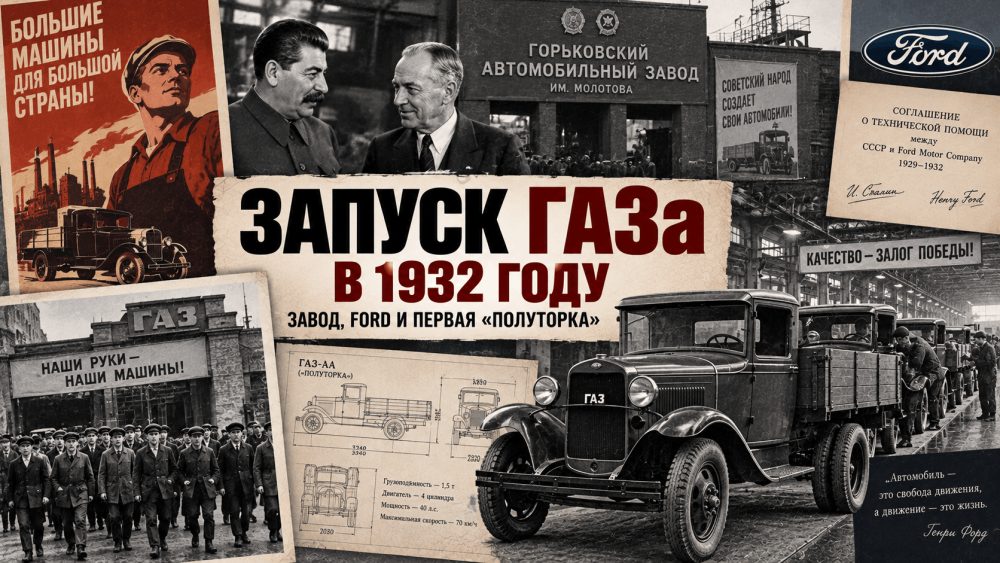
The cover is an original timeline, not an archival factory photograph.