The 1961 Soviet Monetary Reform: Cash, Prices and Exchange Rates
Explore the 1961 reform: cash exchange, savings and wage conversion, rounding rules, the small-coin exception and the changed official dollar rate.
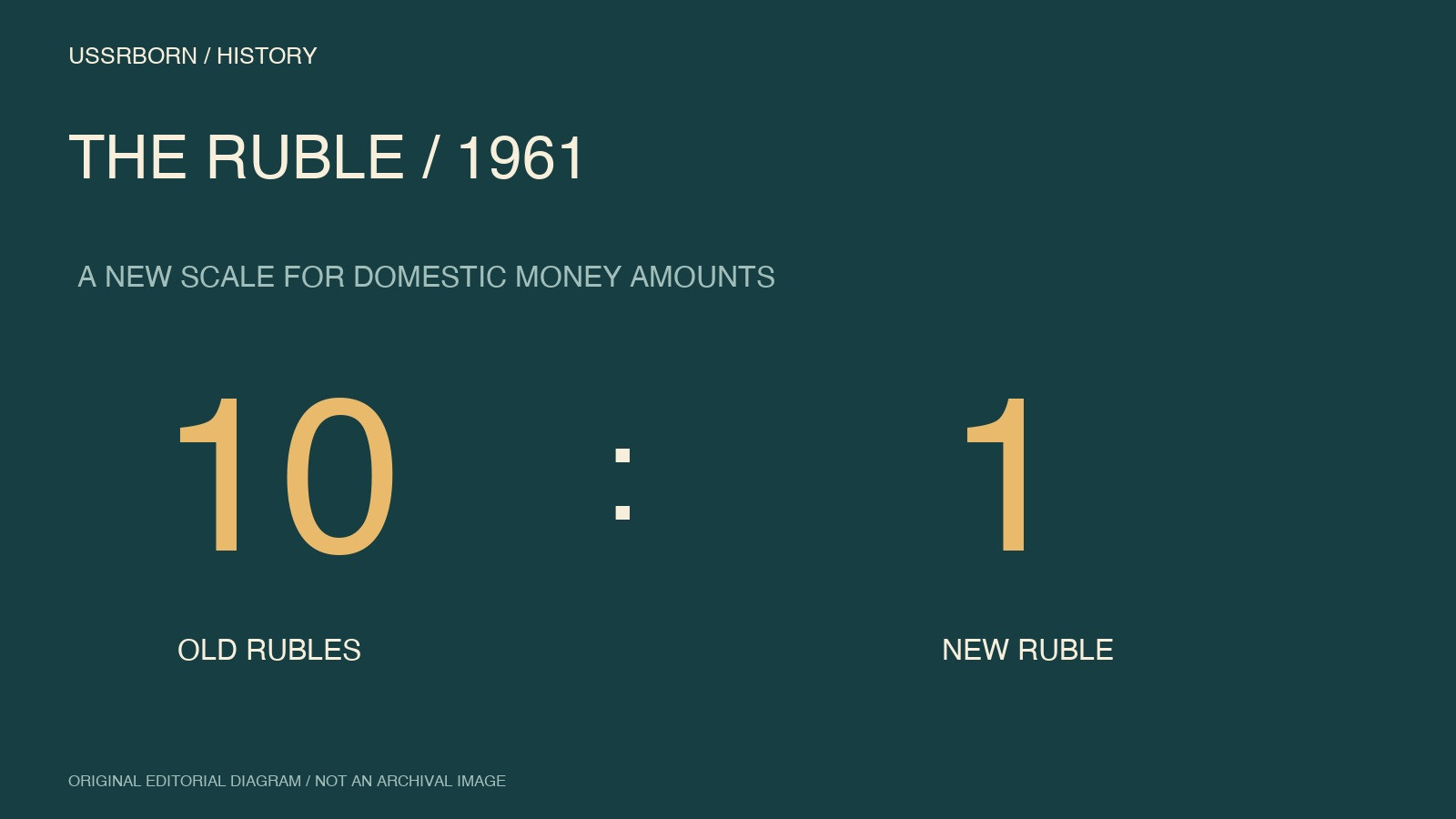
On 1 January 1961, familiar Soviet money amounts became ten times smaller: a thousand old rubles became a hundred new ones. Wages, savings, prices and service charges were recalculated alongside the currency. The disappearance of a zero therefore did not, by itself, mean that a household had lost nine-tenths of its purchasing power. Understanding the reform requires separating domestic accounting, the exchange of cash and the official foreign exchange rate.
A change announced months ahead
The legal foundation was USSR Council of Ministers Resolution No. 470 of 4 May 1960. Its timetable gave institutions several months to prepare. Government bodies had to produce new price lists, employers had to recalculate pay, and shops had to revalue their stock. The operation reached into everyday bookkeeping rather than simply replacing the pictures printed on banknotes.
New currency entered circulation on 1 January 1961. During the first quarter, old money remained acceptable for payments at one-tenth of its previous face value. Gosbank exchange points converted it into the new currency. The old banknotes were withdrawn from circulation from 1 April, after the three-month exchange period. The timetable matters: this was not an announcement giving everyone just a few days to dispose of their cash.
What the ten-to-one ratio covered
Resolution No. 470 applied the new scale to both sides of a household budget. Wage rates and salaries were recalculated, as were pensions and allowances, personal deposits, commodity prices and service tariffs. Savings institutions adjusted account balances as of 1 January. The new balance was entered in a depositor's savings book on the first subsequent visit.
An imaginary example illustrates the arithmetic. Suppose someone earned 900 old rubles and bought an item costing 30. The corresponding figures would be 90 new rubles and 3 new rubles if the general ratio applied exactly. The wage would buy thirty such items under either scale. These figures demonstrate the calculation; they are not a claim about a particular occupation, wage or historical retail price.
This is why records of Soviet wages and prices cannot be compared across January 1961 without identifying the monetary units. Two documents can both use the word rubles while counting different-sized units. A smaller written balance is not sufficient evidence of a smaller amount of goods that the balance could purchase.
Fractions of a kopek
A simple division became more complicated when it produced a fraction of a new kopek. The resolution's general rule rounded fractions below half a kopek down and fractions of half a kopek or more up. It also provided an exception for specified foodstuffs and children's goods: retail prices ending in half a kopek were to be rounded predominantly downward.
The details prevent two opposite shortcuts. It is inaccurate to say that every price was divided by ten with no remainder. It is equally unwarranted to derive a uniform increase in all household costs from the existence of rounding. Establishing what happened to a particular purchase requires its old and new price lists. Establishing the effect on a household requires knowing what that household bought.
Old coins of 1, 2 and 3 kopeks formed another exception: they remained in circulation at their face value. That rule should not be extended to every small pre-reform coin. The new paper series comprised 1, 3, 5, 10, 25, 50 and 100 rubles. The three lower denominations were treasury notes; the others were Gosbank notes. Their official names are useful when identifying a surviving note or reading a contemporary inventory.
The foreign exchange rate was a separate calculation
Before the reform, the official rate was four old rubles to one US dollar. Afterwards, it was ninety new kopeks to the dollar. A purely tenfold conversion of the earlier figure would have yielded forty kopeks. The difference between forty and ninety explains why describing the entire operation as a change in denomination leaves out an essential part of the story.
However, an official exchange rate is not the same thing as the ratio between prices in a Soviet shop and prices abroad. Nor does it directly measure what a particular family lost or gained. The history of the Soviet ruble involves both the domestic unit used to record payments and its externally assigned official value. Recalculating a wage and changing the dollar rate belong to different parts of that history.
A careful comparison therefore asks which relationship changed. If both a wage and a price are divided by ten, their ratio is unchanged before rounding. If the ruble-dollar relationship changes by another factor, the official external valuation changes. These statements can both be true. Neither one should be substituted for a complete account of actual household purchasing conditions.
Why 1947 is not an interchangeable comparison
The ten-to-one cash exchange ratio also appears in accounts of the 1947 monetary reform. Matching numbers do not establish matching policies. The earlier operation had its own treatment of savings and belonged to a different postwar setting. In 1961, the legal framework explicitly coordinated the conversion of monetary earnings, deposits and domestic prices. Comparing the reforms requires examining those rules rather than stopping at the exchange ratio.
Nor did the new notes abolish the system through which prices and supplies were administered. The planned economy continued to operate with a different scale for recording monetary amounts. A shorter figure in an account did not, on its own, reveal whether goods were plentiful or how they were distributed.
Reading an old account accurately
A family savings book, payroll slip or price label from this period should prompt three questions. When was it written? Does it use old or new rubles? What does the number actually measure? A wage, an official currency quotation and the cost of a basket of purchases are not interchangeable indicators.
The 1961 reform is valuable precisely because these distinctions are visible in a single event. It changed the unit in which everyday sums were expressed, established procedures for converting them, and altered the official external value of the ruble. Keeping those operations separate makes the surviving documents much more informative than the familiar phrase about removing a zero.
Sources
- USSR Council of Ministers Resolution No. 470 of 4 May 1960: conversion and exchange rules.
- Presidential Library: the 1961 monetary reform, exchange period and small-coin exception.
- Bank of Russia historical chronology: the ruble and official exchange rates in 1950 and 1961.
- Bank of Russia: the history of banknote circulation and the denominations of successive issues.