The Soviet ruble: money that could not buy
A currency whose rival, the dollar, could put you before a firing squad. Three different rubles in one country, shops for "real money" only, and two reforms that confiscated savings in three days. The Soviet economy, told through a banknote.
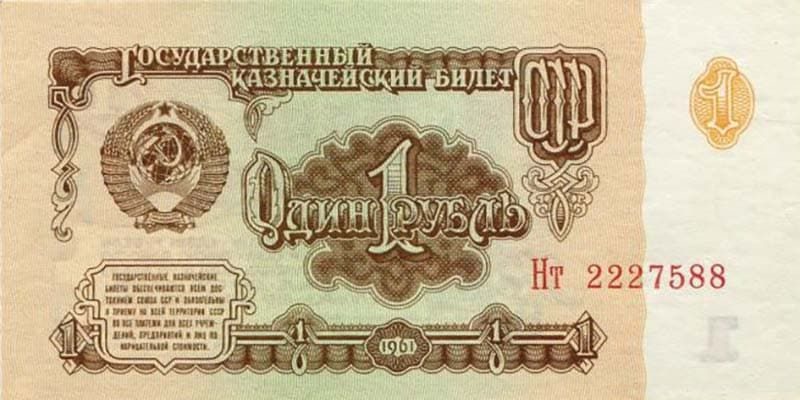
Money in reverse
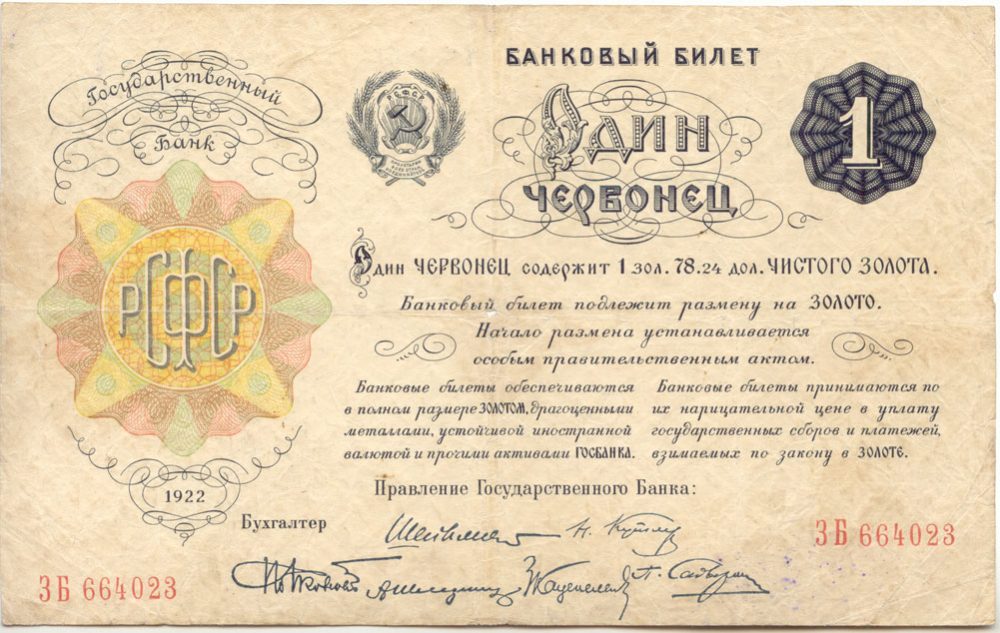
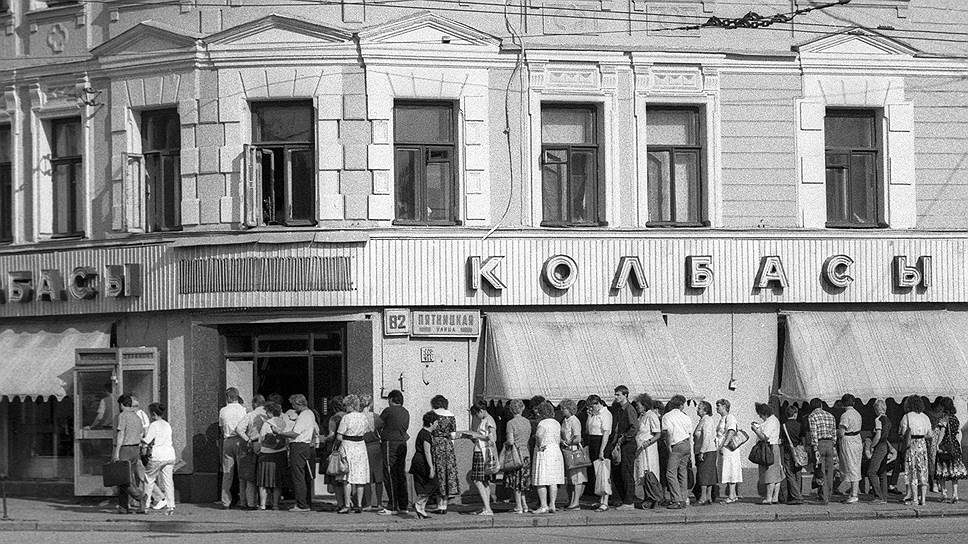
The Soviet ruble (100 kopecks) was the currency of the USSR from 1922 to the country's end, and it shows better than any textbook how the planned economy worked. In the market world, money decides what you can buy. In the Soviet world the ruble was a necessary but insufficient condition: money had to be accompanied by access: a place in line, a ration coupon, a connection, a slot in a closed distribution list. People had salaries, and billions accumulated in savings books, but there was little to spend them on: money did not chase goods, goods hid from money. Economists call this the "monetary overhang"; ordinary people called it shortage.
Nor was the ruble strictly one currency. The cash ruble in one's pocket, the cashless ruble of enterprises (forbidden to convert into cash) and the foreign-trade ruble lived in three parallel worlds with different rules and different purchasing power. A country with a single ideology ran three different kinds of money.
An exchange rate by decree
The official ruble-dollar rate was set by the state: for decades it stood at around 60 to 70 kopecks per dollar and was published monthly in Izvestia with a straight face, as if a currency exchange existed somewhere. The rate was fiction in chemically pure form: an ordinary person could not buy dollars at it, because currency transactions were a criminal offense for citizens. Under aggravating circumstances the "currency speculation" article carried the death penalty, and this is not theory: in 1961 the black-market dealers Rokotov and Faibishenko were executed under a law retroactively hardened specifically for their case. Even citizens legally traveling abroad could exchange only a strictly limited sum, on the order of thirty rubles, and Soviet tourists carried suitcases of canned food so as not to waste precious currency on meals.
A black market existed, of course, and valued the ruble at a fraction of the official rate. The state knew this better than anyone: for settling accounts with its own citizens who had earned currency abroad, it built a separate system.
Beryozka: the shops of real money
From the late 1950s the country ran the Beryozka chain: stores that did not accept Soviet rubles. They sold for hard currency (to foreigners) and for Vneshposyltorg checks, surrogate money issued from 1965 to diplomats, sailors, military specialists and performers in exchange for currency earned abroad. Behind the checks lay a parallel world of plenty: Finnish salami, Japanese electronics, sheepskin coats, even cars without waiting lists. An American journalist recalled a waiter refusing his rubles with the words that only real money was accepted here, a sentence that contained the country's entire monetary system.
The checks instantly became a black-market currency trading at several times face value, and Beryozka became the symbol of an inequality that officially did not exist. Gorbachev closed the chain in 1988 as part of his "war on privilege"; the lines outside the last Beryozkas entered the chronicle of the era.
The reforms: how the state sheared the savers
A genre of its own in Soviet monetary history is the reform, each of which took something away. The postwar reform of 1947 exchanged cash at 10 to 1, devouring the savings of those who kept money at home. Khrushchev's reform of January 1, 1961, looked like a harmless 10 to 1 redenomination, new kopecks for old ten-kopeck pieces, but a devaluation hid inside it: the gold content and the dollar rate were changed not tenfold but by less, making imports and gold nearly twice as expensive. The public noticed that too, along with the small prices creeping upward after rounding.
The final reform came eleven months before the end. On January 22, 1991, television announced the Pavlov reform: 50 and 100 ruble notes were withdrawn from circulation, with three days to exchange them and a limit of one thousand rubles, roughly a month's salary. That same night people besieged the banks; savings above the limit turned into paper. The declared aim was the fight against "unearned income"; the actual result was the final destruction of trust in the ruble and the state. A year later prices were freed, hyperinflation finished what the reform had left, and in 1993 the Soviet ruble was withdrawn in post-Soviet Russia.
The kopeck as a museum piece
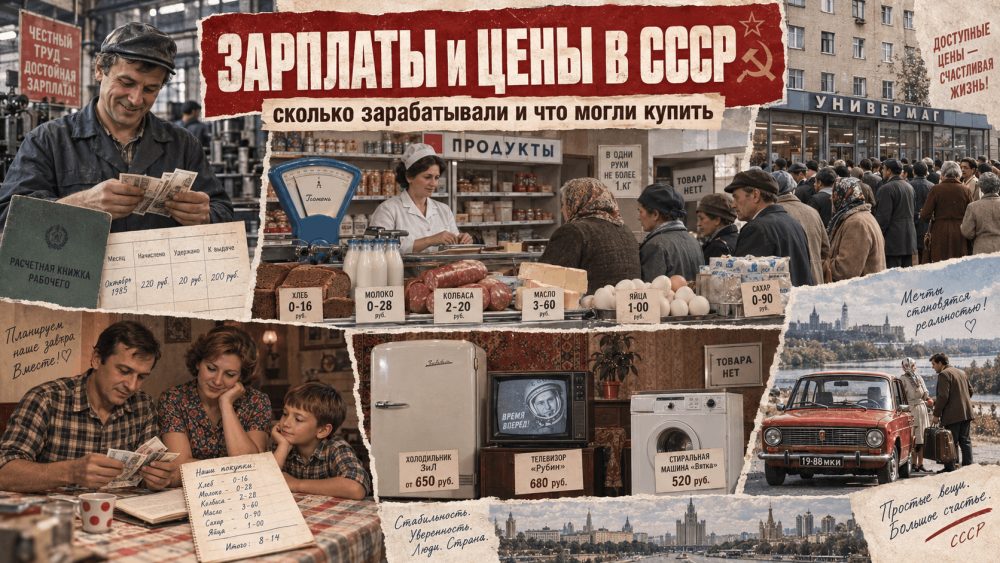
For all of the above, the Soviet ruble carries another, warmer memory. Through decades of fixed state prices the kopeck had weight: a box of matches for one kopeck, fizzy water for one without syrup and three with, ice cream, a metro ride for a five-kopeck piece: several generations remember these figures like the multiplication table. The price stability was real (it was paid for by hidden shortage, but stability is what memory kept), and nostalgia for the "firm kopeck" is one of the most durable Soviet myths, pointless to argue with and easy to understand.
Today Soviet notes and coins are collectors' items, and the ruble itself is a teaching exhibit: economists dissect it as the model case of money that did not perform money's main function. The verdict on its biography is honest and double, like everything in this story: the ruble was stable as long as it did not matter, and collapsed when it tried to.
Frequently asked questions
How much did a dollar cost in the USSR? Officially about 60 to 70 kopecks, but citizens could not buy currency at that rate: currency transactions were criminally punishable. The black market valued the dollar at several times more.
Were people really executed for dollars in the USSR? Yes, under aggravating circumstances: in 1961 the currency dealers Rokotov and Faibishenko were executed under a law hardened retroactively for their case.
What were the Beryozka shops? A chain selling for hard currency and Vneshposyltorg checks: imported goods without lines, for foreigners and for citizens who had earned currency abroad. Closed in 1988.
What happened to money in 1961? A 10 to 1 redenomination with a hidden devaluation: the ruble was "enlarged," but its gold content and dollar rate were lowered, making imports dearer.
What was the Pavlov reform? The withdrawal of 50 and 100 ruble notes in January 1991, with three days to exchange and a one-thousand-ruble limit. Savings above the limit were lost; trust in the ruble was finished.
Why could money not buy everything in the USSR? Because prices were set by the state below market levels, and goods were distributed by lines and access rather than by money. Economists call the resulting idle savings the "monetary overhang."
Related
- The planned economy: the system in which money was not in charge.
- Shortages in the USSR: where the goods actually went.
- Soviet cars: the biggest purchase of a Soviet lifetime.
- The dissolution of the USSR (1991): the ending that began with the siege of the savings banks.
- The nomenklatura — who had access to the parallel world of plenty.
Sources
The facts in this article can be verified against authoritative sources:
- Wikipedia, "Monetary reform in the Soviet Union, 1961": https://en.wikipedia.org/wiki/Monetary_reform_in_the_Soviet_Union,_1961
- Wikipedia, "Pavlov Reform": https://en.wikipedia.org/wiki/Pavlov_Reform
- Russia Beyond, "Beryozka shops: How Soviet citizens bought scarce goods with foreign currency": https://www.rbth.com/history/328174-beryozka-shops-soviet-foreign-currency
- Russia Beyond, "Was it illegal to own U.S. dollars in the Soviet Union?": https://www.rbth.com/history/333072-us-dollars-soviet-union
- World History Edu, "The Soviet Ruble": https://worldhistoryedu.com/the-soviet-ruble/
Estimates (black-market rates, purchasing power) are given as ranges across several sources.