Tu-144: Passenger Service in 1977-1978 and Life After the Airline Route
When the Tu-144 began carrying passengers, how the 1977 service differed from 1975 operations and why a later aircraft became a research laboratory.
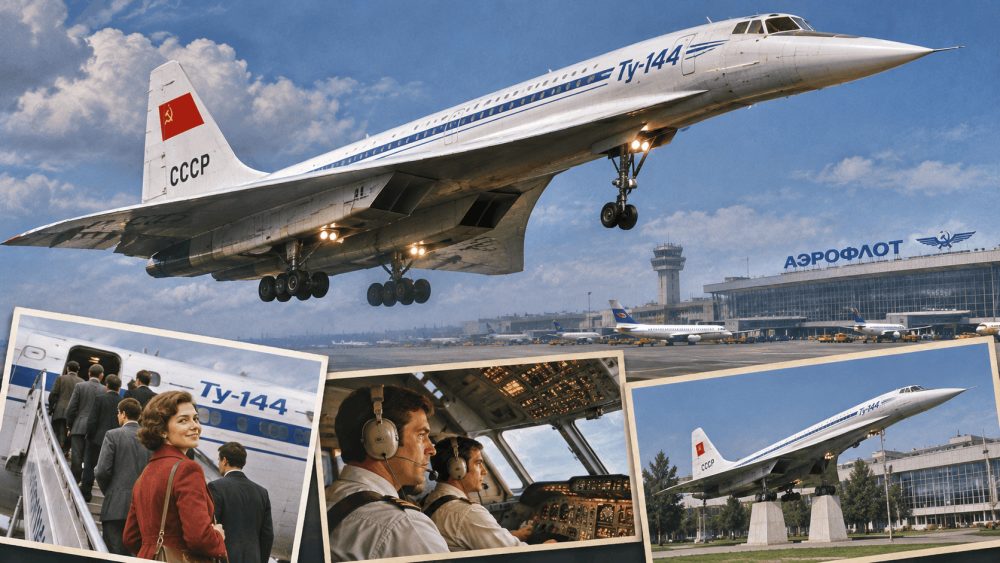
On 1 November 1977, the Tu-144 began carrying passengers between Moscow and Alma-Ata. Almost nine years separated that service from the prototype's first flight on 31 December 1968. The interval is central to the aircraft's history: getting a supersonic transport into the air and operating a passenger route were different achievements.
Passenger service ended in 1978, but flying did not immediately cease across the aircraft family. A later Tu-144D was eventually converted into a laboratory for a Russian-American research programme. Keeping those stages separate avoids assigning the laboratory's equipment or performance to the earlier airline aircraft.
Three milestones that should not be combined
Three dates provide the basic sequence:
- 31 December 1968: the prototype's first flight.
- December 1975: the beginning of operational cargo and mail services.
- 1 November 1977: passenger service between Moscow and Alma-Ata.
The first concerns flight testing, the second freight and mail, and the third passenger carriage. Calling all three the “start of service” removes the distinctions that explain the programme's development.
The Central Air Force Museum describes the December 1975 operational flight in its account of aircraft SSSR-77106. The phrase “supersonic passenger aircraft” identifies a type of machine; it does not by itself establish that paying passengers were aboard that particular operation. NASA's aviation history separately identifies December 1975 as the beginning of cargo and mail service.
This is a small linguistic distinction with a substantial historical consequence. An aircraft designed to carry passengers can perform trials, demonstration flights or freight work before passenger operations begin.
A domestic route rather than a worldwide network
NASA's Tu-144LL fact sheet confirms the opening of passenger service on 1 November 1977. Alma-Ata, now Almaty, was then a Soviet destination. The route was domestic, not transatlantic, and should not be confused with appearances at international air shows.
From a passenger's perspective, the purpose of supersonic travel was a shorter journey. For an airline, however, speed had to be supported by usable range, technical readiness, maintenance and the ability to repeat a scheduled operation. A successful high-speed test did not establish all those things at once.
NASA's historical volume on aeronautics states that two production aircraft served on the passenger routes. The overall number of Tu-144s built consequently cannot be used as the size of the passenger fleet. Some aircraft had other roles.
“Production aircraft,” “passenger transport” and “aircraft used in airline passenger service” are related descriptions, but they are not interchangeable. A precise account needs to say which one it means.
The end of passenger operations
The NASA fact sheet links the discontinuation of service in 1978 to limited range and other technical problems. Its more detailed aviation history discusses the termination following the crash of a new Tu-144D during a test flight. That accident was not a scheduled service carrying airline passengers.
Short chronologies can date an ending in different ways: the last completed flight, cancellation of the next flight or the formal withdrawal of service. The central point here is that the passenger route did not develop into sustained operations after 1978. It was a limited operational experience rather than a long-running network.
Flight totals also require definitions. Cargo, passenger and test flights cannot all be counted under a heading that implies passengers were aboard. A number without its counting method can create an impression of scale that the underlying record does not support.
Nor is speed alone an adequate measure of the commercial outcome. The history of an airliner includes the service it can maintain, not simply the performance it can demonstrate under test conditions.
Individual aircraft had different careers
SSSR-77106, preserved at the Central Air Force Museum, has a documented history of its own. It first flew on 4 March 1975 and arrived at Monino on 29 February 1980. The museum records 582 hours and 36 minutes of flight time, including 319 hours and 20 minutes at supersonic speed.
Those figures belong to one airframe. They are neither the total for the entire Tu-144 family nor a measurement of passenger service. Museum records are particularly useful for keeping such distinctions visible: a familiar outline does not establish what a particular aircraft actually did.
The same principle applies to photographs. A later research aircraft may illustrate the broader programme, but its appearance should not imply that the pictured configuration operated the Moscow passenger route in 1977.
From transport design to flying laboratory
The aircraft selected for the NASA-associated research programme was Tu-144D number 77114, built in 1981. According to the agency's fact sheet, it had never been used in commercial service. Before conversion, it had accumulated 82 hours and 40 minutes of flight time.
Conversion to the Tu-144LL laboratory involved more powerful NK-321 engines, a digital data-collection system and extensive instrumentation. Sensors measured temperatures, pressures, noise and other characteristics of a full-scale supersonic aircraft.
The first flight phase ran from June 1996 to February 1998 and comprised 19 research flights. A follow-on phase began in September 1998 and ended in April 1999. Operations took place from Zhukovsky near Moscow.
These flights allowed researchers to compare real aircraft behaviour with wind-tunnel results, computer methods and other tests. They did not represent a reopening of Tu-144 ticket sales. The aircraft's value in an experimental programme was a different question from its usefulness on an airline timetable.
Two outcomes and a later research role
The Tu-144 was both a major engineering programme and a brief passenger-service experiment. Those descriptions can coexist. The first flight demonstrates a design achievement; sustained airline operation has to be assessed through a different set of evidence.
The later laboratory adds another dimension. A design could remain useful for research after its original transport role had ended. The clearest history therefore follows specific variants, individual aircraft and assigned tasks. In that account, 1968, 1975, 1977 and the 1990s mark distinct stages, not one continuous period of passenger service.