Tu-104 in 1956: The First Scheduled Soviet Jet Service
How the Tu-104 entered service: its 1955 first flight, the Omsk stop, Vnukovo preparations, Prague flights and the earlier commercial debut of Comet.
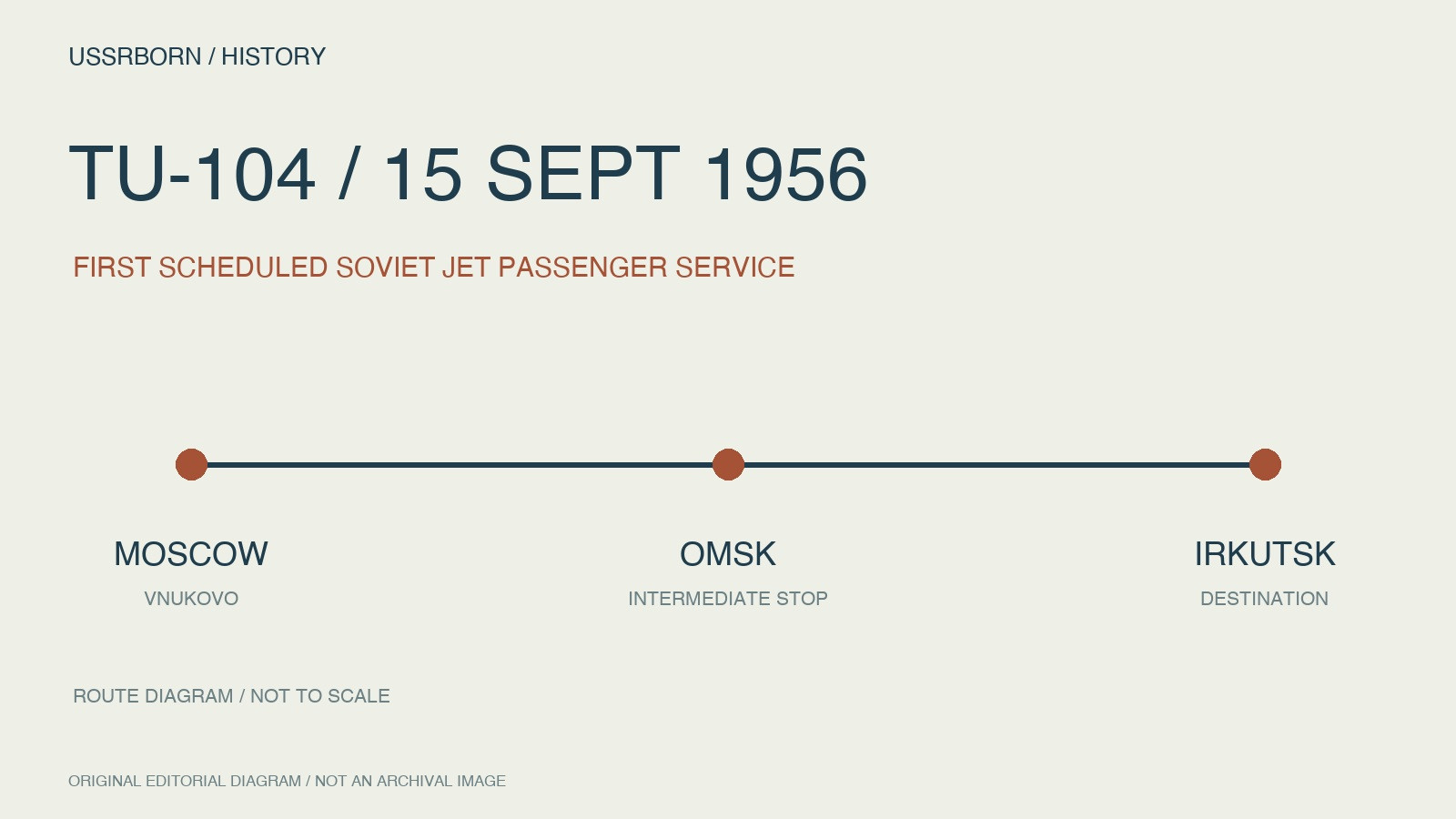
On 15 September 1956, the Tu-104 began scheduled passenger service from Moscow to Irkutsk, with an intermediate stop at Omsk. Soviet civil aviation had entered the era of scheduled jet transport. The aircraft's first flight, its entry into commercial service and the world's first passenger jet, however, belong to different timelines.
First in the Soviet Union, not first worldwide
Britain's de Havilland Comet carried its first fare-paying passengers on 2 May 1952. National Museums Scotland describes that commercial journey from London to Johannesburg, with several intermediate stops. Calling the Tu-104 the world's first passenger jet is therefore incorrect.
This distinction does not diminish the Soviet project's importance. Priority answers who came first. Operational history asks how a new technology became a working transport service. The latter question is particularly revealing for the Tu-104: an aircraft needed trained crews, ground support and suitable airports before it could function as a scheduled airliner.
From first flight to passenger service
The Tu-104 first flew on 17 June 1955, more than a year before its September 1956 service debut. A development flight tested an aircraft in the air. A regular route required repeated carriage of passengers, mail and freight.
The Antonov aviation museum's collection record identifies the project's origins in the Tu-16 bomber, its two turbojet engines and its pressurized cabin. Yet a passenger operation cannot be explained simply as seats added to a military aircraft. A cabin full of travellers, a timetable and routine servicing create their own operational requirements.
The distinction has parallels elsewhere in transport. The history of Soviet cars also extends beyond the first vehicle leaving a factory. Production, maintenance and organization stand between a completed machine and a functioning transport system.
Why Vnukovo mattered
According to the airport museum's chronology, Vnukovo began preparing to operate jet aircraft in 1955. The 200th flying detachment was established there in March 1956, with an engineering service within its organization. Such decisions are less visually striking than a new aircraft, but they connected development to everyday operations.
Rosaviatsiya's address marking the service debut's sixtieth anniversary describes operational trials at Vnukovo over several months in 1956. These examined the aircraft in the setting of its intended employment. A viable design and an airline ready to sustain a safe timetable are related achievements, but they are not identical.
The inaugural scheduled route
The flight left Moscow's Vnukovo airport for Irkutsk via Omsk. Rosaviatsiya gives 50 passengers and 7 hours 10 minutes of flying time. That last qualification matters. Flying time should not silently become total journey time, including the airport process and time spent on the ground.
Nor was the service nonstop. Omsk formed part of the route. Jet describes the propulsion system; it does not promise that an aircraft can cover every itinerary without intermediate landings.
The Vnukovo museum records an initial frequency of three flights a week. On 12 October 1956 the Tu-104 began scheduled international service between Moscow and Prague. These dates mark separate developments: a domestic route and an international operation. An overseas flight also says nothing by itself about an individual citizen's freedom to travel abroad; the history of Intourist addresses another part of that setting.
Speed was only one part of the service
Passengers experience a complete journey, rather than an isolated performance figure. High speed in the air is valuable when accompanied by suitable routes, manageable connections and dependable airport operations. A cruising-speed figure cannot be converted directly into a universal saving in travel time.
Capacity requires similar care. The Tu-104 family contained different cabin arrangements. The TASS historical dossier distinguishes the original 50-seat version from higher-capacity variants. Combining figures from several versions can produce an imaginary aircraft with specifications that never belonged together.
Transport investment operated within the Soviet planned economy, but assessing an individual airliner still requires route and operating evidence. A comparison with Chkalov's 1937 transpolar flight needs another distinction: an exceptional expedition and a repeatable passenger service solve different problems.
An achievement with a difficult operating history
The Tu-104's introduction was accompanied by serious safety problems. Vnukovo's chronology discusses the crash of 17 October 1958 and the information Captain Garold Kuznetsov transmitted about the aircraft's behaviour. Remembering the first scheduled service should not turn into a claim that the technology was flawless.
TASS dates the end of Aeroflot's operation of the type to 1979. That was not the disappearance of every Tu-104 flight. Aircraft used by other organizations and later transfers to museums belong to a different part of the chronology.
September 1956 matters because it brought a regular Soviet jet passenger service into operation. Keeping the experimental flight, scheduled route, international debut and later history distinct makes that achievement easier to understand. It also avoids using a single celebrated date as a substitute for the work required to run an airline.
The cover is an original route diagram, not a geographical scale drawing or an archival image.