Chkalov’s 1937 Transpolar Flight: Three Aviators and an American Landing
How the ANT-25 crew flew from Moscow to the USA: three distinct roles, Arctic conditions, the landing in Vancouver, Washington, and the memory of the flight.
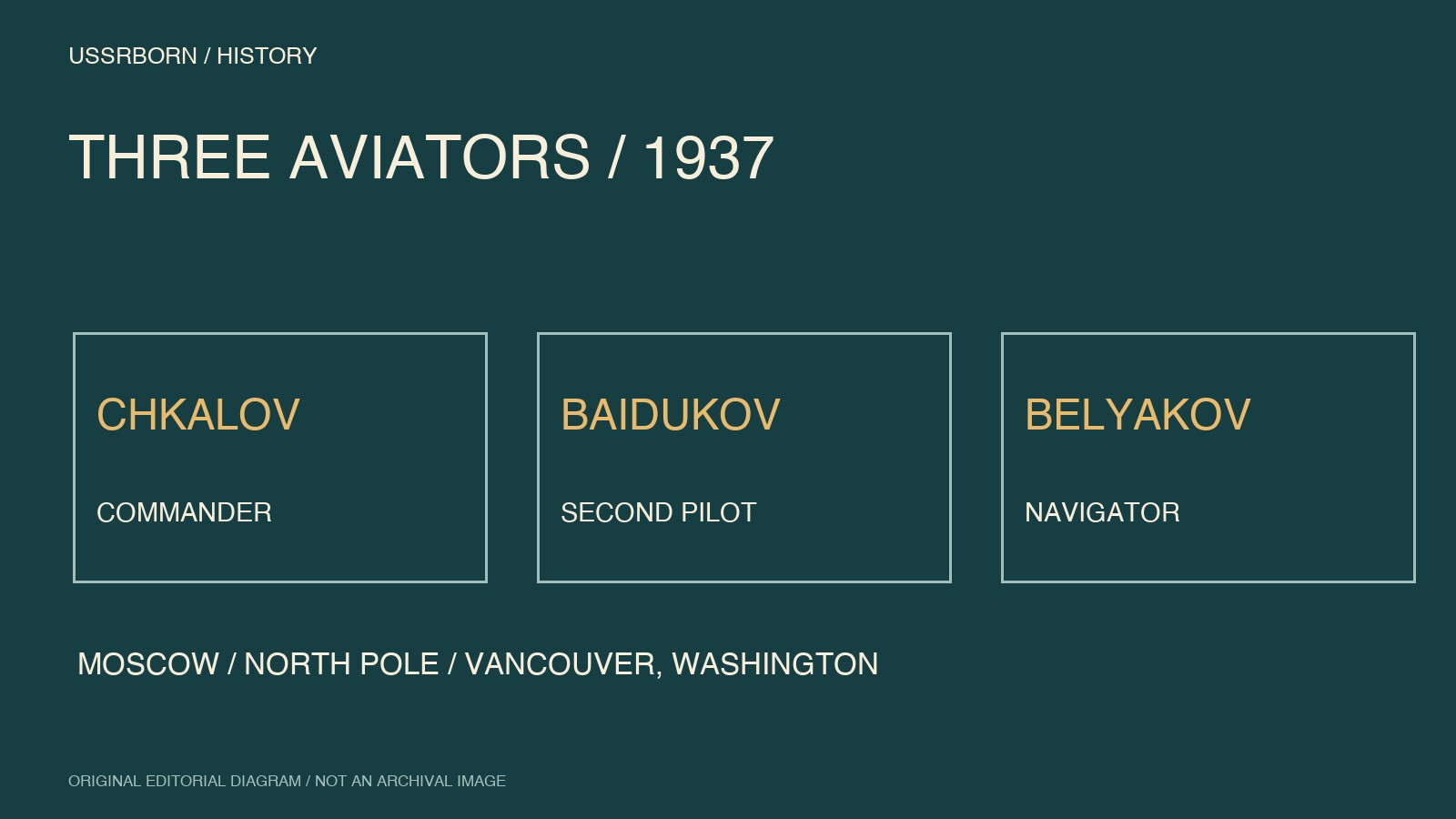
On 20 June 1937, a Soviet ANT-25 landed at Pearson Field in Vancouver, Washington. Valery Chkalov, Georgi Baidukov and Alexander Belyakov had flown from Moscow without an intermediate landing, following a route across the North Polar region. The familiar description of this as Chkalov's flight is convenient, but it can conceal the work of three people with distinct responsibilities and the geography of their unexpected destination.
The Vancouver in the United States
The aircraft landed in Vancouver in Washington State, beside the Columbia River and across from Portland. This was not the better-known Canadian Vancouver in British Columbia. The crew crossed Canada during the journey but completed it in the United States.
The Presidential Library catalog describes the navigator's log as a record of the first nonstop Moscow-North Pole-USA flight of 18-20 June 1937. That wording identifies the achievement more precisely than simply calling it the first flight over the North Pole. It concerns a particular intercontinental route, not the whole preceding history of Arctic flight and exploration.
The distinction also changes how the arrival is imagined. The flight did not conclude in a major Canadian Pacific port. It reached an airfield beside an American military post, where the crew's appearance became an immediate local event. Place names are part of the evidence, not merely a decorative detail in the story.
Three responsibilities on board
Chkalov was the crew's commander and a pilot. Baidukov, the second pilot, brought test-flying experience and expertise in instrument flight. Belyakov was the navigator, responsible for calculations and keeping the aircraft on its intended route. Naming all three makes the operation easier to understand: flying the machine and determining where it was were related but different tasks.
The National Park Service's detailed account emphasizes Baidukov's ability to fly without visual references and Belyakov's role in navigation over unfamiliar territory. Chkalov and Baidukov took turns at the controls. Rest had to fit around the work, including the navigator's continuing responsibility for the aircraft's position.
There is a useful comparison with Sergei Korolev's biography. A famous name can become shorthand for a technical undertaking supported by many complementary skills. Recognizing that division of work does not diminish the individual. It identifies what the person contributed and what depended on others.
Preparation before the polar journey
The ANT-25 was a long-distance aircraft. The National Park Service describes a single-engine machine with a very large wingspan and substantial fuel capacity. The crew also brought shared experience: in 1936 the same three aviators had completed a long flight to Udd Island in the Soviet Far East.
The 1937 undertaking posed a different geographical challenge. They had to cross the Arctic and emerge over North America. Such an achievement carried political importance, but prestige should not replace an account of the practical task. The journey still depended on weather, fuel, navigation and the physical condition of the people in the aircraft.
The era offered different ways of presenting national achievement. VDNKh later became one prominent exhibition setting. A long-distance flight presented a result in another form: the aircraft appeared at an airfield outside the Soviet Union, where foreign observers could see it and meet its crew.
Weather was part of the route
The detailed American museum account identifies icing, cold, poor visibility and the demand for oxygen at altitude as major difficulties. Avoiding adverse weather affected fuel use. Radio contact was available, but reception was not consistently reliable throughout the journey.
A route drawn across the pole on a map should therefore not be mistaken for a perfectly straight track followed without adjustment. The planned course and the path flown through actual weather are different things. The navigator's log is valuable because it belongs to the work of calculation during the flight, rather than only to celebrations after its completion.
The Presidential Library and the National Park Service's detailed narrative give a duration of 63 hours and sixteen minutes. Shorter popular summaries contain different approximations and even a different departure date. This account follows the 18-20 June dates in the log's bibliographic description and the matching duration in the two detailed institutional accounts.
That choice also illustrates how historical precision works. Several pages from reputable institutions can repeat a story at different levels of detail. Where their wording differs, the appropriate response is to identify the discrepancy and prefer a clearly documented basis, rather than combine every detail into a seamless but contradictory narrative.
Why Pearson Field became the destination
The crew had intended to reach Oakland, California, but ended the journey farther north. The National Park Service's extended history links the return toward Portland to a dangerously low fuel supply. Its shorter monument entry gives a different immediate explanation for the landing. It would therefore be unwise to present one particular mechanical failure as an uncontested explanation.
What is securely established is the arrival at Pearson Field on 20 June and the welcome by George C. Marshall, commander of Vancouver Barracks. Journalists and local spectators soon became part of the event. The flight was no longer only a technical undertaking: the exhausted aviators were now people whom an American community could meet.
These encounters did not establish that political differences between the countries had disappeared. They can nevertheless be compared with later occasions for international contact, such as the 1957 Moscow Youth Festival, while keeping the circumstances of the two periods distinct. A meeting between people and a lasting agreement between governments are different kinds of historical event.
A local memory that endured
A monument to the flight was unveiled in Vancouver in 1975. Baidukov and Belyakov attended. Chkalov, who had died during a test flight in 1938, was represented by his children. The ceremony connected the history of the airfield with the lives of the men who had arrived there unexpectedly almost four decades earlier.
The flight can consequently be understood on several levels at once: as a technical test, as the coordinated work of a crew and as an international encounter. That combination differs from the familiar accounts of superpower confrontation during the Cold War. At the center of the 1937 episode remain three identifiable people, one aircraft and a precisely located airfield on the American side of the Pacific region.
Sources
- US National Park Service: A Red Bolt from the Blue, a detailed history of the flight.
- US National Park Service: the Chkalov Transpolar Flight Monument in Vancouver.
- Presidential Library: Chkalov's 120th anniversary, the navigator's log and the flight duration.
- Presidential Library: catalog description of the facsimile navigator's log for aircraft No. 025.