Nikolay Semenov: Chain Reactions and the 1956 Nobel Prize
Understand Nikolay Semenov’s 1956 Chemistry Nobel: chain propagation, branching, termination, thermal feedback and the work of his research school.
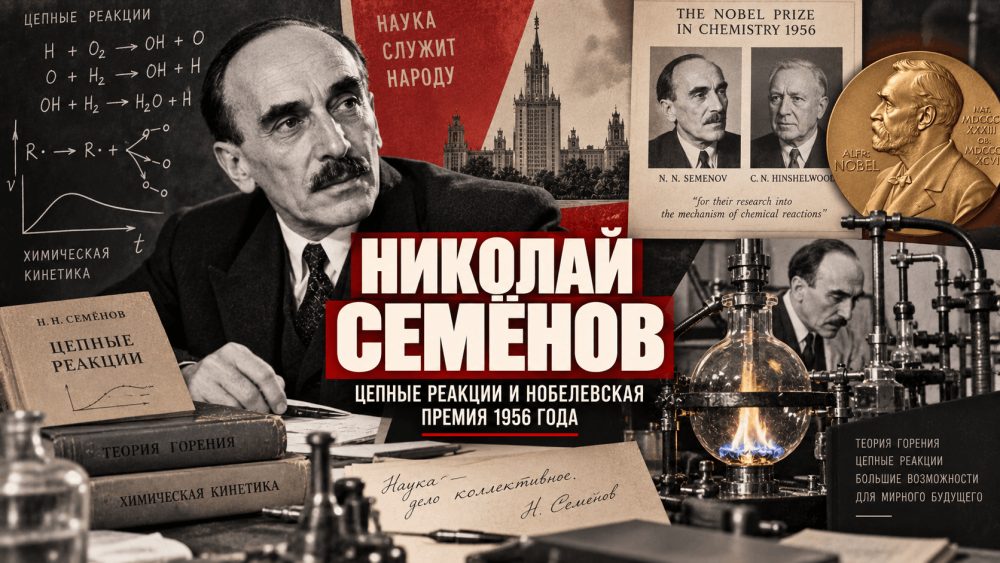
Why can a chemical mixture remain comparatively quiet under one set of conditions and react very rapidly under another? Answering that question requires more than naming the initial substances and the final product. It requires an account of the intermediate steps. Nikolay Semenov studied these mechanisms. In 1956 he shared the Nobel Prize in Chemistry with the British researcher Cyril Hinshelwood for work on how chemical reactions proceed.
What the prize recognised
The award belongs to the history of chemical kinetics, the study of reaction rates and pathways. One of Semenov's central contributions was the development of chain-reaction theory and its comparison with experiments. The Nobel Prize's account identifies phosphorus reacting with oxygen and hydrogen reacting with oxygen among the systems used to test the theory.
This was not a prize for inventing a single substance. The achievement was an ability to explain a class of phenomena. A reaction equation can identify what becomes what without revealing how rapidly the change will happen, which intermediate steps it will involve or under what conditions it might accelerate sharply.
That gap between an overall equation and an actual process is where the scientific problem begins. A list of ingredients and products does not yet amount to a working explanation of the transition between them.
What makes a reaction a chain
Imagine a process in which an intermediate particle reacts and produces another active participant. That participant can continue the sequence. The particles themselves may change, but the ability to trigger a further step is passed along. In chemistry, atoms and free radicals can act as these carriers.
Three situations help organise the explanation:
- Initiation creates participants capable of starting a chain.
- Propagation allows one step to supply the active participant for another.
- Termination removes an active participant without a replacement that can continue the sequence.
Branching occurs when the number of active participants increases. An everyday analogy is passing on a message. One person may tell a single successor, or tell several people who can each repeat it. The second arrangement can expand much faster. The analogy describes the structure of the sequence only: molecules have no intentions, and their behaviour follows physical laws.
The cover uses dots and lines to illustrate this distinction. It is an original educational diagram, not a depiction of a particular molecule or an equation for a specific reaction.
Why the vessel can matter
The 1956 presentation speech describes a historical puzzle arising from experiments by Yuly Khariton and Zinaida Valta in 1926. Observations of phosphorus and oxygen did not fit a simple expectation that more reactant should always mean a more vigorous process. Semenov investigated the findings and connected the behaviour with a chain mechanism.
Competing processes are central to this account: active particles are created, but they are also lost. The walls of a vessel can help terminate chains. A container therefore cannot always be treated as passive packaging, with its dimensions dismissed as an irrelevant detail.
This shows why a theory matters. An explanation based only on the names of the substances cannot account for changes caused by experimental conditions. A quantitative model must connect an observed result to a mechanism and make a prediction that can be tested. Moving between calculation and experiment is more informative than merely cataloguing the transformations that happen to occur.
It also explains why an unexpected result is not automatically a failed experiment. The difficult task is to determine whether the observation reflects an error or a weakness in the existing explanation. A reproducible anomaly can become evidence that the model needs to change.
Branching and heat accumulation
A different route to acceleration involves heat. Energy released during a reaction can raise the temperature, which under suitable conditions increases the reaction rate and releases heat still faster. The Institute of Chemical Physics's biographical account describes Semenov's work on thermal explosion, when heat removal cannot keep pace with heat generation.
Chain branching and thermal feedback should not be collapsed into one explanation. The first focuses on the production and loss of active particles; the second on the heat balance. They may interact in a real process. But saying that a mixture accelerated because it became hotter does not, on its own, establish the chemical mechanism.
The practical significance does not require a laboratory demonstration. Obtaining a transformation is only part of the problem; understanding its progress over time is also essential to controlling it. The Nobel award recognised fundamental research, not a universal recipe for the behaviour of every combustible mixture.
A scientist and a research institution
Semenov graduated from Petrograd University in 1917. He became director of the Institute of Chemical Physics in 1931 and a professor at Moscow University in 1944. His Nobel biography highlights books on kinetics and chain reactions published in 1934 and 1954.
Those dates reveal how much work preceded the award. The short label of 1956 laureate stands for a long research programme, the training of specialists and repeated tests of explanations. A director's biography should not hide the contributions of colleagues and predecessors. Chain-mechanism ideas existed before Semenov, and the prize itself was shared with Hinshelwood.
Comparing different scientific questions is more useful than treating every Nobel award as interchangeable. The work of Lev Landau, Pyotr Kapitsa and Leonid Kantorovich concerned distinct problems. A common honour does not imply a common subject or a single method of discovery.
Chemical chains are not nuclear chains
The word chain describes a sequence in which one stage supports another. It appears in both chemistry and nuclear physics, but that shared word does not make the underlying processes identical. Chemical change concerns molecular composition and bonding; nuclear change concerns atomic nuclei.
Semenov's institutional history nevertheless did include the Soviet atomic project. The Russian Academy of Sciences records that his institute received assignments in 1946 involving calculations and research for nuclear weapons. Leaving that out of a discussion of the connection would be misleading. It does not, however, mean that his chemistry Nobel was awarded for building an atomic bomb. For another part of the history of nuclear science and its public consequences, see Andrei Sakharov.
Common questions
Who shared the prize with Semenov? Cyril Hinshelwood. Both received the 1956 Nobel Prize in Chemistry.
Does every chain reaction end in an explosion? No. A chain mechanism by itself does not establish the speed or final behaviour of a process. Conditions and competition between individual steps matter.
Did Semenov originate the entire idea alone? No. His contribution lies in developing and testing the theory within a history that also includes predecessors, colleagues and his own research school.