Lev Landau: Why Quantum Liquids Won the 1962 Nobel Prize
Why did Lev Landau win the 1962 Nobel Prize? A clear guide to liquid helium, superfluidity, quasiparticles and the documents behind his scientific recognition.
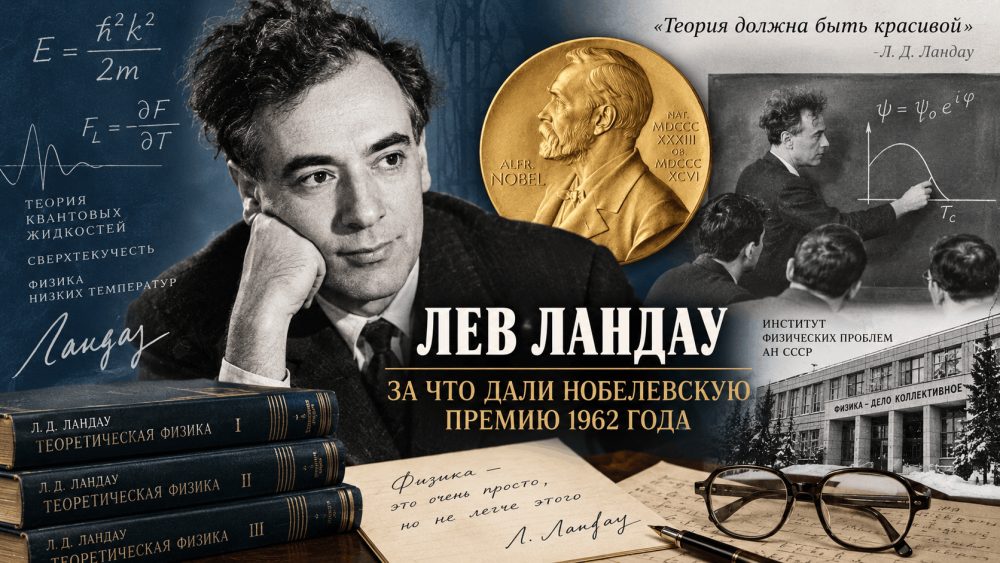
Lev Landau received the 1962 Nobel Prize in Physics for theories of condensed matter, particularly liquid helium. Behind that short description lies a difficult question: how can a liquid be understood when its behaviour at very low temperatures no longer fits everyday expectations about flow?
Landau's contribution was not simply a name for an unusual effect. His work helped make the properties of quantum liquids calculable and connect theoretical descriptions with measurements. The prize therefore offers a way into the distinction between observing a phenomenon and explaining it.
What the prize recognised
The official award description extends beyond one paper on superfluidity. Condensed matter includes, in particular, solids and liquids, where large numbers of interacting particles form a system. Listing the individual atoms is not by itself a convenient explanation of the system's behaviour.
Landau was the sole recipient of the physics prize that year. A prize awarded to one person nevertheless does not imply that one person carried out every aspect of the research. Experimental discovery, theoretical explanation and subsequent testing are distinct contributions that depend on one another.
This matters when reading accounts that compress a scientific history into the name of a laureate. The award identifies a contribution; it does not replace the surrounding history of the field.
What was unusual about helium?
At sufficiently low temperature, helium-4 enters a superfluid state. The 1962 presentation speech described its ability to pass through extremely narrow channels that strongly resist the flow of ordinary liquids.
The term should not be read as a claim about a magical fluid capable of doing unlimited work. It describes a physical state and particular conditions of motion. Superfluidity does not abolish conservation of energy.
Temperature is another potential source of confusion. A few degrees above absolute zero refers to a very different range from a few degrees above zero Celsius. Kelvin is especially useful here because its scale begins at absolute zero. That distinction conveys more about the experimental setting than an adjective such as extraordinarily cold.
A popular explanation must therefore preserve the conditions of a phenomenon, even when it leaves out the equations. Removing those conditions can turn a striking but precise result into a misleading claim.
Understanding a quasiparticle
A central element of Landau's approach was to describe excitations of the liquid as a whole through quasiparticles. These are not chemical impurities added to the helium, or tiny mechanical balls that could be separated from the liquid and collected.
A wave on water provides a limited analogy. We can follow the wave's movement without treating it as a permanent lump made from exactly the same molecules throughout its journey. The analogy does not reproduce quantum mechanics. It simply separates a collective pattern of motion from the identity of an individual particle.
The scientific value of this language comes from its consequences. A new name alone explains little. A theory must assign properties to the excitations and show how those properties connect with observations.
That is why a theoretical object need not be an isolated object visible in a photograph to be useful. Its role depends on whether the description produces reliable, testable accounts of the system being studied.
Helium-4 and helium-3 were different problems
The Nobel biography distinguishes work on Bose-type quantum liquids, including helium-4, from the Fermi-liquid theory developed in 1956-1958. Isotopes of the same element differ in nuclear mass and can have substantially different quantum properties.
The phrase theory of liquid helium should consequently not be understood as a single short explanation that applies identically to every isotope and temperature. The substance, conditions and state all matter.
This distinction also shows why the research cannot be reduced to one paper followed by a final answer. A broad scientific achievement may involve several descriptions, each with its own range of application. Identifying the limits of a model is part of explaining it, rather than a reason to dismiss it.
A career across several scientific centres
Landau was born in Baku in 1908. After graduating from Leningrad University, he worked at its physicotechnical institute. He spent 1929-1931 abroad, including time with Niels Bohr in Copenhagen, then led theoretical work in Kharkiv before moving to Moscow's Institute for Physical Problems in 1937.
His name is also associated with the Course of Theoretical Physics written with Evgeny Lifshitz. Textbook writing represents another form of scientific influence: organising methods so that later researchers can learn to tackle problems beyond the authors' own investigations.
The Nobel biography was prepared at the time of the award. It is useful for tracing scientific appointments and research directions, but it is not a complete life history. An official career summary and a full biography have different purposes and scopes.
Why the award was received in Moscow
A serious car accident early in 1962 left Landau unable to travel to the Stockholm ceremony. The presentation speech explained his absence and stated that the Swedish ambassador was handing him the prize in Moscow.
The coincidence of the accident and award does not establish that the decision was an act of sympathy. Mats Larsson and Alexander Balatsky's study of the Nobel archive examines the scientific arguments in nomination documents, including those associated with Heisenberg and Pellam. They explicitly leave uncertainty about the accident's influence on the deliberations.
This is a useful example of a historical limit. Knowing that one event preceded another is not the same as knowing why a decision was made. Where the documents do not settle the question, preserving the uncertainty is more accurate than supplying a dramatic motive.
Four sources, four different questions
The laureate's official facts page identifies the award and its stated reason. The biography outlines a career. The ceremony speech explains the work's significance as presented to contemporary listeners. Research into nomination records investigates the process of recognition.
Together, they show a theorist whose contribution included a language for collective excitations and quantum liquids. That contribution is difficult to capture in a single spectacular experiment, because part of the result was a way of formulating further questions.
Related reading
- Andrei Sakharov, a different scientific and public biography of a Soviet physicist.
- Nikolai Vavilov, on research, a scientific school and preserving material for future investigation.
- Sergei Korolev, for a different kind of scientific and technical work centred on engineering programmes.
- Pasternak and the 1958 Nobel Prize, a history of international recognition in literature.
Sources
- NobelPrize.org: Lev Landau, Facts, for the date, award description and prize share.
- NobelPrize.org: Lev Landau, Biographical, a career account prepared at the time of the award.
- The 1962 Nobel presentation speech, for the scientific explanation and circumstances of presentation.
- Mats Larsson and A. V. Balatsky: Landau's Nobel Prize in Physics, a 2016 study of Nobel archive documents.
The cover is an original abstract diagram of collective motion, not an experimental photograph or a quantitative scientific graph.