Lidiya Skoblikova: Six Olympic Gold Medals in 1960 and 1964
How Lidiya Skoblikova won two races at Squaw Valley and all four at Innsbruck: dates, times, rivals and the details behind six Olympic titles.
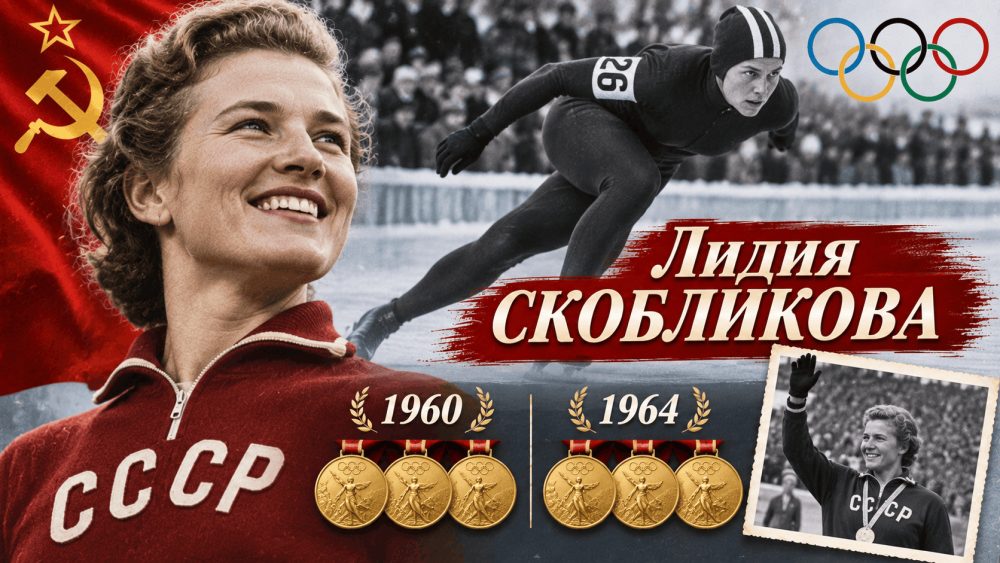
Lidiya Skoblikova won six Olympic gold medals in speed skating: two at Squaw Valley in 1960 and four at Innsbruck in 1964. The Austrian series is particularly remarkable because she won every women's distance on the Olympic programme at those Games.
These were separate events over 500, 1,000, 1,500 and 3,000 metres, each awarding its own medal. They should not be described as a single prize for a combined all-around score.
Two golds at Squaw Valley
Skoblikova was born on 8 March 1939 in Zlatoust. In 1960, when women's speed skating entered the Winter Olympic programme, she won the 1,500 and 3,000 metres. She finished fourth over 1,000 metres.
The 1,500-metre result is especially revealing. On 21 February, Skoblikova covered the distance in 2 minutes 25.2 seconds, setting a world record. Poland's Elwira Seroczynska took silver in 2:25.7, while her compatriot Helena Pilejczyk won bronze in 2:27.1. Only half a second separated first and second place.
This began an Olympic tally that would grow from two victories to six four years later.
Innsbruck: four starts, four wins
In 1964, the women's events took place on four successive days. Skoblikova's results were:
- 30 January, 500 metres: 45.0 seconds.
- 31 January, 1,500 metres: 2:22.6.
- 1 February, 1,000 metres: 1:33.2.
- 2 February, 3,000 metres: 5:14.9.
She set Olympic records in the first three events. Her final victory did not produce another Olympic record: her own 1960 time of 5:14.3 over 3,000 metres remained faster.
How the sprint victories unfolded
Over 500 metres, Irina Yegorova established a benchmark of 45.4 seconds in the first pair. Skoblikova skated in the thirteenth pair and lowered that time to 45.0. Tatyana Sidorova placed third in 45.5, giving Soviet skaters all three medals.
Yegorova again took silver over 1,000 metres. Her 1:34.3 was 1.1 seconds slower than Skoblikova's winning time. Finland's Kaija Mustonen won bronze in 1:34.8. Skoblikova had actually been slower than Yegorova at the intermediate 200- and 600-metre marks. The complete distance decided the result, not the quickest opening section.
The final distance and an unusual podium
Skoblikova finished the 3,000 metres in 5:14.9. Valentina Stenina and North Korea's Han Pil-hwa shared second place, both recording 5:18.5. The results therefore show two silver medals, while Klara Nesterova's 5:22.5 placed her fourth.
This illustrates why medal outcomes should be checked against the results rather than reconstructed from the familiar gold-silver-bronze pattern. Skoblikova's four victories encompassed both a short sprint and the longest women's Olympic distance available at the time.
Her achievement combined two qualities: consistency over four consecutive competition days and versatility across different distances. The complete set of Innsbruck victories, added to her two Squaw Valley titles, explains the celebrated total of six Olympic gold medals.