Olga Korbut: Six Olympic Medals and the Memory of Munich 1972
Which medals Olga Korbut won in Munich and Montreal, why she was not an all-around champion and how to distinguish her results from sporting legend.
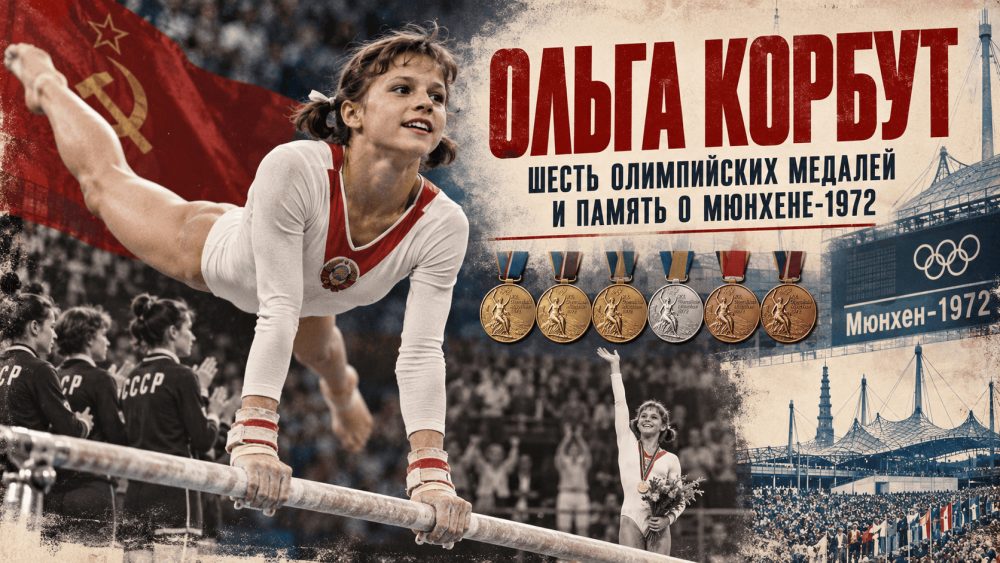
Olga Korbut became one of the most recognisable gymnasts of the 1972 Olympics. Her fame, however, can obscure the precise competitive record. Across two Games she won six medals: four gold and two silver. She was not an Olympic individual all-around champion. How do these facts fit together, and why are her performances still remembered?
An Olympic debut at seventeen
Korbut was born on 16 May 1955 in Grodno, in the Byelorussian Soviet Socialist Republic. She was seventeen at the Munich Games. Olympedia records seventh place in the individual all-around in 1972 and fifth in that event at the next Olympics, in Montreal.
Those placings do not contradict her status as a multiple Olympic champion. Artistic gymnastics awards several sets of medals. A team victory, a result on an individual apparatus and the individual all-around title are different achievements. Calling someone a “champion” without naming the event does not explain which competition she won.
Six medals, separated by event
The International Gymnastics Hall of Fame records Korbut’s Olympic collection as follows:
- Munich 1972: gold in the team competition, balance beam and floor exercise; silver on uneven bars.
- Montreal 1976: gold in the team competition and silver on balance beam.
That makes three golds and one silver in 1972, followed by one gold and one silver in 1976. A team medal belongs in a participating athlete’s Olympic record even though it is won collectively. Removing team medals produces a different statistic, which needs to be labelled explicitly.
Korbut became the first inductee into the International Gymnastics Hall of Fame in 1988. That honour belongs to the history of her reputation; it is not an additional Olympic medal. Combining Games medals and later distinctions into a single tally would mix awards made for different purposes.
The cleanest way to describe a sporting record is therefore to keep three questions separate: what was the competition, what was the event and what was the result? The approach may look less dramatic than a sweeping superlative, but it lets readers understand the achievement rather than merely admire a number.
Why public memory differs from the standings
A results table answers a narrow and essential question: who finished where? Audience memory works differently. It may preserve a movement, a way of performing or an emotional moment even when that episode did not produce a gold medal. Recognition cannot be calculated simply by adding points or awards.
With Korbut, it is particularly useful to distinguish documented results from interpretations of her influence. The former can be checked against the competition record. The latter needs an explanation of what is being assessed: technical novelty, audience attention, later recognition or a spectator’s personal response. Saying that she “beat everyone” does not provide that explanation.
The career of Larisa Latynina, winner of eighteen Olympic medals, offers a useful comparison. Medal totals can illuminate differences between careers. They do not create a universal scale for artistic impact or historical fame. A comparison becomes more informative when it states its criterion instead of treating every kind of distinction as interchangeable.
Two different acrobatic stories
The biography on Korbut’s own website describes elements shown at the 1969 Soviet championships: a backward somersault on beam and a backward release-and-recatch movement on bars. This is the athlete’s presentation of her own career and should be distinguished from an independent competition record.
The important point is not to merge beam and bars. Even when a popular retelling attaches the same surname and the word “somersault” to both, they involve different apparatus and movements. A short video alone cannot reliably establish the date, stage of competition and complete result of a performance.
Historical description is also different from an instruction for attempting a skill. Understanding an athlete’s contribution does not require turning a biography into a training guide. It requires identifying the event and the source clearly. Claims about whether an element is permitted under present rules would need a separate check of the applicable regulations, not an assumption based on an old recording.
Revisiting Munich half a century later
In 2022, the Olympic Channel released the four-part documentary project “72 - A Gathering of Champions.” IOC materials introducing the production describe Olympians revisiting Munich; Korbut was among its subjects. This is an example of a sporting event becoming a subject of remembrance decades after the competition itself.
A later interview and a results sheet perform different jobs. The sheet preserves a competitive outcome. Recollection helps explain the meaning a person gives to an experience. Reading them together is more productive than asking one to replace the other.
The Munich Olympics contained many distinct stories, including the USSR-USA basketball final. A shared year and national team connect those accounts without making them a single event. For a broader chronology of Soviet participation, the USSR’s Olympic debut at Helsinki in 1952 provides another starting point.
An Olympic biography also concerns elite competition. The GTO mass fitness programme opens a different part of physical-culture history. Keeping those levels separate matters: the exceptional career of one gymnast is not a direct statistical measure of exercise or sport across an entire population.
Korbut’s documented record needs no invented all-around title to make it significant. Four Olympic golds and two silvers describe a substantial achievement. Naming the events precisely makes the biography easier to understand while leaving room to explore why a particular athlete remained memorable beyond the medal table.