The USSR-USA Basketball Final in Munich 1972: 51-50 and Three Seconds
How the 1972 USSR-USA Olympic basketball final ended: Edeshko’s pass, the two Belovs, repeated inbound plays, the protest and the official 51-50 result.
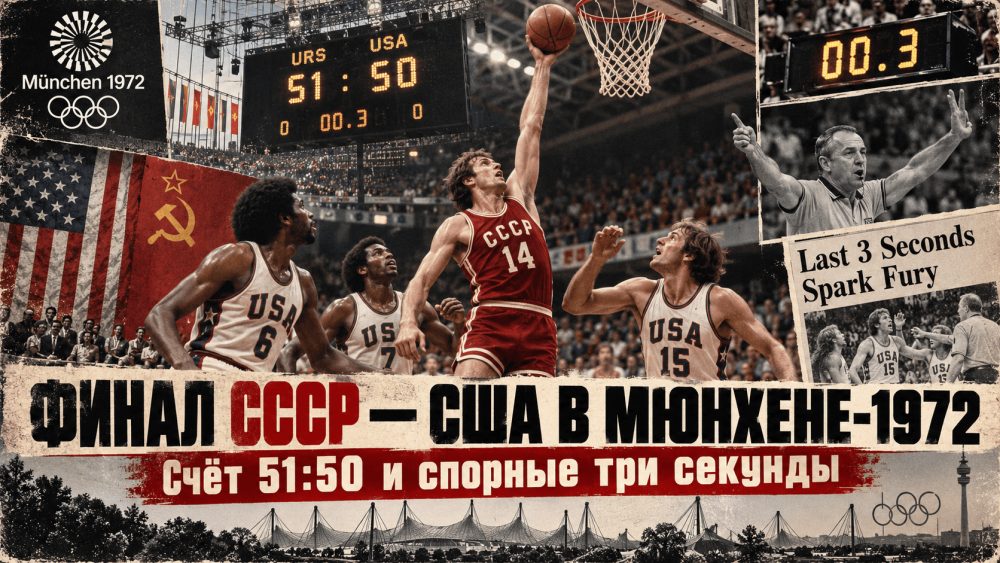
The Soviet Union won the 1972 men’s Olympic basketball final against the United States, 51-50. Alexander Belov scored the winning basket after a long pass from Ivan Edeshko. The Munich game is remembered for more than that finish: stoppages and repeated inbound plays preceded it, and the American side disputed the result.
Two facts need to remain in view together. The official victory stayed with the USSR. The decisions that allowed the closing sequence to unfold that way produced a serious controversy. An account confined either to the successful play or to the protest leaves out an essential part of the event.
The route to the final
Olympedia’s tables record seven Soviet wins in the preliminary group, followed by a 67-61 semi-final victory over Cuba. The United States beat Italy 68-38 in its semi-final. The final is dated 9 September 1972.
Vladimir Kondrashin coached the Soviet team, while Henry, or Hank, Iba coached the Americans. The final classification awarded gold to the USSR, silver to the United States and bronze to Cuba. The American players’ refusal to accept their medals did not remove their official second place.
Munich belonged to an established history of Soviet Olympic participation, following the country’s Summer Games debut in Helsinki in 1952. The 1972 victory was an achievement by a particular team in a particular tournament, not the country’s sudden arrival in international sport.
The closing seconds
FIBA’s overview identifies the starting situation: two successful Doug Collins free throws put the United States ahead 50-49 with three seconds remaining. The Soviets subsequently had three opportunities to inbound the ball. On the final one, Edeshko passed towards the far basket, Alexander Belov caught the ball and scored, making it 51-50.
The arithmetic is straightforward. A one-point deficit became a one-point advantage. The difficulty lies in the sequence of stoppages between the free throws and the final attack.
FIBA’s longer account of Sergei Belov describes a dispute about a Soviet timeout request and a clock-setting problem before a repeated inbound play. FIBA Secretary General William Jones intervened. Decisions about the stoppage, time remaining and renewed play lay at the centre of the conflict.
“Three seconds” therefore does not mean three seconds of uninterrupted television footage. Playing time and the actual time taken to resolve a disagreement are different quantities. Nor should the number of inbound plays be turned into a claim that three fully independent endings occurred with identically set clocks.
A careful account needs the sequence as well as the final score. Otherwise a summary can make the ending seem either entirely routine or impossible to understand, when the specific issue is how the game was stopped and restarted.
Two Belovs, different contributions
Sergei Belov and Alexander Belov were separate players and were not related. FIBA credits Sergei with 20 points in the final. Alexander made the decisive basket from Edeshko’s pass.
The distinction prevents the entire game from collapsing into one familiar surname. Many possessions create a final score, even when the last possession dominates memory. Sustained scoring throughout a contest and successful execution at its conclusion matter in different ways.
To analyse the final move itself, it helps to distinguish the pass, reception and finish. A long pass does not score by itself. Catching without losing control creates the possibility of a shot; completing that shot changes the score. This explains the sporting demands of the move without settling questions about the procedure that preceded it.
A technically impressive play and a disputed restart can coexist in the same historical event. Recognising one does not require denying the other.
Protest and the official outcome
FIBA’s historical overview records an American protest and confirmation of the 51-50 result. Olympedia records the players’ refusal to accept silver medals.
Neither point makes the controversy imaginary, and neither erases the official outcome. A competition record and its participants’ responses are different kinds of evidence. They can disagree while both remaining necessary to the story.
The Cold War provides context for the attention given to a Soviet-American final. Political tension, however, is not by itself proof of a secret arrangement. Such allegations need independent, verifiable evidence rather than an emotional judgement about officiating.
The useful distinction is between describing what was officially decided and endorsing every action that led to it. Historical reporting can establish the former while clearly acknowledging disagreement about the latter.
Munich beyond basketball
The Australian Olympic Committee’s account recalls the Games’ tragic setting: the attack on the Israeli delegation on 5 September led to the deaths of athletes and officials, and competition was suspended. The basketball final cannot serve as a complete account of that Olympics.
Within sporting history, it nevertheless became a distinct landmark. Comparisons with other team sports, including Soviet hockey, can help broaden the discussion without assuming that different national teams succeeded for one universal reason.
Sergei Belov later lit the Olympic flame at the 1980 Moscow Games. That connection is a reminder that an athlete’s career continues beyond a single celebrated contest.
Sporting memory often compresses a long career or tournament into a few seconds. Restoring the other players, earlier matches and institutional decisions makes those seconds easier to understand, rather than diminishing their importance.
Questions about the final
Who scored the winner? Alexander Belov, from Ivan Edeshko’s pass.
Who scored 20 points? Sergei Belov, a different player on the Soviet team.
Why is the ending disputed? Because of the stoppages, restoration of time and repeated inbound plays in the closing sequence.
What is the official result? A 51-50 Soviet victory. The American protest did not change it; the US players refused to accept their silver medals.