The Soviet Olympic Debut in 1952: First Gold and 71 Medals
Explore the Soviet Olympic debut at Helsinki 1952: Nina Romashkova’s first gold, 71 medals, Otaniemi accommodation and how to interpret the results.
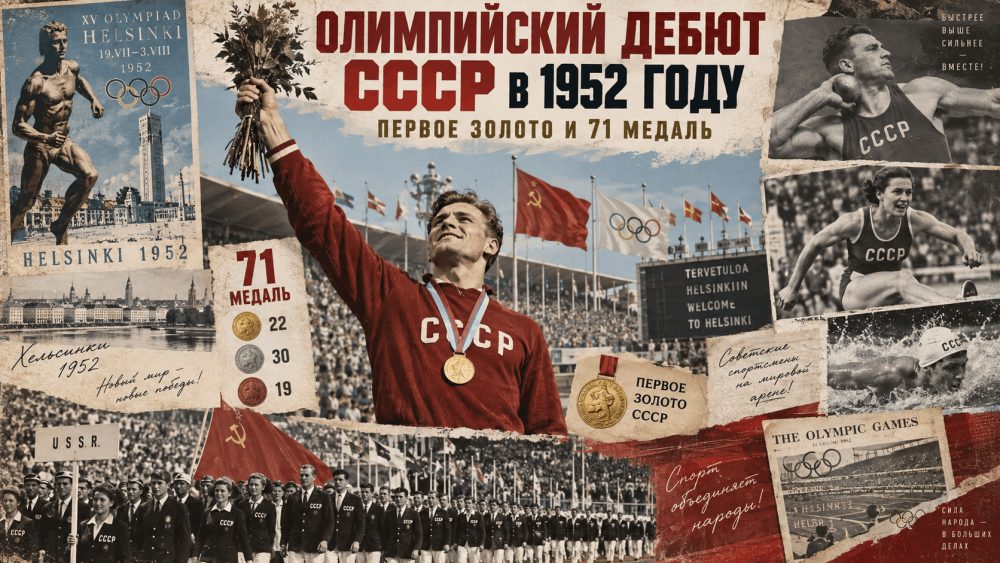
The Soviet Union made its Olympic debut at Helsinki in the summer of 1952 and immediately finished second in the medal table. Its tally was 22 gold, 30 silver and 19 bronze medals, or 71 altogether. The importance of that appearance went beyond the total. Soviet athletes entered a competition in which their performances could be compared with those of their rivals on the same track, on the same platform and in the same results sheet.
What began in Helsinki
The Games of the XV Olympiad ran from 19 July to 3 August 1952. They marked the arrival of the Soviet Union, not the beginning of every Olympic connection with Russia. The Russian Empire had participated before the revolution. Treating the two states as interchangeable removes a meaningful distinction from the historical record.
Nor does an Olympic debut necessarily mean that athletes had never competed abroad. Olympic participation is a particular form of international competition. What was new here was the appearance of the USSR at the Summer Games, with their shared programme, ceremonies and opportunities to compare performances across many disciplines.
The delegation represented a multinational union. A competitor's result was recorded under the Soviet team designation. The later location of an athlete's birthplace within a different independent state does not alter that entry. Personal background and the team represented are both worth understanding, but they answer different questions.
The first gold and a discus sweep
On 20 July, Nina Romashkova won the women's discus throw and became the Soviet team's first Olympic gold medallist. Later known as Nina Ponomaryova, she appears under different versions of her surname in historical records. These names refer to the same competitor, not to two athletes who shared an achievement.
The final's results show exactly how the event ended. Romashkova threw 51.42 metres in the third round, an Olympic record. Yelizaveta Bagryantseva took silver with 47.08 metres, while Nino Dumbadze won bronze with 46.29. The Soviet competitors occupied all three places on the podium.
This is a useful example of how Olympic results should be read. Three podium positions in one event produced three medals of different colours for one delegation. Each performance nevertheless belonged to an individual athlete. Describing a Soviet sweep should not make the three women disappear behind a national label. Equally, Romashkova's winning mark was an Olympic record; it should not be relabelled a world record.
What the medal total measures
Olympedia lists 22 gold, 30 silver and 19 bronze medals for the USSR. The United States headed the table with 40 golds. The Australian Olympic Committee's account highlights Soviet strength in gymnastics, weightlifting and wrestling.
Medal tables require some care. A team victory counts as one medal for the delegation even when several team members receive medals. The Soviet total of 71 is therefore not a count of individual people who returned home with an award. Adding together every physical medal presented to members of a team would answer a different question.
Second place also needs a qualifier: second in the medal table. It was not an extra silver medal presented to the Soviet Union for the entire Games. Accounts using points for finishing positions may describe another kind of team comparison. Before comparing their totals with a medal table, a reader needs to know how those points were calculated.
These distinctions matter because sporting statistics often become shorthand for much larger claims. A clear account should identify the unit being counted before asking what the number means. Medals, medal-winning performances and individual medallists are related measures, but they are not identical.
A shared competition, separate accommodation
Competing at the same Games did not remove political distrust. Helsinki's municipal history portal records that the Soviet team and Eastern Bloc delegations stayed on the Otaniemi student campus in neighbouring Espoo. It connects that arrangement with Soviet concerns about close contact with Western athletes and possible defections.
The result was an uneasy combination of common sporting venues and distance in everyday accommodation. This belongs to the history of the Cold War. Yet separate housing alone cannot demonstrate that no conversations or friendships occurred. Claims about a particular encounter require their own evidence.
Helsinki had its own stake in the event. For Finland, staging the Games was a major postwar organisational undertaking. The host country was more than scenery for a contest between Moscow and Washington. Remembering that perspective prevents a history of the Olympics from collapsing into a single political rivalry.
Accommodation, competition and informal contact should consequently be examined separately. A result sheet can establish who won an event. It cannot, by itself, describe what athletes experienced away from the arena. Photographs and recollections may help with that question, but they need to be read in their own contexts.
What a successful debut cannot prove
Olympic medals record the achievements of selected athletes at a particular competition. They do not directly measure the health of an entire population, the availability of local sports facilities or the amount of exercise in ordinary daily life. Those are different levels of observation.
Mass physical education calls for a separate account of institutions such as the GTO fitness programme. Individual development calls for biographies. The career of Larisa Latynina, whose Olympic appearances began later, is a reminder that a famous Soviet sporting name should not be attached indiscriminately to every Soviet Olympic success.
Helsinki in 1952 and Moscow in 1980 also represent different positions within the Olympic movement: newcomer and host. Between them lay many years of training, competition, victories and defeats. The later record was not automatically determined by the first appearance.
Common questions
When did the USSR first enter the Olympics? At the 1952 Summer Games in Helsinki. This statement concerns the Soviet delegation and should not be confused with earlier participation by the Russian Empire.
Who won the first Soviet gold? Nina Romashkova, in the women's discus on 20 July. Later references to Ponomaryova concern the same athlete.
How many medals did the team win? Seventy-one: 22 gold, 30 silver and 19 bronze. This is the delegation's medal tally, not a headcount of individual medallists.
The cover is an original editorial diagram of the medal tally. It is not an archival Olympic poster or a photograph from the Games.