The Soviet Five-Day Working Week: What Changed in 1967
How the USSR introduced the five-day working week in 1967: two rest days, unchanged total hours, new schedules and exceptions, explained through original documents.
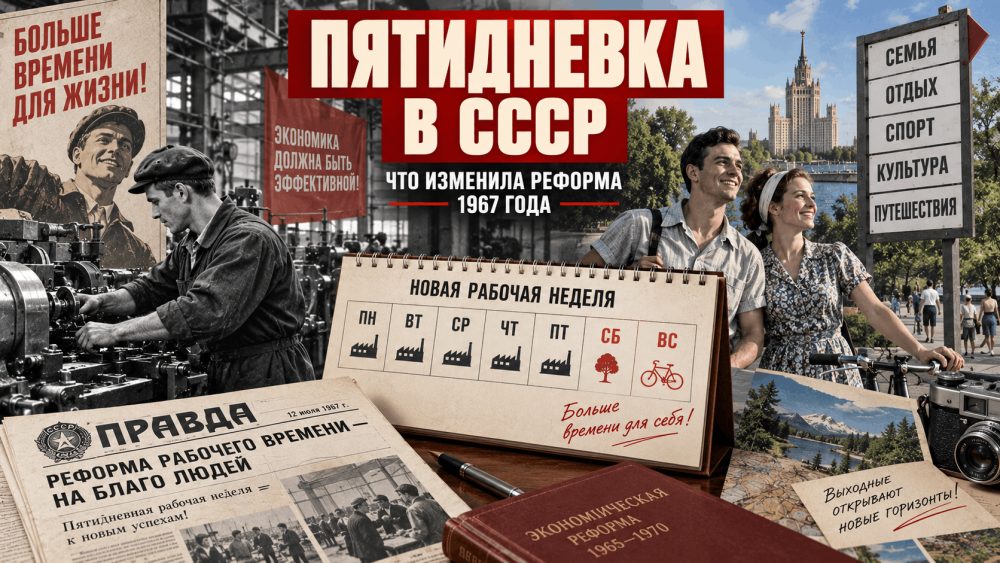
A two-day weekend can seem like a natural feature of the calendar. In the Soviet Union, the transition to a five-day working week was a major reform of 1967. It required changes to factory shifts, transport schedules, customer services and wage calculations. Crucially, the number of working days and the total number of working hours were different measures. The reform did not simply remove Saturday while leaving every other working day unchanged.
Resolution No. 199 of March 7, 1967, explicitly preserved the established total weekly working time. Those hours had to be redistributed across fewer working days. The history of the five-day week is consequently a story of additional rest days and the reorganisation of production schedules at the same time.
What the March 1967 decision required
The resolution was issued jointly by the Communist Party Central Committee, the USSR Council of Ministers and the All-Union Central Council of Trade Unions. It called for a planned transition of workers and employees in state, cooperative and public enterprises and organisations to five working days and two days off. The main part of the transition was intended to be completed by the fiftieth anniversary of the October Revolution.
This was not an instruction for the entire country to adopt the new pattern the following morning. Calendar plans were to be prepared for republics, regions and major industrial centres. Decisions depended on the administrative responsibility for each enterprise and involved the relevant trade-union bodies. The date of the national decision was therefore not necessarily the date when a particular factory changed its roster.
The stated aims included better working conditions, opportunities for education and cultural activities, and greater productive efficiency. The last aim was not incidental. Enterprises were expected to continue meeting production and financial targets. The change took place within the planned economy, rather than suspending its requirements.
Why five days did not automatically mean forty hours
The number of working days tells us how often an employee has to attend work during a week. Total working time tells us how many hours must be worked. Understanding the reform requires keeping those two measures separate.
An explanatory document issued by the Soviet labour committee and trade-union council on April 8, 1967, repeated the requirement to preserve total working time. It discussed shifts of eight hours, eight hours and twelve minutes, and other lengths. The rules required the appropriate balance of hours over an accounting period, rather than assuming that every calendar week would be identical.
A simple calculation illustrates the principle. Distributing forty-one hours equally across five days gives eight hours and twelve minutes per day. This is an arithmetic example, not a claim that every Soviet employee worked that exact schedule. Particular categories had reduced hours, special restrictions or their own shift arrangements.
The phrase “introduction of the five-day week” should therefore not automatically be translated into the establishment of a universal modern forty-hour week. It describes the distribution of working and rest days. The required hours must be established from the relevant rules and roster.
This is also why memories of a shorter working day before the reform can coexist with memories of an improved weekend afterwards. A longer individual shift and fewer journeys to work could be parts of the same change.
Why a workplace could operate during an employee's weekend
An enterprise's operating calendar did not necessarily match any one employee's personal schedule. The resolution required more effective use of equipment and, where appropriate, additional shifts or continuous production. Trains, power systems and many industrial processes could not all stop when a particular team went off duty.
Freight handling received explicit attention. Dispatch, receipt, loading and unloading were to continue throughout the week. Otherwise, a day off in one organisation could create idle railway wagons and missing materials elsewhere. Providing a new rest pattern for employees required arrangements for work that still had to be performed.
The April explanation permitted support workers to have days off that differed from those of the main production workforce. Maintenance, for instance, could be organised when production employees were not using the machinery. Two days of rest did not necessarily guarantee the same Saturday and Sunday for every occupation.
This distinction helps explain the scale of the task. A five-day roster for a person, a seven-day operating schedule for a service and a continuous production process are not inherently contradictory. They require different teams or schedules to fit together.
Who was excluded from the general transition?
The resolution allowed the previous weekly pattern to remain where the nature of production or working conditions made a change inappropriate. It also explicitly excluded general schools, higher and specialised secondary educational institutions, and vocational educational establishments from its scope.
That has an important consequence for family history. A recollection that parents received a second day off while a child continued attending school under an older timetable need not contain a contradiction. Workplace and educational calendars were not controlled by one universal switch.
Nor should the experience of one office employee be projected onto the whole Soviet population. Questions about working time need a workplace, a period and a particular arrangement. These details make the diversity of Soviet everyday life easier to understand.
The reform's broad social significance does not depend on pretending that every worker changed schedules simultaneously. Its reach and its exceptions are both part of the history.
Wages and holidays required their own calculations
Fewer working days meant that daily wage rates had to be reconsidered. The 1967 explanation related the new daily rate to shift length and specified that piecework rates remained unchanged. Comparing an old and a new daily payment without comparing their hours would therefore be misleading: the working day itself could be longer.
Annual leave followed separate rules. The resolution stated that the additional weekly rest day did not itself increase the established length of ordinary or additional annual leave. The explanation connected leave calculated in working days to the calendar rather than simply counting days on the new personal roster.
These provisions are useful historical evidence. They can help a researcher interpret attendance sheets, pay records and recollections. They are not instructions for present-day employment administration. A legal database's note that a document no longer operates describes its later legal status; it does not remove its importance as a source for 1967.
The change extended beyond the factory gate
The resolution devoted substantial attention to urban and suburban transport, shops, cultural institutions, medical services and everyday consumer services. If many people rested at the same time, organisations serving them needed to respond to the changed pattern of demand. A free day had different practical value depending on whether the necessary shops, trains and facilities were available.
Another resolution issued that day, No. 198, connected the development of canteens and cafes with the two-day rest pattern. It discussed reducing the burden of preparing meals at home, particularly women's domestic work. This demonstrates that the policy connected the production calendar with unpaid household labour. A stated objective, however, does not prove that it was achieved in every household.
Two consecutive days could make a dacha visit, sporting activity or trip to the cinema easier to arrange. The resolutions do not establish how every person actually spent that time. Studying those experiences requires surveys, family records and local evidence. An opportunity created by a schedule and the way people used it are related but distinct questions.
What the reform changed
The central change of 1967 was a planned move for large numbers of workers and employees to five working days and two days off, while preserving established total working time. It had exceptions and required the coordination of many different schedules.
Behind the familiar idea of the Soviet five-day week are therefore shifts, transport connections, wage calculations and the organisation of services, as well as family rest. Those details explain why a significant social change could not be completed simply by crossing out a day on a wall calendar.
Sources
- Resolution No. 199 of March 7, 1967: full text on the five-day working week, in Russian.
- Soviet labour committee and trade-union council: explanation No. 4/P-10 of April 8, 1967, in Russian.
- Resolution No. 198 of March 7, 1967, on public catering, in Russian.
- Electronic Library of Historical Documents: archival and bibliographical record of the March 7 resolution, in Russian.