Likbez: How Soviet Russia Organised Literacy Education
What was likbez? Read how the 1919 decree and 1920 instructions organised literacy schools, from finding learners to teaching and assessing their skills.
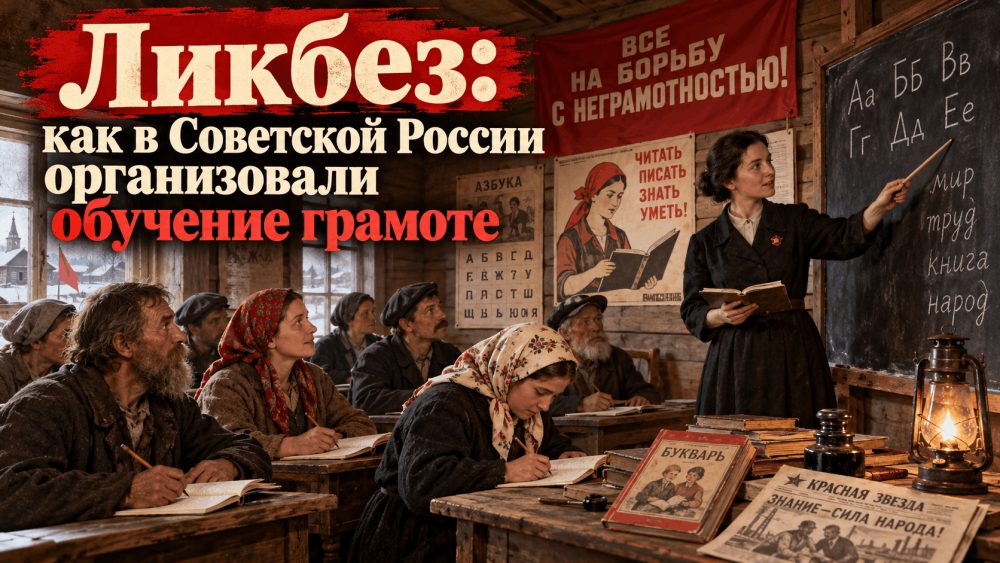
In modern Russian, likbez often means a quick introduction to an unfamiliar subject. In the early Soviet period, the abbreviation referred to a much larger undertaking: teaching people to read, write and count when they had missed elementary education. For an adult learner, this meant fitting lessons around work and household responsibilities. For the authorities, it meant finding pupils, organising teachers and making schools accessible.
The decree of 26 December 1919 was a central legal starting point. Yet a signature on a decree did not create a working classroom. The instructions that followed reveal the practical decisions needed to turn a general demand for literacy into a course someone could actually attend.
What the 1919 decree required
The decree applied to residents of the Russian Soviet Federative Socialist Republic, or RSFSR, aged eight to fifty who could not read or write. Learning was compulsory; learners could choose instruction in their native language or in Russian. The element of choice concerned language, rather than whether to learn at all.
The state named in the document matters. The Soviet Union did not yet exist in December 1919. Describing this as a decree of the USSR government therefore places it in the wrong institutional setting. It belongs to the history of Soviet Russia and subsequently became part of the broader history of Soviet education.
The Presidential Library connects the campaign with participation in public and economic life. A statement of that ambition, however, is different from an account of how it was implemented. For the latter, the instruction issued by the People's Commissariat of Education on 21 January 1920 is particularly revealing.
Why the instruction gives a different age range
The January instruction addresses people aged fourteen to fifty. This is not simply a contradiction of the decree's range of eight to fifty. The instruction identifies its own field of responsibility: the population normally served by institutions of out-of-school education.
The broader decree and the narrower implementing instruction therefore answer different questions. One defines the population required to acquire literacy. The other organises a particular part of the educational system. Without that distinction, two accurate age ranges can look like incompatible accounts.
It also matters when interpreting family memories. An account of a child attending an ordinary elementary school and an account of an adult relative taking literacy lessons describe different routes through education, even when both contributed to the same larger objective.
Finding pupils before opening schools
The instruction required local authorities to establish how many people lacked literacy, where they lived, their sex, age and occupation. Separate lists were to be prepared for individual settlements or urban districts. For people outside existing organisations, information could be gathered through visits to households.
This was intended to shape the location of schools, rather than merely produce a total for a report. Knowing the number of potential learners across a large administrative area did not tell an organiser how far one particular person would have to travel. The document explicitly connected school provision with the distribution of the people who needed it.
Potential teachers also had to be identified. Trade unions, educational bodies, party organisations and youth organisations were included in the work. The role of the Komsomol can be understood within that wider mobilisation, without attributing the whole campaign to one organisation.
The distinction between counting people and reaching them is fundamental. An impressive total on a register could coexist with an inconveniently located classroom. The instruction's attention to residence shows that administrators recognised access as a practical problem.
Where lessons would take place
The first schools were to use existing educational and public institutions, including premises connected with factories. Additional provision would follow as the survey of learners became more complete. The instruction envisaged a school in each settlement able to assemble at least fifteen pupils.
Initial groups were to contain fifteen to twenty-five people, with age and level of preparation taken into account. These figures describe the intended organisation in a specific instruction of 1920. They are not evidence that every literacy class throughout the country, or in every later decade, actually had that size.
This is a useful safeguard when reading historical rules. A prescribed standard tells us what organisers were meant to do. Demonstrating what happened in one locality requires the records of that locality.
More than learning the alphabet
Reading, writing and elementary mathematics formed the core curriculum. Reducing likbez to recognising letters therefore misses an important part of its purpose. Learners were expected to acquire usable skills with written language and numbers.
At the same time, elementary literacy was not equivalent to secondary education or professional training. Nor did completing a short course necessarily establish a lasting habit of reading demanding material independently. Different levels of education should not be merged into a single category of being educated.
The instruction allowed social studies and other subjects to be added according to the teachers and pupils available. It stipulated a Communist instructor for social studies. This is a concrete example of the campaign's political dimension, rather than a reason to dismiss the practical value of reading and arithmetic.
The two aspects could exist together. A programme could expand a person's ability to deal with written information while also introducing the political language and institutional priorities of the new authorities.
Fitting education around adult life
Local bodies were to determine the number of teaching days and hours with attention to the conditions of different sections of the population. The wording recognised that one timetable would not suit everyone. Access involved time as well as distance.
The instruction also provided for short training courses for instructors and school councils with equal representation of teachers and pupils. Some of its Russian terminology can be misleading today: the word used for those teaching looks very similar to the word for those learning. In context, the council was meant to represent both sides of the classroom.
Budget provisions covered staff, premises, running expenses, textbooks and teaching aids. Their inclusion is a reminder that a mass education programme could not be explained through enthusiasm alone. It required recurring expenditure, supplies and organisational work.
These arrangements should be read as requirements, rather than as a claim that every school received everything it needed. The difference between a budget heading and an actual supply of books is precisely the sort of question that local evidence can help answer.
How learning was supposed to be assessed
At the end of a course, pupils were to be tested in reading, writing and arithmetic. Those who did not pass were to repeat the course. The instruction also called for graduates to become involved with local out-of-school educational institutions so they could deepen their knowledge.
Enrolment, attendance, course completion and demonstrated ability are consequently different measures. A document showing that a relative joined a class does not necessarily establish that the person passed its final assessment. Conversely, a certificate may tell more about the course than a general recollection of having gone to school.
Local bodies were required to report regularly. The existence of a reporting system nevertheless does not prove uniform success. Regulations describe a programme's intended structure; registers, reports, teaching materials and personal testimony help reveal its operation.
This distinction also cautions against using a single literacy percentage without checking its age range, territory and definition. A statistic can be accurate for one population while being misleading when applied to another.
The commission created in July 1920
On 19 July 1920, the Council of People's Commissars ordered the creation of a five-member All-Russian Extraordinary Commission for the Elimination of Illiteracy within the education commissariat. Its decisions on matters within its remit were to be binding.
A standing consultative body was to bring together representatives from party, trade union, youth and military organisations. The decree thus addressed coordination between institutions already involved in the campaign.
The word extraordinary needs to be read as part of the full title. This was an education body attached to the education commissariat. An abbreviated reference can easily be confused with another Soviet institution. Checking the complete name and date avoids that mistake.
The decree is evidence of an attempt to organise the work centrally. It is not a statistical report, and it does not establish that illiteracy had already been eliminated in 1920.
What literacy meant outside the classroom
Being able to read a notice, write an application or check a calculation changed a person's relationship with written information. Such ordinary tasks help explain the campaign's significance in everyday Soviet life, without reducing its entire history to one percentage.
A comparison with the GOELRO electrification plan suggests the wider setting: programmes of transformation needed people able to work with new forms of information and organisation. The comparison does not mean that one decree automatically delivered the results promised by another.
Children's schooling, out-of-school education and the Pioneer movement also intersected within Soviet society. They were not interchangeable names for likbez. Distinguishing them makes an individual educational biography easier to understand.
Following the evidence
The Presidential Library's thematic collection lists primers and instructional publications from different years. A catalogue is a useful route into those materials, but its entry for a book is not the same as reading that book.
For a family or local history, begin with a person's age, place and date. Then look for the institution, the kind of course and evidence of completion. This approach turns a broad campaign into a specific educational experience, while preserving the differences between an official plan, an administrative report and a participant's memory.
Sources
- Presidential Library: the decree of 26 December 1919, for its date, age range and language provision.
- Education commissariat instruction of 21 January 1920, for population surveys, school organisation, curriculum and assessment.
- Decree establishing the extraordinary commission, 19 July 1920, for the commission's membership and powers.
- Presidential Library: materials on the elimination of illiteracy, a catalogue of historical teaching and instructional publications.
The cover is an original editorial diagram of the campaign's organisation, not a historical propaganda poster.