Soviet Maternity Leave: What Changed in 1956
Why maternity leave increased to 112 days, when 126 days applied, and how three additional unpaid months differed from maternity benefit entitlement.
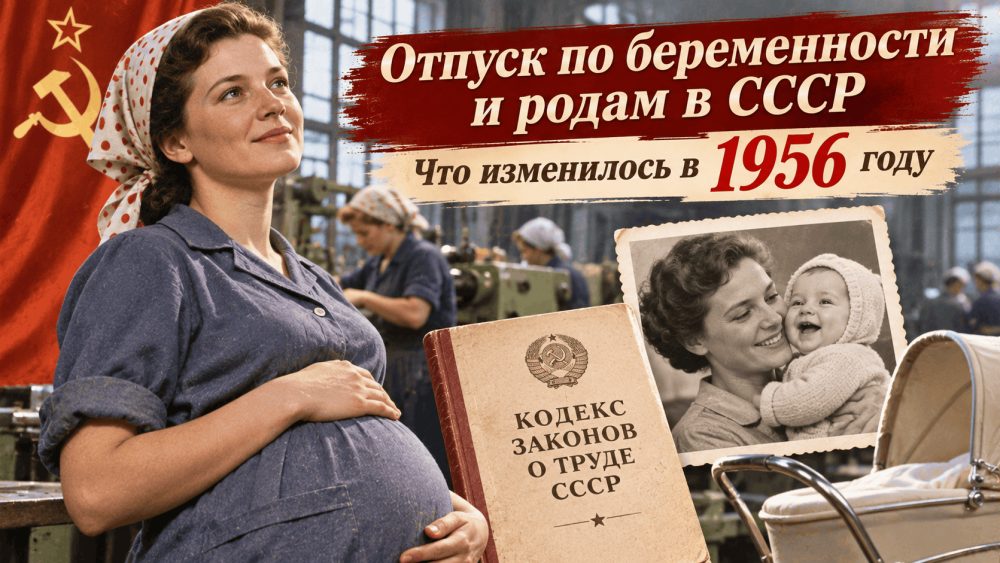
From 1 April 1956, the ordinary Soviet maternity leave period increased from 77 to 112 calendar days. The decree had been issued on 26 March. The new total consisted of 56 days before childbirth and 56 afterwards. Other measures that year addressed additional unpaid leave and eligibility for maternity benefits, so the story cannot be reduced to a single number.
Three questions need to be kept separate: how long a woman was entitled to be away from work, what financial support she could receive, and how an interruption in employment affected her service record. Everyday references to maternity leave often combine these questions. The documents did not always regulate them together.
What the March decree changed
The decree of the Presidium of the Supreme Soviet explicitly compared the old and new periods: 77 and 112 calendar days. The increase was 35 days. The unit was a calendar day, rather than a working shift or a month of assumed length.
Two periods of 56 days can also be expressed as sixteen weeks in total, with eight before and eight after childbirth. That conversion helps explain the arithmetic. It does not alter the wording of the decree, which specified the entitlement in calendar days.
The adoption date and effective date were different. The document was dated 26 March, while the longer period was introduced from 1 April 1956. It would therefore be incorrect to describe the new entitlement as having applied from the beginning of that year.
The decree also provided for a benefit to be issued under the established procedure. It did not set out every eligibility or calculation rule in the same short text. A statement about the duration of leave consequently cannot, on its own, establish the amount paid to a particular employee.
The longer postnatal period
For certain circumstances the decree specified 70 calendar days after childbirth. Its historical wording referred to abnormal childbirth and, separately, to the birth of two or more children. Combined with the 56-day prenatal period, this produced a total of 126 days.
The number 70 referred to the postnatal part, not the entire entitlement. Fourteen extra days were added to the ordinary postnatal period. Keeping the two components visible prevents the exceptional period from being mistaken for a shorter total leave allowance.
This decree establishes a general rule about duration. It does not by itself describe the medical and personnel paperwork in an individual case. Reconstructing the experience of a particular woman would require those records as well as the general legislation.
Up to three additional months without salary
In her study of women's employment in Karelia, historian Lyudmila Vavulinskaya discusses the Council of Ministers resolution of 13 October 1956. Employers were required, at a woman's request, to grant up to three additional months of unpaid leave after maternity leave.
The study also records protection of continuous service for women who left work following childbirth and returned to employment within one year of the child's birth. The intervening period was not itself counted as service. Preserving continuity and adding the entire interruption to time worked were different provisions.
The shorthand expression “112 days plus three months” thus needs qualification. It combines ordinary maternity leave with a possible additional absence governed by a different payment arrangement. It does not describe one uniformly paid period.
A December decision taking effect in January
Council of Ministers Resolution No. 1586 of 6 December 1956 addressed benefit entitlement. From 1 January 1957, female workers and employees, including those outside a trade union, were entitled to maternity benefits from state social insurance without needing three months of continuous employment at the particular enterprise or institution.
That was a specific change to a service condition. It should not be expanded into a claim that every social insurance requirement disappeared or that the resolution established an identical payment for all women in the country. The text identified an employment category and a particular qualifying period.
For female workers and employees who were not union members, the resolution expressly set the benefit at two-thirds of earnings for the entire maternity leave period. It also excluded recalculation for any portion of leave that had already elapsed before 1 January 1957.
Here, too, the dates have different meanings. The government adopted the decision in December 1956, but introduced the new benefit arrangements in January 1957. Reading only the year printed in the document's title would miss that distinction.
What the changes show, and what they do not
The measures dealt with several parts of working mothers' circumstances. The March decree extended leave. The October measure provided an additional unpaid option. The December resolution changed a benefit eligibility condition from the following year.
Those are related developments, but they are not interchangeable. A woman might have a right to additional time away from work while still facing the practical question of how her household would manage without her salary. That distinction follows directly from the difference between an entitlement to leave and its financial support. Establishing how families actually used the option requires evidence about income, household circumstances and employment.
For anyone reading old personnel records, a useful approach is to identify the date first, the type of leave second, and the applicable payment rule third. This keeps the ordinary 112 days, the exceptional 126-day total and the additional unpaid period separate. The cover illustrates the basic 56 + 56 formula as an original explanatory diagram, not a reproduction of a Soviet document.
Related articles
- The 1956 state pensions law
- The five-day working week
- The 1960 working-day law
- Civil marriage and registration in 1917