The 1917 Civil Marriage Decree: Registration, Children and Records
How the decree of 31 December 1917 changed marriage registration and children’s legal status: dates, surnames, certificates and earlier records.
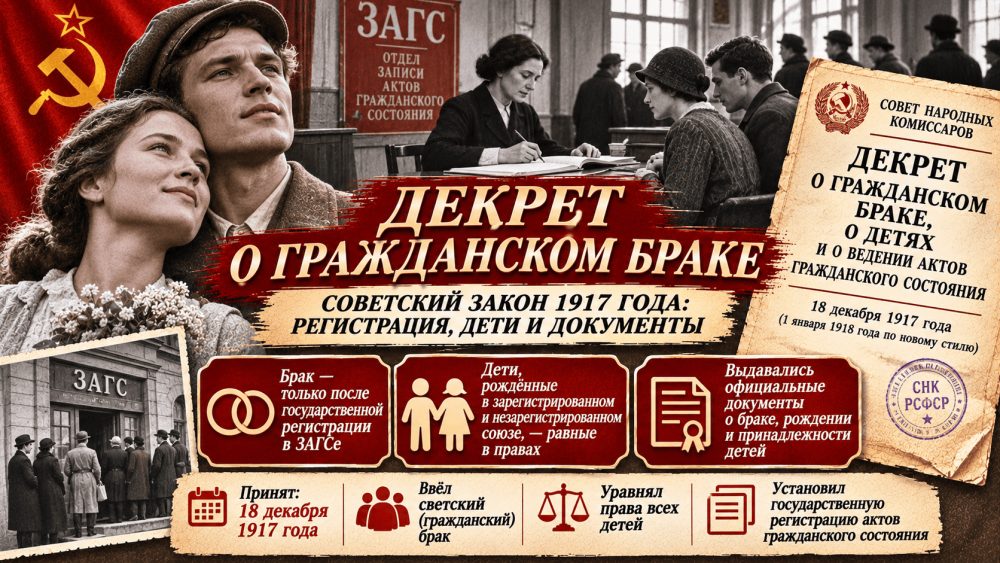
In December 1917, the Soviet government changed the legal procedure for recording marriage and family relationships. Its decree on civil marriage, children and civil-status registers was adopted on 18 December in the old calendar, equivalent to 31 December in the new calendar. Here, “civil marriage” meant marriage registered by secular authorities. It did not mean living together without registration. The procedure was intended to produce an official entry and a certificate for the couple.
Why the decree has two dates
The Historical Documents Library dates the act of the All-Russian Central Executive Committee and the Council of People’s Commissars to 18 (31) December 1917. These are two calendar expressions of the same day, not separate decisions. Publication came later: 20 December in the old calendar, or 2 January 1918 in the new one. This explains why accounts of the reform may mention both December 1917 and January 1918.
The distinction matters beyond chronology. Adoption, publication and the practical organisation of registration were different stages. The text establishes the rules being introduced; it cannot demonstrate that identical offices immediately began working in every settlement.
What civil marriage meant
The decree’s opening provision recognised civil marriages. A religious ceremony became a private matter for the couple and could accompany the required civil registration. The change therefore concerned the authority responsible for giving a marriage legal recognition.
In present-day conversational Russian, the same expression is sometimes used for an unregistered partnership. Applying that meaning to the 1917 document would reverse its purpose. Registration was its central concern: an application, confirmation of eligibility, an entry in a register and a certificate.
How registration was supposed to work
A couple could apply orally or in writing to the department recording marriages and births attached to the relevant local authority. They had to appear in person for registration and confirm that they were marrying voluntarily and that no impediments specified by the decree existed.
Those impediments included an existing marriage and certain degrees of family relationship. After making the entry, the official declared the marriage legally effective. A certificate was to be issued immediately. It was the documentary outcome of the procedure, not an optional souvenir of a ceremony.
The decree also addressed surnames. The couple could choose the husband’s surname, the wife’s surname or a combined surname. This short provision illustrates the document’s practical character: a general principle had to become information that could actually be entered beside two people’s names.
Birth registration and paternity
The decree was not concerned with weddings alone. Births were to be entered by the same department at the mother’s location. Notification could be made by both parents or one parent, or, in circumstances specified by the text, by someone caring for the child. The procedure also provided for witnesses.
Children born outside marriage received equal rights and obligations in the relationship between parents and children. Where a father did not acknowledge paternity by declaration, the issue could be brought before a court by the mother, a guardian or the child. Equal status and proof of parentage were therefore connected but distinct matters. One established a rule; the other could require a finding about a particular family.
This distinction helps explain why a reform of registration included a provision about children. A birth record was more than a date and a name: identifying parentage could affect the legal relationship the document was intended to record.
Registers, duplicate copies and earlier records
Marriage and birth registers were to be maintained in duplicate, with one copy sent to a court at the end of the year. Deaths required a separate register. Earlier registration books held by religious or administrative institutions were to be transferred to local authorities for safekeeping.
These provisions show that the reform extended beyond replacing one ceremony with another. It required a documentary system through which marriage, birth and death could be established. Transferring older registers preserved their information; it was not an instruction to erase existing entries.
The decree also allowed a person to approach a local judge over a refusal to register or an incorrect entry. A register was consequently more than an administrative list. Its contents had legal significance and could be challenged.
What the sources establish
The published decree provides the rules themselves. Documentary catalogue records separately establish the adoption and publication dates. The Presidential Library also describes an archival file containing a draft decree and correspondence involving the justice commissariat. That description is not a substitute for examining the file’s actual pages, which are available through electronic reading rooms.
The decree’s historical importance lies in moving family events into a secular registration system and changing the legal position of children born outside marriage. The existence of a rule, however, does not show how quickly it became everyday practice. Research into an individual family needs local entries; research into implementation needs the records of the offices that produced them. Keeping those levels separate makes the reform easier to understand without mistaking its intended procedure for a complete account of life after 1917.