Life in the USSR: What Was Everyday Soviet Life Really Like?
Housing, work, shopping, school, health care and holidays. How everyday life in the Soviet Union changed across decades, regions and families.
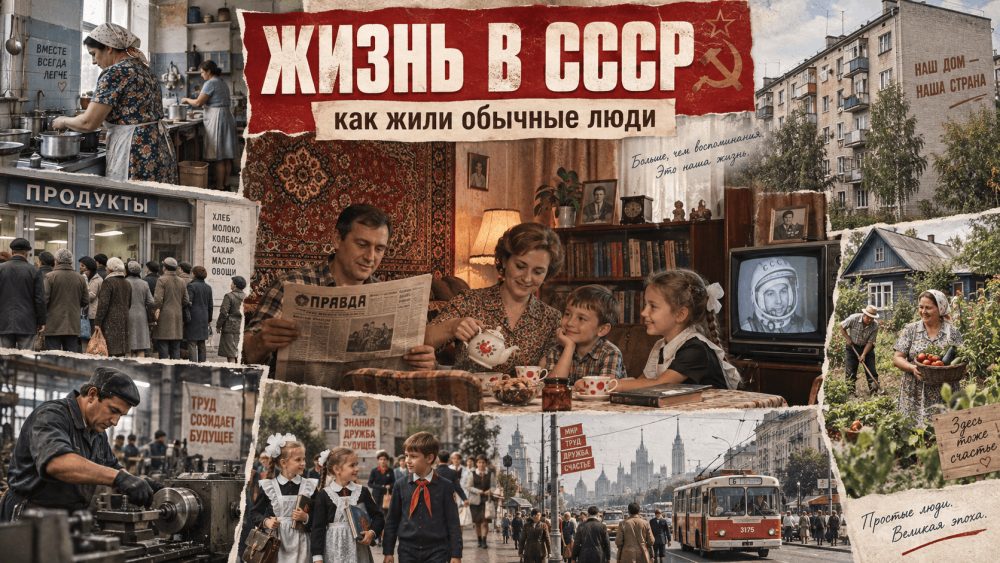
Ask two people what life in the USSR was like and you may hear two answers that seem impossible to reconcile. One remembers a first apartment, a steady job and summers at a family dacha. The other remembers waiting for meat, sharing a kitchen with strangers or trying to leave a village for the city. Neither has to be lying.
They may simply be remembering different Soviet Unions. A child in an urban family in 1978 did not experience the same country as a factory worker in the 1930s or a farmer during the postwar recovery. The Soviet Union lasted from 1922 to 1991, stretched across enormous distances and contained many different local economies and social worlds.
There was no single, timeless Soviet standard of living. To understand ordinary life, it helps to ask smaller questions. Where did people live? How were jobs and apartments obtained? What happened when a shop had no goods? What did children do after school? And what did a state that promised social security demand in return?
First, which Soviet decade are we talking about?
| Period | An essential point about everyday life |
|---|---|
| 1920s | Recovery from civil war and a partial return to market exchange under the New Economic Policy. |
| 1930s | Rapid industrialization, crowded cities, collectivization and mass political repression. |
| World War II and its aftermath | Enormous losses, evacuation, destroyed housing and long reconstruction. |
| Late 1950s and 1960s | A mass apartment-building campaign gave many families their first private domestic space. |
| 1970s and early 1980s | More household comfort for many urban residents, alongside queues and uneven consumer supplies. |
| Late 1980s to 1991 | Reform, economic disruption and increasingly severe problems in everyday supply. |
No table can stand in for a family history. Yet the period matters enormously. Historian Sheila Fitzpatrick's study of urban Soviet Russia in the 1930s describes shortages, cramped housing and the informal connections people used to manage daily problems. Research on housing in the Khrushchev era describes a very different turning point: a separate apartment becoming an attainable dream for many urban households. [1][2]
Housing: the difference a front door could make
Imagine getting ready for work in a communal apartment. Several families occupy separate rooms, but they use the same corridor, kitchen and bathroom. There may be rules about cleaning, stove space and where to store food. A household can have a room of its own without having much privacy.
Communal apartments were only one Soviet housing arrangement. Workers and students lived in dormitories, some families occupied barracks or private houses, and others later moved into cooperative or state-provided flats. The arrangements differed by city, profession and period.
Mass housing construction expanded under Nikita Khrushchev from the late 1950s. A small new apartment could be a substantial improvement over a single room shared by a family. It offered a separate kitchen and a door that no unrelated neighbor could simply open. The apartments were modest and often standardized, but privacy itself mattered. Housing historians describe the separate flat as both a practical improvement and a powerful ideal of normal family life. [2]
Receiving one was not automatic. State or workplace allocation, waiting lists and local rules shaped who moved and when. Having a job did not mean receiving a flat immediately, and not everyone moved out of older housing during the same decade.
Our more detailed guides cover communal apartments and Khrushchev's mass housing program.
Work: more than a monthly wage
For many city residents, a workday was organized around a factory, school, hospital, office or research institute. Employment in the state sector did more than provide income. A workplace might help someone obtain a dormitory room, apply for an apartment, secure a holiday voucher or find childcare.
That did not make every job equally desirable. A skilled engineer in a well-supplied industrial center and a teacher in a remote district faced different opportunities. An enterprise with influence could sometimes provide things that a less fortunate institution could not. Professional networks and personal connections mattered, too. These differences complicate the image of an entirely uniform society.
Nor was the rural labor system identical to urban employment. Collective farms had a distinct legal and economic status. For years, collective farmers faced different arrangements of remuneration and mobility from those of state employees. The extension of internal passports to the collective-farm population began in the 1970s, although it would be inaccurate to claim that no rural person possessed a passport before then. [4]
What counted as a secure livelihood changed over time and between places. A fixed wage is only one part of a household's resources. Access to housing, food, transport and public services could be just as consequential.
Shopping: why having money was not always enough
A price tag tells you what something cost. It does not tell you whether the thing could be found.
Soviet shoppers encountered both low administered prices for some essentials and shortages of particular foodstuffs or consumer goods. Finding the right shoes, furniture, an appliance or a special meal ingredient could require time, information and luck. The answer to "Can we afford it?" might be yes, while the answer to "Can we buy it today?" was no.
People developed practical responses. They asked friends to report deliveries, visited several shops, kept supplies at home or relied on a personal contact who knew when goods were available. These habits were neither universal nor identical across decades. Supply in a capital city could be quite different from that in a provincial town.
An archival and oral-history study of food shopping in Stalingrad, later Volgograd, during the late 1950s and early 1960s found that obtaining food absorbed hours and much of that labor fell on women. The study is valuable precisely because it describes a particular place and period. It is not evidence that every store in every Soviet republic always looked the same. [3]
The larger economic question belongs in our guides to Soviet shortages and queues and the planned economy.
School, childhood and the gap between generations
A child might remember the Soviet Union through the classroom rather than the shop queue: a schoolyard, a football game, a library card, a summer camp, a train ride to visit relatives. Children's lives were made from specific friendships and routines, not only from political institutions.
Education expanded during the Soviet period and schooling was a major part of the state's social ambitions. Schools also carried official ideas about the country, citizenship and history. The Library of Congress country study describes Soviet education in relation to the requirements of the state-run economy and the state's political goals. [5]
Pioneer activities and, later, the Komsomol were familiar experiences for many young people. Some remember friendships, trips and shared projects; others remember pressure to conform. Those memories can coexist. A child who loved a camp holiday might not have known how hard it had been for a parent to get the necessary supplies or time off.
Explore the stories of the Young Pioneers, Artek summer camp and Komsomol.
Health care: a guarantee with uneven results
Soviet public health care was organized around state institutions, where a patient generally did not face an ordinary market bill for a visit or hospital stay. That feature mattered to families, especially when illness threatened their ability to work or care for children.
Yet the existence of a public system did not guarantee equal access to every medicine, specialist or piece of equipment. A major city and a distant settlement could offer very different practical experiences. The Library of Congress's study of the USSR, with research completed in 1989, records both broad medical provision and difficulties obtaining certain medicines and specialized care. [5]
It is also misleading to compare a hospital in the 1930s directly with one in the late 1980s. Medicine and the country's infrastructure changed. Descriptions that ignore time and place tend to flatten both achievements and shortcomings.
The second shift: family work after paid work
The image of two employed parents is common in accounts of Soviet life. But paid employment ended only one part of the working day. Someone still had to shop, cook, wash, mend clothes and help children with homework.
Household appliances gradually reduced some tasks, but domestic labor did not become evenly shared simply because women were employed. Researchers of Soviet women describe a double burden: responsibilities at work combined with a disproportionate share of household work. When obtaining food itself required visiting several shops or queuing, that burden could be particularly heavy. [3][6]
This helps explain why statistics on employment alone cannot describe a family's quality of life. Two adults may both have jobs and still have very different amounts of free time.
Free time, television and the dacha
There was much more to a Soviet week than production targets and queues. People went to the cinema, read, listened to music, played sports, met friends and fell in love. A family evening might revolve around a television or books from the local library. Children and teenagers found their own places in courtyards, parks and sports grounds.
Holidays, too, varied. A seaside trip or a stay at a sanatorium was not a universal annual entitlement in practice. Workplaces, availability, household money and transport influenced who could travel. Others spent the summer with relatives or at a dacha, where time away from the city often meant repairs and vegetable-growing as much as rest.
That distinction matters when someone remembers Soviet life as restful or communal. Their memory may be entirely genuine. It still cannot tell us how every other family spent its holiday.
Read more about the dacha, Soviet cinema and football in the USSR.
City and village were not interchangeable
An apartment in Moscow was not a measure of life across the whole Soviet Union. Large cities generally had more specialized institutions and a wider range of shops and transport connections. Smaller towns and rural districts had different resources, routines and obstacles.
Rural families could supplement supplies through a garden plot, but travel, services and household amenities were often less convenient. Collective farms were also workplaces and social institutions with their own arrangements. The rights of collective farmers, especially concerning passports and mobility, changed over the Soviet period. [4]
It would be a mistake to imagine a countryside frozen in time. Schools, electrification, machinery and new roads transformed many places, but at different speeds. The gap between urban and rural life remained one of the questions behind any claim about an "average" Soviet citizen.
Freedom, movement and the limits of private life
Daily life cannot be understood through consumption alone. The Soviet state also set boundaries around politics, public speech, published culture and travel. Those boundaries changed. The risks of dissent during Stalin's terror were not identical to those of an ordinary late-1970s household, but it would be wrong to interpret employment or schooling as evidence of political pluralism or unrestricted emigration. [1][5]
Residence registration and access to housing could affect where someone could settle. Foreign travel involved separate permissions and constraints. One person's successful journey abroad tells us about that person's circumstances; it does not establish that the option was open equally to everyone.
A careful history can recognize the pleasure of friendship, family and private achievement without treating those experiences as proof that political restrictions did not matter.
So was life in the Soviet Union good or bad?
The better first question is: for whom, in which decade, in which place, and in what respect?
A family might be grateful for its first apartment and resent the years spent waiting for it. Someone might value their education and remember difficulty finding decent food or clothing. A person may feel nostalgia for childhood without wanting to revive the political order of their youth. Those are not contradictions that need to be ironed out.
The people who lived in the USSR were not characters in an argument about it. They had ordinary ambitions and relationships, made compromises, pursued pleasures, and tried to build a life under conditions they did not entirely choose. Their differences are part of the history.
Frequently asked questions
What was everyday life in the USSR like?
People worked, raised children, shopped, studied and spent time with friends, as people do elsewhere. The distinctive circumstances included state-dominated employment, housing allocation, consumer shortages, official ideology and constraints on movement and dissent. Experiences varied across time and place.
Did everyone get a free apartment?
No. State and workplace housing could be allocated through waiting lists, and some households waited for years. Communal rooms, dormitories, private houses and cooperative housing also existed. Receiving a separate flat was an important achievement for many families, not an instant universal outcome.
Were Soviet stores always empty?
No single description fits 1922 to 1991. Shortages varied by product, place and decade. Postwar hardship, recurring shortages in the later planned economy and disruption during the late 1980s should not be treated as the same condition.
Was Soviet health care free?
State care was generally provided without an ordinary market charge for treatment, but access to specialists, medicines and equipment varied by time and location.
Could Soviet citizens move to any city they wanted?
Not without constraints. Residence registration, access to housing, employment and passport rules affected mobility, with different arrangements for some rural populations during much of the Soviet period.
Why do former Soviet citizens remember life so differently?
They lived in different regions, generations, occupations and households. Memories of a happy childhood or stable job can coexist with experiences of shortages, discrimination, repression or restricted freedoms.
Related reading
- Communal apartments
- Khrushchev's mass housing program
- Soviet shortages and queues
- Dacha life
- The Soviet planned economy
Sources
1. Sheila Fitzpatrick. *Everyday Stalinism: Ordinary Life in Extraordinary Times: Soviet Russia in the 1930s*. Oxford University Press, 1999. https://academic.oup.com/book/47328
2. Christine Varga-Harris. *Stories of House and Home: Soviet Apartment Life during the Khrushchev Years*. Cornell University Press, 2015. https://academic.oup.com/cornell-scholarship-online/book/336
3. Natalya Pushkareva et al. “There are no Foodstuffs in Grocery Stores, Everything is Very Difficult to Obtain: Women’s Everyday Life in the Provincial Soviet City in the 1950-1960s.” *RUDN Journal of Russian History*. https://journals.rudn.ru/russian-history/article/view/42330
4. IMF / OECD et al. *A Study of the Soviet Economy*, chapter V.5, Agriculture (1991), on the legal and economic position of collective farmers. https://www.elibrary.imf.org/display/book/9789264134683/ch020.xml
5. Library of Congress, Federal Research Division. *Soviet Union: A Country Study* (1991; research completed 1989). https://www.loc.gov/item/90025756/
6. Gur Ofer and Aaron Vinokur. “Work and family roles of Soviet women: historical trends and cross-section analysis.” *Journal of Labor Economics* (1985). https://pubmed.ncbi.nlm.nih.gov/12267651/