The Komsomol: forty million people in one organization
The rung between the red scarf and the party card, climbed by nearly all Soviet youth. Construction sites on swamps and virgin steppe, a badge that opened careers, and a finale in which Komsomol activists became the country's first capitalists.
What the Komsomol was
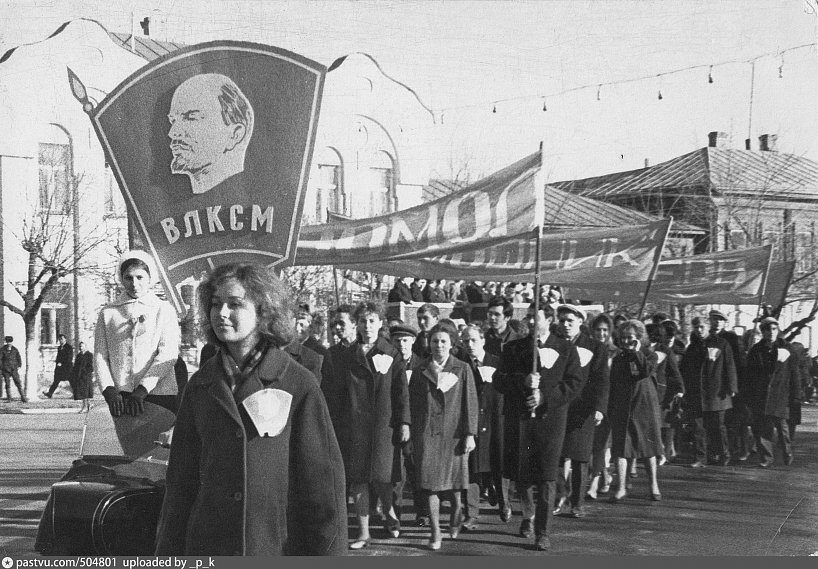
The Komsomol (short for "communist union of youth"; the full name was VLKSM, the All-Union Leninist Communist League of Youth) was the Soviet youth organization for ages 14 to 28. Officially it was "the helper and reserve of the party"; in practice it was the party's cadre conveyor: the third rung of a ladder up which the state led a person from the age of seven. First the Little Octobrists, then the Young Pioneers, then the Komsomol, and the best went further, into the Communist Party.
The organization's scale has no parallel: at its peak the Komsomol counted about 40 million members, and more than half the country's adult population passed through it. Its newspaper, Komsomolskaya Pravda, printed runs of ten million copies. The Komsomol was everywhere: a cell existed in every school, university, factory shop and military unit.
Born of war
The Komsomol was founded on October 29, 1918, at the height of the Civil War, gathering into one structure the scattered unions of working youth that had fought for the revolution. The first generation of Komsomol members was shaped not by meetings but by fronts: young people left for the war in whole organizations. Hence the military aesthetic that accompanied the league all its life: headquarters, call-ups, mobilizations, "fronts" of the sowing and harvest campaigns.
Lenin saw the youth league as a tool for building the new man, and after his death the organization took his name. Into the country's history the Komsomol wrote itself above all through construction. The "Komsomol assignment" sent the young where adults would have had to be driven by decree: to the Magnitogorsk steelworks and the Dnieper dam, to the city named Komsomolsk-on-Amur, after the war to the Virgin Lands, in the 1970s to the BAM railway. Romance and propaganda were woven together inseparably: for some the assignment was an escape into real life and serious money, for others a ticket to a barracks in the taiga. In the Second World War the Komsomol paid the most terrible price of all: hundreds of thousands of its members died at the front, and the names of its heroes, from Zoya Kosmodemyanskaya to the Young Guard underground, were known to every schoolchild.
A badge as a pass
By Brezhnev's time the Komsomol had completed its transformation from a union of enthusiasts into an obligatory line in one's biography. One joined at fourteen almost automatically, with one's whole class: memorize the charter, answer a couple of questions at the district committee, receive the badge with Lenin's profile. Not joining was possible, but costly: a Komsomol reference was required for university admission and for employment, and a non-member's file closed doors quietly, without explanations. Expulsion had consequences too: for belief in God, for one's "moral profile," for a careless word.
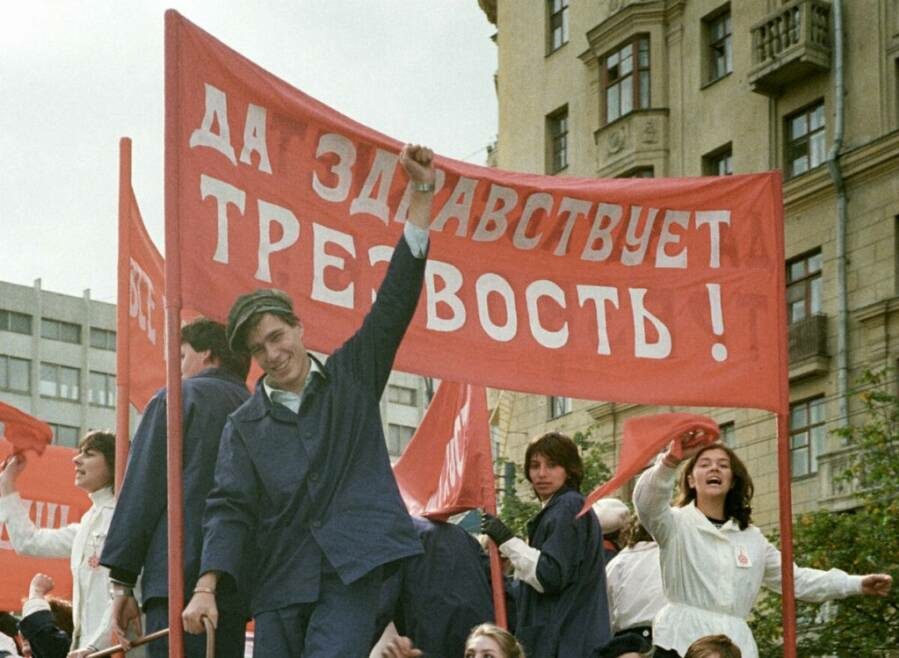
The league's daily life was eaten by formalism, and its own members said so: meetings held for the record, two-kopeck dues, speeches nobody listened to. But the same machine had a living side that people remember warmly: the student construction brigades with their campfire songs and first earned money, the hiking trips, the discos that could be held only "under the aegis" of the Komsomol. The league was at once a bureaucracy and the only legal form of youth life: no other existed.
The finale: from activists to capitalists
The plot's most unexpected turn came at the end. In the years of perestroika, the Komsomol became the first institution in the country allowed to do what everyone else was forbidden: to make money. The Centers of Scientific and Technical Creativity of Youth (NTTM) attached to the Komsomol received the right to commercial activity and to converting funds into cash, and yesterday's cell secretaries turned out to be the only people in the USSR with legal businesses, connections and access to money. Out of this "Komsomol economy" grew the first cooperatives, exchanges and banks; the school's most famous graduate is Mikhail Khodorkovsky, the future owner of Yukos, who began precisely with an NTTM center. The formula "the Komsomol member as the first capitalist" sounds like a joke, but it is the documented economic history of the late USSR.
The league itself ended without drama: in September 1991, after the failed coup, an extraordinary congress announced its self-dissolution. An organization of forty million vanished in a day, provoking neither protest nor much grief, which is perhaps the most honest verdict on what it had become. A few months later the country itself was gone.
What remained
More remained of the Komsomol than it may seem. Komsomolskaya Pravda still publishes, and cities with Komsomol names remain on the map. A whole managerial school remained: a substantial share of the first wave of post-Soviet politicians and businessmen were graduates of the Komsomol apparatus, where they learned both organization and cynicism. And the memory of generations remained, holding, as always in this history, two truths side by side: the official boredom of the meetings, and the best years of one's life in a construction brigade. Both are genuine, and our project will not choose between them.
Frequently asked questions
What was the Komsomol, in simple terms? The Soviet youth organization (ages 14 to 28), the rung between the Pioneers and the party. Most Soviet people passed through it; at its peak it had about 40 million members.
What does VLKSM stand for? The All-Union Leninist Communist League of Youth. The word Komsomol is a contraction of the Russian for "communist union of youth."
Was joining the Komsomol compulsory? Formally no, in practice nearly yes: without a Komsomol reference, university admission and careers were difficult. One usually joined at 14, with almost the whole class.
What was a Komsomol assignment? The league's posting of young people to the great construction projects and new lands: Magnitogorsk, the Virgin Lands, the BAM railway. A blend of romance, propaganda and a way to earn quickly.
Why are Komsomol members called the first businessmen? During perestroika the Komsomol's NTTM centers were the first allowed to trade commercially. The first cooperatives and banks grew out of this "Komsomol economy"; the best-known example is Mikhail Khodorkovsky.
When and how was the Komsomol dissolved? In September 1991, after the August coup: an extraordinary congress announced the organization's self-dissolution. A few months later the USSR itself ceased to exist.
Related
- The Young Pioneers: the previous rung of the same ladder.
- Artek: the supreme reward of a Pioneer and Komsomol childhood.
- Vladimir Lenin: the man whose name the league carried from 1924.
- Perestroika and glasnost: the years when the Komsomol learned to make money.
Sources
The facts in this article can be verified against authoritative sources:
- Encyclopaedia Britannica, "Komsomol": https://www.britannica.com/topic/Komsomol
- Wikipedia, "Komsomol": https://en.wikipedia.org/wiki/Komsomol
- Encyclopedia.com, "Communist Youth": https://www.encyclopedia.com/social-sciences-and-law/sociology-and-social-reform/social-reform/communist-youth
- GlobalSecurity.org, "Komsomol": https://www.globalsecurity.org/military/world/russia/komsomol.htm
- Presidential Library (Russia), "Komsomol in the national history": https://www.prlib.ru/en/collections/1168193
Where assessments diverge (a school of life or a machine of formalism), we present both sides of the memory.