Artek: the country of childhood at Bear Mountain
Four canvas tents and eighty children in 1925. A million and a half children over a century, the longest camp session in history lasting an entire war, and an American girl who came to stop a cold one. The story of the Soviet Union's most famous camp.
What Artek is
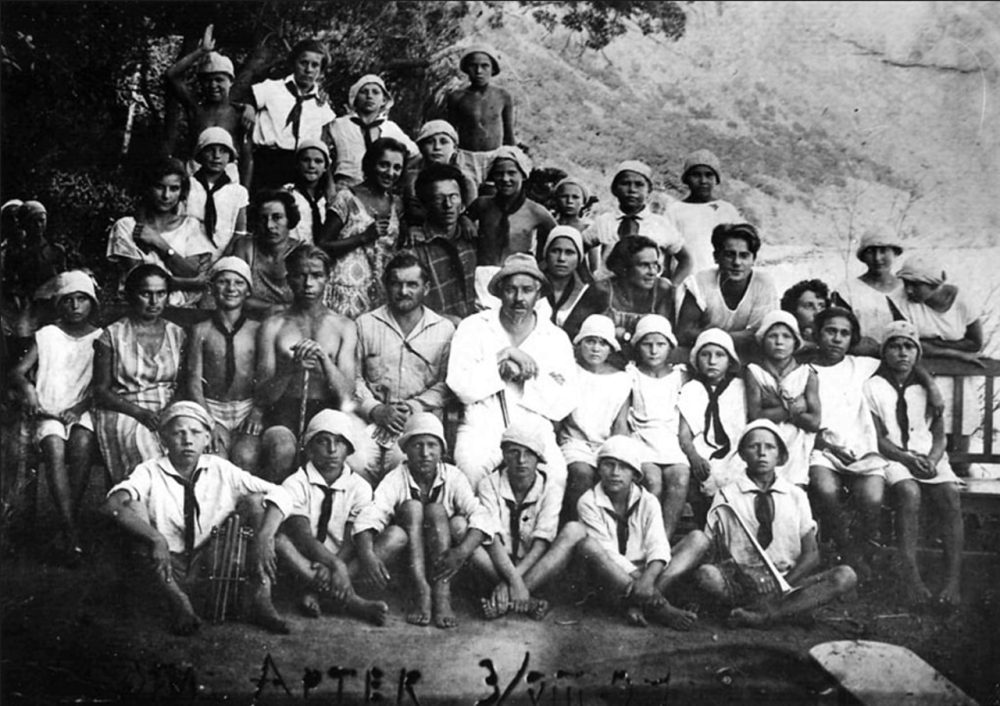
Artek is the most famous children's camp of the Soviet Union, and probably of the world. It opened on June 16, 1925, on Crimea's southern shore at the foot of Ayu-Dag, Bear Mountain, near the town of Gurzuf, and it operates to this day: about one and a half million children have passed through it in a century.
To a Soviet child the word "Artek" sounded roughly the way "Hollywood" does: a place from another reality, reserved for the chosen. A place here could not be bought; it was awarded, and getting to Artek was a dream that came true for few. Sea, mountains, bonfires, troops in matching uniforms, oaths of eternal friendship: several generations remember their Artek session as the brightest summer of childhood. This showcase had a flip side too, and we will get to it.
Tents for sick children
Artek began without any glamour. The idea belonged to Zinovy Solovyov, deputy people's commissar of health and head of the Red Cross: after the revolution, the Civil War and the famine, the country was full of sick children, and Solovyov was looking for a place to treat them with sun, sea and routine. The choice fell on the Artek tract: dry climate, a pebble beach, pine air.
The first session was modest: four large canvas tents and eighty children from Moscow and other cities, most of them recovering from tuberculosis. A flag with a red cross flew over the camp, and the day revolved around morning exercises, the sea, and extra rations. As early as 1926 the camp received its first foreign guest, the German communist Clara Zetkin, and with her visit began Artek's second life: that of a showcase the country presented to the world.
By the end of the 1920s the tents had given way to buildings, from 1930 the camp ran year-round, and the voucher changed from a medical referral into a reward for exemplary Young Pioneers. Thus formed the duality that stayed with Artek forever: the camp was at once a genuine children's paradise and a carefully curated picture of one.
The longest session in history
On June 22, 1941, an ordinary summer session was beginning at Artek. The war decided otherwise. Children from the western republics, who had nowhere to return to, were taken east, and a routine three-week session turned into an evacuation odyssey across half the country, all the way to Belokurikha in the Altai. Those campers got home years later: their session, as long as the war itself, entered camp history as the longest ever. Crimea itself was occupied; the camp was liberated in April 1944 and received its first children again that same summer.
Artek carries the history of that war as a scar and a pride at once: destroyed and rebuilt, it became one of the country's symbols of peacetime regained.
The golden age: a republic by the sea
The sixties and seventies were the years of flowering. Artek grew to 218 hectares with seven kilometers of beaches and some ten camp "republics" with names of their own: Morskoy, Gorny, Khrustalny, Rechnoy, Lesnoy. It acquired its own stadium, its own flotilla, its own film tradition: dozens of children's movies were shot here. The camp received up to 27,000 children a year; from 1925 to 1969 three hundred thousand came, including thirteen thousand guests from seventy countries.
Internationalism was Artek's signature genre. Cuban, Indian and African delegations, festivals, declarations of friendship: children's diplomacy ran here in a continuous stream. Its most famous episode came in July 1983, when ten-year-old American Samantha Smith arrived, the girl who had written to Andropov asking whether there would be a war. She lived in an ordinary troop, wore the Artek uniform, and left saying that Soviet children were just like her. In the iciest year of the Cold War, those images traveled the planet.
Getting to Artek remained a feat: vouchers were awarded for top grades, victories in competitions and olympiads, and activity in Pioneer work. The children of the nomenklatura received their share of places too, something not written about at the time but known to all. Still, for most campers Artek was happiness honestly earned, and that is how it stayed in the memory of generations.
After the Union
With the dissolution of the USSR, Artek found itself in independent Ukraine and shared the fate of the entire post-Soviet infrastructure of childhood: underfunding, decay, commercial vouchers instead of awarded ones, and by the late 2000s talk of closure. The camp that one sixth of the world's landmass had dreamed of was quietly crumbling by the same sea.
After 2014, when Crimea came under Russian control (an annexation unrecognized by most of the world's countries), Artek became the flagship of a Russian state program: hundreds of millions of dollars in reconstruction, new buildings, awarded vouchers once again for competition winners. The camp is back at full capacity, and politics surrounds it once again: according to international journalists' reports, in the 2020s Artek housed, among others, children taken from occupied territories of Ukraine, which became the subject of investigations and condemnation. The camp met its centenary in 2025 in the same role it has played for most of its century: a showcase of the state that owns it. The children, as a hundred years ago, are simply going to the sea.
Frequently asked questions
What is Artek, in simple terms? The most famous children's camp of the USSR, on Crimea's southern shore, opened in 1925. A voucher to it was an award every Soviet schoolchild dreamed of. It still operates.
Why is the camp called Artek? After the Artek tract and stream at Ayu-Dag mountain, where the first tents stood. The "bear" mountain became the camp's main symbol.
How did children get to Artek in the USSR? Vouchers were not sold: they were awarded for top grades, victories in contests and olympiads, and activity in the Pioneer organization. A share of places went to the children of officials.
Who was Samantha Smith, and what does Artek have to do with her? An American schoolgirl who wrote to Andropov in 1982 asking whether the USSR wanted war. At his invitation she visited the USSR in the summer of 1983 and stayed at Artek; her trip became a world sensation.
What happened to Artek during the war? The session that began on June 22, 1941, turned into an evacuation: the children were taken to the Altai, and their "session" stretched across the war years, the longest in the camp's history. Crimean Artek was occupied and received children again in the summer of 1944.
Does Artek operate today? Yes, year-round. After 1991 the camp belonged to Ukraine and fell into decline; since 2014 it has been under Russian control, rebuilt, and again awards its vouchers as prizes. The status of Crimea remains internationally unrecognized.
Related
- The Young Pioneers: the organization whose reward Artek was.
- Yuri Andropov: the addressee of Samantha Smith's letter.
- The Great Patriotic War: the time of Artek's longest session.
- The dissolution of the USSR (1991): the boundary after which the camp's second history began.
Sources
The facts in this article can be verified against authoritative sources:
- Encyclopedia.com (Encyclopedia of Russian History), "Artek": https://www.encyclopedia.com/history/encyclopedias-almanacs-transcripts-and-maps/artek
- Wikipedia, "Artek (camp)": https://en.wikipedia.org/wiki/Artek_(camp)
- Radio Free Europe / Radio Liberty, "Crimea's Famed Artek Camp Turns 100": https://www.rferl.org/a/russia-ukraine-artek-pioneers-crimea/33436003.html
- Russia Beyond, "Crimean summer: would you send your kids to the legendary Artek camp?": https://www.rbth.com/longreads/artek/
- Russia Beyond / GW2RU, "Artek: What the iconic Soviet pioneer camp was like": https://www.gw2ru.com/history/2043-artek-soviet-pioneer-camp
The modern period is described using sources from different sides; sensitive claims are attributed.