The Great Patriotic War: the 1,418 days that changed the world
The bloodiest war in human history: from the catastrophe of June 22, 1941, through Moscow, Stalingrad and Kursk — to Berlin. The people's feat and the price of victory, told honestly.
What the Great Patriotic War was
The Great Patriotic War is the name used in the USSR and most post-Soviet countries for the war between the Soviet Union and Nazi Germany with its allies: from June 22, 1941, to May 9, 1945 — exactly 1,418 days. In the West the same theater is known as the Eastern Front of the Second World War. The name echoes the Patriotic War of 1812 against Napoleon — and appeared as early as June 23, 1941, in the newspaper Pravda.
Whatever one calls it, it was the largest and most terrible front in human history. More than 80% of all combat in the Second World War took place there; of the war's 70–85 million dead, some 30 million were victims of the Eastern Front. The Soviet Union paid for victory with 26–27 million lives, most of them civilians. It was here that the military machine of the Third Reich was ground down: the fate of the entire world war was decided between Moscow, Stalingrad and Berlin.
Before the storm: the 1939 pact
An honest account of the war does not begin on June 22. In August 1939 the USSR and Germany signed a non-aggression treaty — the Molotov–Ribbentrop Pact — with secret protocols dividing Eastern Europe into spheres of influence. A week later Germany invaded Poland, starting the Second World War; on September 17 Soviet troops occupied eastern Poland, and in 1940 the Baltic states and Bessarabia. In the winter of 1939–40 the USSR fought a costly war against Finland.
Stalin calculated that the pact would buy time to prepare for the inevitable clash. Hitler never intended to honor it: the destruction of the USSR and "living space" in the East had been his declared goal since the 1920s. Intelligence — including the legendary Richard Sorge — warned Moscow of the coming invasion, but Stalin dismissed the reports as provocation. The country met the war by surprise — though a surprise it was not.
1941: catastrophe, and the miracle at Moscow
At dawn on June 22, 1941, Germany and its allies launched Operation Barbarossa — the largest invasion in military history: over three million soldiers from the Baltic to the Black Sea. The plan was "lightning war": to crush the USSR in a single campaign. The first months seemed to confirm it: the Red Army, bled white by the pre-war purges of its officer corps, lost entire fronts in gigantic encirclements — at Kyiv alone, hundreds of thousands of soldiers were taken prisoner. By autumn the Germans had blockaded Leningrad, beginning an 872-day siege that killed, by various estimates, from 800,000 to over a million civilians.
This was a war of annihilation — and in that it differed from the war in the West. Nazi doctrine assigned the Slavs the role of slaves, and Soviet Jews death: behind the Wehrmacht came the Einsatzgruppen, shooting Jews town by town; Babyn Yar became the symbol of these crimes. Soviet prisoners of war died in German camps by the millions.
In December 1941, outside Moscow, something happened that no one in Berlin expected: exhausted but unbroken Soviet forces counterattacked and threw the Wehrmacht back from the capital. The blitzkrieg had failed — the war became a long one, and a long war Germany could not win.
1942–43: Stalingrad and the turning point
In the summer of 1942 Hitler drove south — toward the oil of the Caucasus and the city on the Volga that bore Stalin's name. The Battle of Stalingrad (July 1942 – February 1943) became the largest and bloodiest urban battle in history: the fighting went house by house, floor by floor, workshop by workshop. In November 1942 the Red Army encircled the entire German Sixth Army; on February 2, 1943, its remnants capitulated. Axis losses in the Stalingrad campaign exceeded 800,000 men; Soviet losses were about 1.1 million. It was the turning point of the entire world war: the strategic initiative passed to the USSR and never returned to Germany.
The price of that turning point must be named honestly. At the height of the 1942 retreat came Order No. 227 — "Not a step back!" — with blocking detachments and penal battalions: retreat without orders was equated with treason. People fought out of patriotism and hatred for the invader — and under the pressure of a system that left no choice; the truth includes all of it at once.
In the summer of 1943, at Kursk, Germany launched its last great offensive in the East. In the largest tank battle in history — thousands of machines, including the legendary T-34 — the Wehrmacht was stopped and bled dry. After Kursk, the German army in the East only retreated.
The home front: a whole country at war
Victory was forged not only at the front. In 1941 the USSR carried out an unprecedented evacuation: more than 1,500 factories, together with millions of workers, were moved to the Urals, Siberia and Central Asia — and within months they were supplying the front with tanks and aircraft. Women and teenagers stood at the machine tools. Women fought at the front as well — as snipers, pilots (the Germans nicknamed one night-bomber regiment the "Night Witches"), nurses and anti-aircraft gunners — hundreds of thousands of them.
The Allies helped too: through Lend-Lease the USSR received hundreds of thousands of trucks, aircraft, food and raw materials from the United States and Britain. Historians argue over the share of that contribution, but agree on the essential point: it was above all the Soviet soldier who fought and died on the Eastern Front, and Lend-Lease helped him fight more effectively.
1944–45: from Belarus to Berlin
In the summer of 1944 Operation Bagration destroyed Army Group Center — the heaviest defeat in the history of the German army. The Red Army reached the borders of the USSR and pressed on — through Poland, Romania, Hungary. By January 1945 Soviet troops stood on the Oder, a hundred kilometers from Berlin.
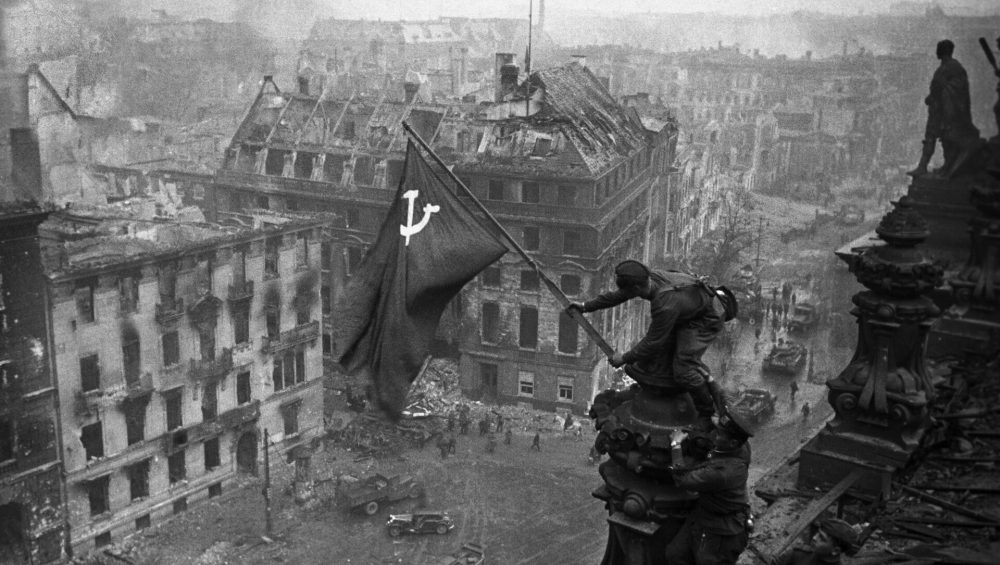
The Battle of Berlin was the war's final battle in Europe. On April 30, 1945, Hitler killed himself; on May 2 the city's garrison surrendered, and the red banner rose over the Reichstag. In the night of May 8–9 Germany signed its unconditional surrender — because of the time difference, the West celebrates victory on May 8 and the former USSR on May 9. In August 1945 the Soviet Union, honoring its commitments to the Allies, entered the war against Japan and crushed its army in Manchuria within weeks — hastening the end of the entire Second World War.
The price of victory
The numbers defy comprehension, so let us state them slowly. Twenty-six to twenty-seven million Soviet citizens dead — one in every seven inhabitants of the country. Of these, about 8.7 million were military battlefield losses; the rest were civilians: killed under occupation and bombardment, starved in besieged Leningrad, deported to forced labor, shot. 1,710 towns and cities destroyed, tens of thousands of villages burned — some, like Khatyn in Belarus, together with their inhabitants.
Someone fought in every Soviet family, and someone failed to return in almost every one. That is why May 9 became, in the USSR and the post-Soviet countries, the most personal of all state holidays — "a holiday with tears in its eyes," as the famous song puts it.
Memory, and the battles over it
The memory of the war is itself a battlefield. For decades the USSR surrounded it with a ceremonial canon that had no room for the 1939 pact, the penal battalions, or the fate of prisoners of war who returned from German captivity into suspicion — and often into the camps. Glasnost opened the archives and the difficult subjects. The arguments continue today: some countries see 1945 as liberation, others as the beginning of a new unfreedom; since 2015 Ukraine has officially used the term "Second World War" instead of "Great Patriotic War." And the image of Victory is frequently pressed into the service of present-day politics.
Our position is simple and does not bend with the times: the soldier's feat and the people's sacrifice are real and immeasurable; the mistakes and crimes of the leadership are documented; the one neither cancels nor excuses the other. We tell both.
Frequently asked questions
When did the Great Patriotic War begin and end? It began on June 22, 1941, with Germany's attack on the USSR, and ended with Germany's capitulation in the night of May 8–9, 1945. It lasted 1,418 days.
How is the Great Patriotic War different from World War II? World War II (1939–1945) is the entire global war. The Great Patriotic War is its Soviet-German front from June 1941. The term is used in Russia and several post-Soviet countries; in the West it is called the Eastern Front.
How many people died in the Great Patriotic War? The USSR lost 26–27 million people, of whom about 8.7 million were military battlefield losses; most of the dead were civilians. In total, about 30 million people died on the Eastern Front.
Which battle was the turning point? Stalingrad (July 1942 – February 1943): there Germany lost an entire army and the strategic initiative. The battles of Moscow (1941) and Kursk (1943) sealed the reversal.
Why is it called the "Patriotic" War? By analogy with the Patriotic War of 1812 against Napoleon: a war for the country's very existence, fought on its own soil. The name appeared in Pravda the day after the invasion.
Did the Allies help the USSR? Yes — with Lend-Lease supplies (trucks, aircraft, food, raw materials) and by fighting on other fronts. But the main weight of the war against Germany fell on the USSR: more than 80% of all combat in World War II took place on the Eastern Front.
Related
- Joseph Stalin — the Supreme Commander: his role and his responsibility.
- The T-34 tank — the weapon that became the war's symbol.
- The Gulag: an archipelago of forced labor — where many returned after German captivity.
- The Cold War — the confrontation that grew out of the victory.
- The Berlin Wall — the symbol of Europe's postwar division.
- The Battle of Stalingrad — the 200 days that turned the entire war.
Sources
The facts in this article can be verified against authoritative sources:
- Encyclopaedia Britannica, "Eastern Front (World War II)": https://www.britannica.com/event/Eastern-Front-World-War-II
- Wikipedia, "Eastern Front (World War II)": https://en.wikipedia.org/wiki/Eastern_Front_(World_War_II)
- United States Holocaust Memorial Museum, "The Eastern Front: The German War against the Soviet Union": https://encyclopedia.ushmm.org/content/en/article/the-soviet-union-and-the-eastern-front
- The National WWII Museum (New Orleans), "The Eastern Front": https://www.nationalww2museum.org/war/articles/eastern-front
- Encyclopaedia Britannica, "Battle of Stalingrad": https://www.britannica.com/event/Battle-of-Stalingrad
- World History Encyclopedia, "German-Soviet War: WWII's Bloodiest Front": https://www.worldhistory.org/German-Soviet_War/
Where figures diverge (losses, siege estimates, the weight of Lend-Lease), we give ranges and both sides of the argument rather than one.