Chernobyl: the worst accident in the history of nuclear power
On 26 April 1986 the explosion at the Chernobyl plant became the worst nuclear accident in history. In depth: what happened, why the authorities stayed silent, how the disaster was cleaned up, and how many were harmed.
What happened
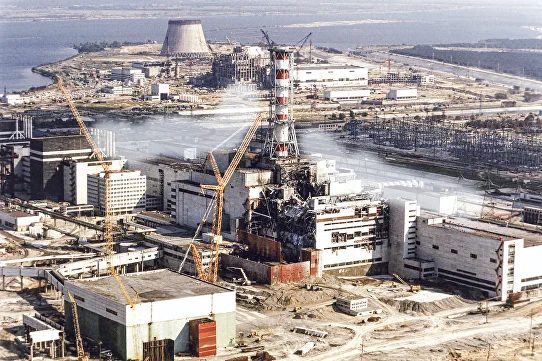
In the early hours of 26 April 1986, at 1:23 a.m., a catastrophe struck reactor No. 4 of the Chernobyl Nuclear Power Plant. During a test the reactor's power went out of control. An explosion rang out, followed by a second — they tore off the reactor's heavy lid, weighing about a thousand tonnes, and destroyed the building. Incandescent graphite burst out, a fire began, and for days enormous quantities of radioactive material were thrown into the air.
It is the worst accident in the history of nuclear power. On the International Nuclear Event Scale it was rated at the highest level, 7 — a rating later matched only by the Fukushima accident in Japan (2011).
The plant and the town of Pripyat
The Chernobyl plant stood in the north of the Ukrainian SSR, near the border with Belarus and about 100 kilometres from Kyiv. The station was commissioned in 1977; by 1984 four reactors were running, each producing 1,000 megawatts.
A few kilometres from the plant stood the young town of Pripyat, built for the station's workers. At the time of the accident about 49,000 people lived there — mostly young families. By Soviet standards it was a comfortable town.
The reactors were of the RBMK type. This design had dangerous features: in certain conditions its power could surge sharply, and it had no robust containment shell to hold back a release in an accident.
The fateful test
That night a test was being run on reactor No. 4. The aim was to check whether the turbine, while it was still spinning by inertia after being switched off, could power the cooling pumps for a time — in case of a loss of electricity.
The test did not go to plan. The reactor's power fell too low, and to raise it the operators withdrew almost all the control rods from the core and switched off some safety systems. The reactor was left in an unstable and dangerous state not allowed for by the procedures.
When the crew tried to shut the reactor down in an emergency, the unexpected happened: because of the design of the rods, the power did not drop for a brief instant but spiked upward. That was enough: a thermal explosion followed.
For a long time there was argument over who was to blame — the operators or the designers. Today it is accepted that the cause was a combination of factors: a dangerous reactor design, mistakes and rule violations by the crew, and a general lack of "safety culture" in a closed system where the weaknesses of the RBMK were known but left uncorrected.
The explosion and the fire
The explosion destroyed the reactor and the building, hurling incandescent pieces of graphite and fuel onto the roof and around the site. The bituminous roofs of nearby buildings caught fire — and the blaze threatened to spread to reactor No. 3.
The firefighters were the first to arrive. They fought the fire with no protection from radiation and no instruments to show how dangerous it was. Many received lethal doses within minutes. The roof fires were brought under control by morning, but the graphite inside the reactor itself burned until 10 May, continuing to release radiation. Two workers died on the night of the accident; another 28 died within three months from acute radiation syndrome.
Silence and how the world found out
At first the authorities said nothing. Neither residents nor the world were told the scale of what had happened.
The world learned of the disaster from the outside. On the morning of 28 April, radiation detectors went off at the Forsmark plant in Sweden, more than a thousand kilometres away — the radiation had been carried on the wind. The Swedes set out to find the source, and only then, under pressure, did the USSR admit the accident. The official television announcement was extremely brief — about twenty seconds.
The grimmest episode of those days was the May Day demonstration. On 1 May 1986 in Kyiv, despite the radiation (its level in the city that day was many times above normal), the parade was not cancelled: thousands of people with flags, flowers and children came out onto the streets. By many accounts the head of the Ukrainian Communist Party, Volodymyr Shcherbytsky, tried to have it cancelled, but Moscow ordered it to go ahead as usual — for the sake of a "normal" picture. That secrecy later became a symbol of how dangerous it is to hide the truth from people.
The evacuation of Pripyat and the exclusion zone
Pripyat only began to be evacuated some 36 hours later — in the afternoon of 27 April. About 1,200 buses were brought in from Kyiv, and within a few hours almost all the residents were taken away. People were told the evacuation was temporary and instructed to take things for two or three days. In fact they never returned home — which is why personal belongings, furniture and toys still remain in Pripyat to this day.
An exclusion zone with a radius of about 30 kilometres was created around the plant. In 1986 about 115,000 people were evacuated; in the following years a total of around 350,000 were resettled from the most contaminated areas. To replace Pripyat, a new town — Slavutych — was built for the station's workers.
The liquidators: the battle with the reactor
To deal with the aftermath, hundreds of thousands of people were brought in — the "liquidators." By various estimates, between 600,000 and 800,000 took part in the work in all. It was one of the largest man-made-disaster cleanup operations in history.
The battle with the reactor was fought on several fronts:
- From the air. From the second to the tenth day, helicopters dropped sand, clay, lead and neutron-absorbing boron onto the burning reactor — more than 5,000 tonnes in all. About 600 pilots flew thousands of sorties under intense radiation. It was later found that almost none of what was dropped reached the core.
- Beneath the reactor. There was a danger that the molten fuel would burn through the foundation and reach the groundwater. About 400 miners dug a tunnel under the reactor by hand, almost without protection, to install a cooling system. (In the end it was not needed — the fuel cooled by itself.)
- On the roof. Radioactive debris on the roof was first tackled with robots, but the machines failed: the radiation knocked out their electronics. So people went up onto the roof — bitterly nicknamed "biorobots." Because of the lethal radiation, each could work there for only about 90 seconds: run up, shovel debris over the edge and leave.
- In the flooded chamber. Three volunteer engineers went down into a water-flooded chamber under the reactor and opened the valves to drain it. In doing so they prevented a possible steam explosion — and saved the area from an even greater catastrophe.
The work was often done blind: the liquidators' dosimeters were confiscated to hide the real picture, and understated "administrative" doses appeared in the records. By the end of 1986 a concrete "sarcophagus" had been built over the destroyed reactor, limiting the release.
Health consequences
In the first weeks, 134 people suffered acute radiation syndrome, about 30 of whom died. They were plant workers, firefighters and the first liquidators.
A documented effect is a rise in thyroid cancer among children, linked to radioactive iodine that entered the milk supply. Several thousand such cases were registered in the affected areas (by various counts, up to 5,000–6,000). Importantly, most of them are treatable, and fatal cases were few.
Experts stress another consequence too — the psychological one. Fear, uncertainty, resettlement and the stigma of being a "Chernobyl person" dealt people a heavy blow, comparable to the aftermath of major natural disasters.
How many people died: a contested question
This is the most contested question — and here it is important to be honest.
There is agreement that about 30 people died in the first weeks — from the explosion and from acute radiation syndrome.
The number of later deaths — from illnesses that radiation can cause years afterward — is estimated very differently. The authoritative international report by the UN and the IAEA (the Chernobyl Forum, 2005) estimated up to about 4,000 possible deaths over the lifetimes of the most exposed groups. The World Health Organization cited around 5,000 cancer deaths related to the accident; other estimates are markedly higher, up to tens of thousands across Europe as a whole.
There is no single, universally accepted number: the counting methods differ, many deaths are hard to link reliably to radiation, and the debate continues to this day. That is why we give a range rather than a single figure.
Consequences for the country and the world
The radioactive cloud spread over part of Europe. Belarus was hit hardest: a significant part of its territory was contaminated — more than that of Ukraine itself.
The accident undermined trust in the Soviet government. The secrecy around Chernobyl directly contradicted the glasnost ("openness") that Gorbachev had proclaimed. Gorbachev himself later said that Chernobyl may have played an even greater role in the collapse of the USSR than his reforms did.
Oddly enough, the plant's other reactors kept operating; the last was shut down only in 2000. The old "sarcophagus" deteriorated over time, and in 2016–2019 a new protective arch — the "New Safe Confinement" — was erected over it. Pripyat remains an abandoned town to this day, and the exclusion zone has gradually turned into a kind of nature reserve to which wildlife is returning.
Frequently asked questions
Is it possible to be in Chernobyl now? For short visits — yes; with a guide and on permitted routes the exposure is low. But dangerous "hotspots" remain in the zone, and the destroyed reactor itself is still covered by the protective arch.
How long will the zone be dangerous? The longest-lived of the main hazardous isotopes — caesium-137 — has a half-life of about 30 years. Full recovery of the most contaminated areas will take many more decades.
Was it the worst nuclear incident in history? Yes — in severity, Chernobyl is the worst accident in civilian nuclear power. Only it and the Fukushima accident (2011) have been rated at the highest level, 7, on the international scale.
Related
- Sputnik 1: the start of the space age — the other side of Soviet science and technology.
- Shortages and queues — the strains of the late USSR, the years of the accident.
- The dissolution of the USSR (1991) — the accident was one of the events that hastened the Union's end.
- Perestroika and glasnost — the reforms the disaster catalyzed.
Sources
The facts in this article can be verified against authoritative sources:
- IAEA, "Chernobyl: The True Scale of the Accident": https://www.iaea.org/newscenter/pressreleases/chernobyl-true-scale-accident
- World Nuclear Association, "Chernobyl Accident 1986": https://world-nuclear.org/information-library/safety-and-security/safety-of-plants/chernobyl-accident
- Encyclopædia Britannica, "Chernobyl disaster": https://www.britannica.com/event/Chernobyl-disaster
- UN Scientific Committee on the Effects of Atomic Radiation (UNSCEAR), "Chernobyl": https://www.unscear.org/unscear/en/chernobyl.html
- HISTORY, "The Chernobyl Cover-Up": https://www.history.com/articles/chernobyl-disaster-coverup
- TIME, "Holding a Parade in the Days After Chernobyl Was a Mistake": https://time.com/4313139/post-chernobyl-parade/
- Wikipedia, "Chernobyl disaster": https://en.wikipedia.org/wiki/Chernobyl_disaster
Where estimates differ (especially on the number of later deaths), we give the range rather than a single figure.