Mir: fifteen years of a home in orbit
It was assembled in space over ten years like a construction set, designed to last five, and served fifteen. The story of the station where a human first lived 437 consecutive days in weightlessness, and where former enemies learned to work together.
What Mir was
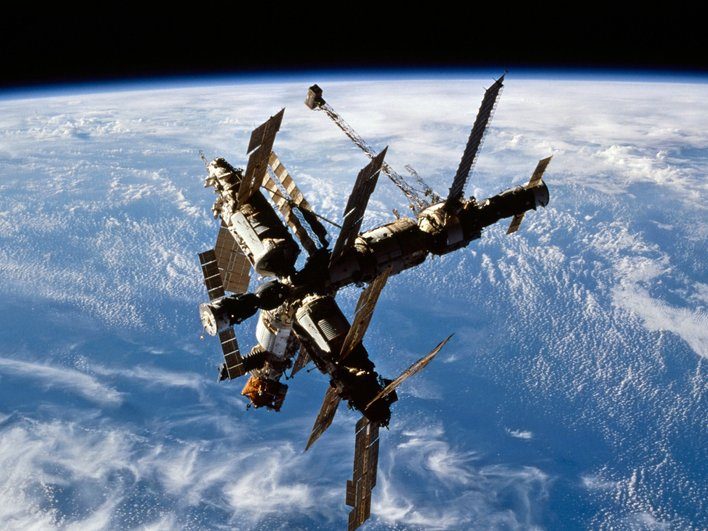
Mir, "peace" or "world" in Russian, was the Soviet and then Russian orbital station that operated in low Earth orbit from 1986 to 2001. It was the first modular space station in history: rather than being launched whole, it was assembled in orbit from seven blocks over ten years. The result was a complex of about 130 tons with the living volume of a small apartment, the largest man-made structure in space of its time.
People lived aboard Mir from March 1986 to June 2000, including a stretch of nearly ten years without a single break. The station hosted more than a hundred cosmonauts and astronauts from twelve countries, survived a fire and a collision, set records that stand to this day, and ended its life in a controlled plunge into the Pacific. An entire epoch fit between its launch and its end: the country that built it ceased to exist in the fifth year of the flight.
A house assembled in orbit
By the mid-1980s the USSR had flown seven stations of the Salyut series, but each was a single piece: what you launched was what you lived in. Mir was conceived differently. The core block, launched on February 20, 1986, was essentially a living quarters with six docking ports: crew cabins, a wardroom, a treadmill. The laboratories would be attached later, by separate launches.
The attaching took ten years: Kvant with its telescopes in 1987, Kvant-2 with an airlock for spacewalks in 1989, Kristall with its furnaces in 1990, Spektr and Priroda with American instruments in the mid-1990s. Each module flew up on its own, docked automatically, and added new capabilities to the shared house. The scheme proved so sound that the present-day ISS is built on it: the Russian segment is a direct descendant of Mir, and the very idea of modular assembly comes from here.
Records that still stand
Mir's main science subject was the human being: the station existed to find out how long people could live in weightlessness. The answer exceeded expectations. In 1987 and 1988 Titov and Manarov spent a full year in orbit for the first time. In 1994 and 1995 the physician-cosmonaut Valery Polyakov lived aboard for 437 consecutive days, fourteen months, longer than the estimated flight to Mars. That single-flight record has never been broken. On return, Polyakov insisted on walking from the descent capsule on his own legs, to prove that after such a stay a human could work on Mars as well.
Records accumulated outside the hull too: Anatoly Solovyev made 16 spacewalks from the station totaling 82 hours, and both marks remain unbeaten. In all, more than twenty thousand experiments were performed on Mir, from semiconductor smelting to the first complete seed-to-seed cycle of wheat grown in weightlessness.
Former enemies on one station
Fate arranged for the Soviet station to become a bridge between worlds. After the collapse of the USSR, Russia had the station but no money; the United States had money but no experience of long flights. Out of this came the Shuttle-Mir program: in June 1995 Atlantis docked with the station, the first docking of American and Russian spacecraft since Apollo-Soyuz in 1975. Over three years the shuttles came to Mir nine times, American astronauts lived aboard for months, and Shannon Lucid set the women's flight duration record there.
For the history of the Cold War this is the final scene with the sign reversed: a station conceived as a trump card in the contest of systems became the place where recent adversaries learned to trust each other. Without that school of joint work there would be no ISS.
1997: the year everything broke
A station rated for five years was flying its second term by the mid-1990s, and age was telling. The worst year was 1997. In February an oxygen canister ignited: the crew fought, through smoke, the only real fire in the history of crewed spaceflight. In June a Progress cargo ship missed during a manual docking test and struck the Spektr module: a breach, the whistle of escaping air, the crew sealing the damaged compartment's hatch by hand. The station was saved, but Spektr stayed depressurized forever.
Computers crashed, systems failed, mold crept through the compartments. The Western press mocked the "flying veteran," while the crews accumulated experience that no new hardware can buy: how to repair a house you cannot step out of. ISS engineers later said plainly that they learned from Mir's emergencies.
The farewell
By the late 1990s Russia was carrying two stations at once: the aging Mir and the ISS under construction. There was not enough money for either. A private company made the last rescue attempt, funding the expedition of 2000, but no miracle followed. The decision to deorbit was made.
On March 23, 2001, the engines of a docked Progress braked the station, and Mir entered the atmosphere over the South Pacific. The debris settled on the "spacecraft cemetery" between New Zealand and Chile; residents of Fiji watched burning fragments cross the sky. In 15 years the station had circled the Earth 86,000 times. In Russia many took the sinking as a personal loss and still argue that the station could have been saved; supporters of the decision answer simply that the resource was exhausted, and keeping people on worn-out hardware meant risking their lives. Both positions are heard to this day.
The name stayed in the sky twice over: an asteroid is named after the station, and Mir's experience lives in every module of the ISS. Fifteen years of one Mir proved the essential thing: humans can not merely visit space but live there.
Frequently asked questions
What was the Mir station, in simple terms? The Soviet and Russian orbital station (1986 to 2001), the first space home in history assembled in orbit from seven modules. People lived aboard almost continuously for fourteen years.
How did Mir differ from earlier stations? Modularity: the Salyuts were launched in one piece, while Mir was built up in space over ten years. The scheme became the standard and the basis of the ISS.
What records were set on Mir? Valery Polyakov lived aboard for 437 consecutive days (1994 to 1995), a single-flight record that still stands. Anatoly Solovyev holds the records for the number of spacewalks (16) and their total duration.
What happened on Mir in 1997? Two serious accidents: an oxygen canister fire in February and a collision with a Progress cargo ship in June that depressurized the Spektr module. The crews coped with both.
Why was Mir deorbited? Its five-year design life had been exceeded threefold, failures were multiplying, and Russia was already building the ISS and could not maintain two stations. On March 23, 2001, Mir was guided into the Pacific in a controlled descent.
Did Americans fly to Mir? Yes, under the Shuttle-Mir program (1995 to 1998): nine shuttle dockings, with American astronauts living aboard for months. It was the first major Russian-American space cooperation after the Cold War.
Related
- Sputnik 1: the first step of the road that peaked with a home in orbit.
- Sergei Korolev: the school from which all Soviet stations grew.
- Buran: the other great project of the same final era.
- The dissolution of the USSR (1991): the event that cut the station's life in two.
Sources
The facts in this article can be verified against authoritative sources:
- Encyclopaedia Britannica, "Mir": https://www.britannica.com/topic/Mir-Soviet-Russian-space-station
- NASA, "20 Years Ago: Space Station Mir Reenters Earth's Atmosphere": https://www.nasa.gov/history/20-years-ago-space-station-mir-reenters-earths-atmosphere/
- Wikipedia, "Mir": https://en.wikipedia.org/wiki/Mir
- Russia Beyond, "10 things you didn't know about the famous Mir space station": https://www.rbth.com/science-and-tech/333568-mir-space-station-facts
- Star Walk, "Mir Space Station: Meaning, History, and Key Facts (1986-2001)": https://starwalk.space/en/news/mir-space-station
Where assessments diverge (whether the station should have been sunk), we give both positions.