Zond 5: The 1968 Lunar Flyby and the Tortoises’ Return
Why Zond 5 carried tortoises around the Moon, how a flyby differed from lunar orbit and why the spacecraft returned to the Indian Ocean.
In September 1968, the Soviet spacecraft Zond 5 travelled around the Moon and returned to Earth carrying biological specimens, including two steppe tortoises. It achieved the first successful return of a spacecraft from a circumlunar flight. No cosmonauts were aboard, although the mission belonged to preparations for future human expeditions.
The result is sometimes reduced to a story about tortoises being sent “to the Moon.” That wording can mislead. The spacecraft neither landed on the lunar surface nor became a lunar satellite. Its trajectory carried it around the Moon and back towards Earth.
What was Zond 5 testing?
NASA's historical account distinguishes the L1 programme, which included the later Zond flights, from the Soviet project to land a person on the Moon. L1 aimed at a flight around the Moon without a landing. Its spacecraft was a modified Soyuz without the usual orbital module, launched by a Proton rocket.
That distinction explains the test's scope. A circumlunar mission had to send a spacecraft to the Moon, sustain the journey and recover it on Earth. A landing programme required additional operations: entering lunar orbit, descending, taking off and then returning. Success with one flight profile did not establish readiness for the other.
The Lunar and Planetary Institute likewise identifies Zond 4 through 8 as tests of technology for future human missions. They also had scientific objectives of their own. The programme's name should therefore not be understood as describing photographic probes alone.
The September flight, step by step
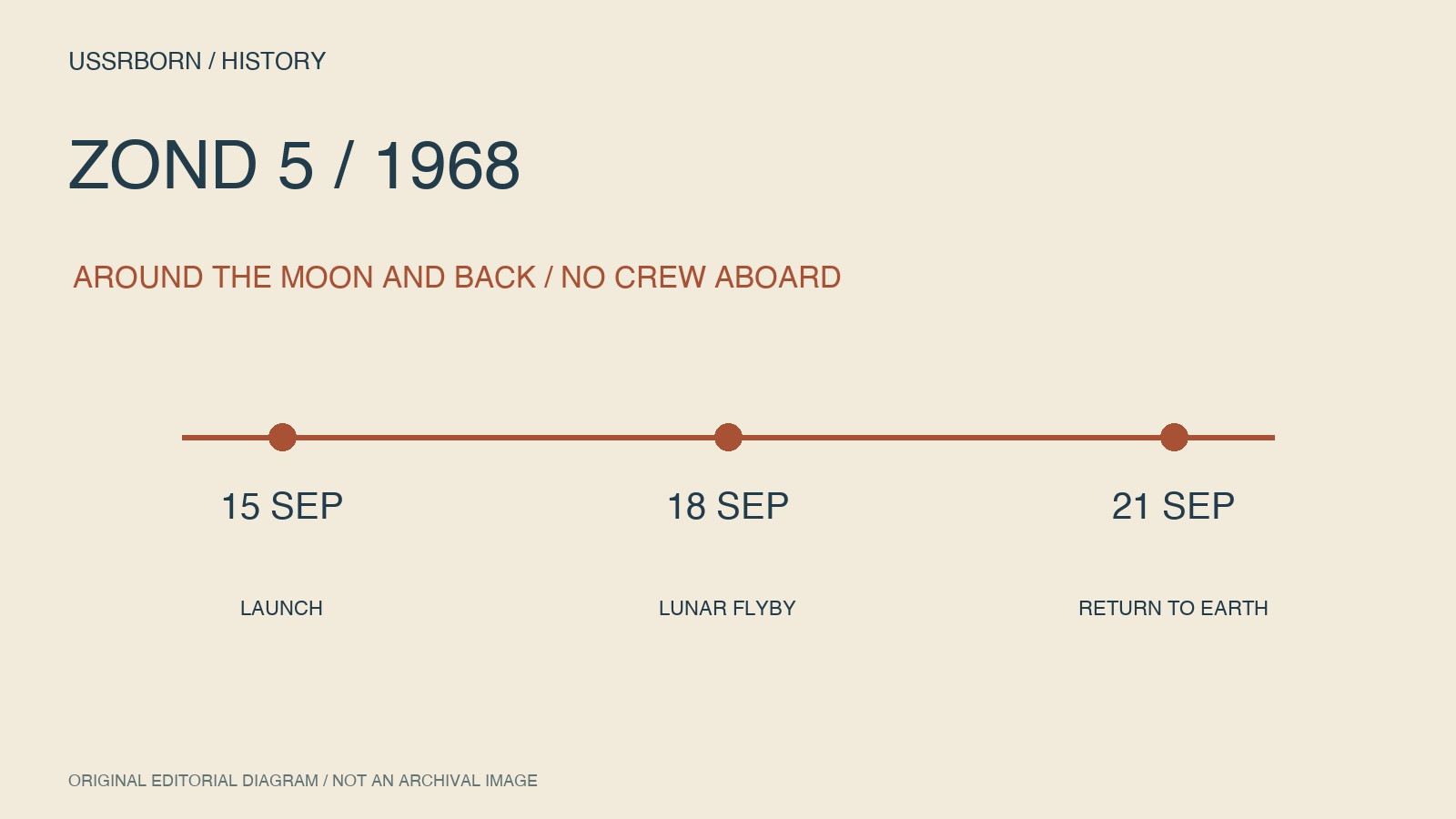
NASA's chronology dates Zond 5's launch to 15 September 1968. After reaching an Earth parking orbit, the spacecraft was sent towards the Moon. On 18 September it passed behind the lunar far side, about 1,950 kilometres above the surface.
Three dates keep the sequence clear:
- 15 September: launch and departure towards the Moon.
- 18 September: lunar flyby.
- 21 September: return of the descent capsule to Earth.
“Flyby” is an essential distinction. Passing the Moon on a returning trajectory differs from entering a closed orbit around it. Zond 5 did not collect lunar soil either: its biological cargo had been launched from Earth.
Why send tortoises?
Besides the two steppe tortoises, the spacecraft carried other biological specimens, including plants and insects. Recovering that cargo allowed examination on Earth, rather than relying solely on measurements transmitted during flight.
NASA's spacecraft image description specifically records that the tortoises survived the Indian Ocean splashdown and were taken to Moscow. Their survival should not, however, be equated with a complete demonstration of safety for cosmonauts. It was an important experimental result, not evidence that every system had worked as intended.
Why was the return off plan?
According to NASA's historical account, a guidance problem during return led to a splashdown in the Indian Ocean instead of the intended landing in Soviet territory. The ship Vasily Golovnin recovered the capsule; it was subsequently transported through Bombay to Moscow.
The mission consequently requires a two-part assessment. The circumlunar flight and recovery of the biological cargo succeeded, but the planned landing sequence did not. That combination of achievement and discovered failure makes Zond 5 an important test: it demonstrated a return from a lunar trajectory while also showing why preparations for carrying people could not yet be considered complete.
Related articles
- Luna 3 and the lunar far side
- Luna 9’s first soft landing
- Luna 16’s sample return
- The Soviet space programme