Luna 2 in 1959: The First Lunar Impact and Its Confirmation
Why Luna 2 was sent to impact the Moon, how Jodrell Bank tracked the flight and why accounts record both 13 and 14 September 1959.
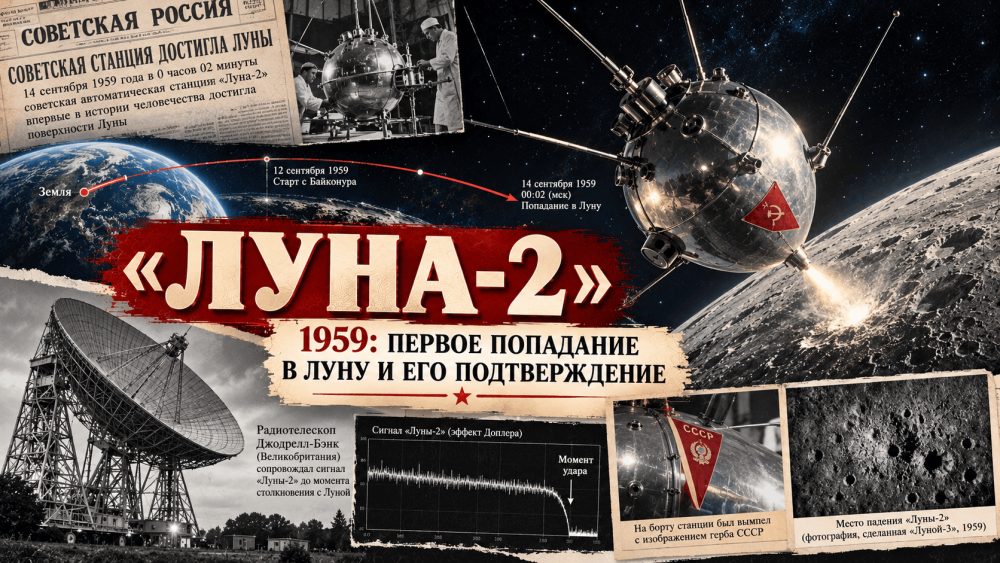
Luna 2 was the first human-made spacecraft to reach the surface of another celestial body. Launched from Baikonur on 12 September 1959, it struck the Moon on the evening of 13 September in Greenwich time, when the date in Moscow had already become 14 September. The impact was planned. It was not a soft landing followed by operations on the ground.
That distinction defines the achievement. The spacecraft was not expected to survive. The task was to put it on a trajectory that met the Moon, maintain radio contact during flight and establish that a machine sent from Earth had reached its destination.
Why an impact was a separate objective
NASA's historical account traces the Soviet programme to a 1958 decision to develop spacecraft for lunar impact and others for photographing the far side. The objectives required different trajectories and equipment. Completing one did not automatically accomplish the other.
The route to success included launch failures. Luna 1, launched in January 1959, passed the Moon and entered an orbit around the Sun. It returned useful information but did not achieve the intended impact. The September flight addressed the particular objective that its predecessor had missed.
The Moon moves around Earth. A rocket cannot simply aim at the visible lunar disc at launch and assume that it will remain there. Its trajectory must bring the spacecraft to the place the Moon will occupy at the time of arrival. This separates an interception problem from the simpler idea of travelling “towards the Moon.”
Launch, flight and two calendar dates
The successful launch took place on 12 September. The Presidential Library gives the Moscow launch time as 09:39:42 and arrival at the surface as 00:02:24 on 14 September. Jodrell Bank's account places the cessation of the radio signal at approximately 21:02 Universal Time on 13 September.
Adding three hours changes the evening entry into the following day's Moscow date. The dates 13 and 14 September can therefore describe the same event. They do not signify two arrivals or the beginning and end of a prolonged landing operation.
Not every discrepancy in reference tables is a time-zone difference, however. Some older summaries give incompatible times. This article uses the mutually consistent British observatory account and Russian library chronology, without suggesting that every published source agrees to the second.
Recording a date together with its time standard is especially important for events close to midnight. Without that information, two accurate calendar entries can appear to contradict each other.
Observing the flight from Earth
Britain's Jodrell Bank radio observatory tracked the spacecraft. Its historical account draws on correspondence, signal recordings and antenna-pointing information supplied from Moscow. The motion of the radio source before transmission stopped mattered as much as the final silence.
In correspondence reproduced by the observatory, staff referred to Doppler measurements as confirmation of impact. This supplied an external check on the Soviet announcement. The received signal could be associated with a tracked trajectory, and contact ended at the expected destination.
A silent transmitter alone would not prove a collision: communications can fail for several reasons. The evidence comes from the combination of direction, changes in the signal over time and the moment at which reception ends. Together, those observations gave a stronger basis for the conclusion than a missing signal in isolation.
The episode also shows that tracking was an active scientific and technical task. A ground station had to know where to point, when the target would become observable and how to interpret the received transmission.
Measurements before arrival
The instruments operated during the journey. NASA reports that they detected no lunar magnetic field or radiation belts under the conditions of those measurements. That is a result from a particular flight and instrument sensitivity, not a claim that every possible magnetic phenomenon on the Moon was excluded.
On the way to the target, the upper stage released a sodium cloud that served as an optical marker. The purpose is straightforward: a small spacecraft is difficult to see at enormous distances, while an expanding luminous cloud offers a different object for observers to detect.
Scientific information had to be transmitted before impact. After the collision, the probe could not continue working as a stationary surface laboratory. Saying that instruments were physically delivered to the Moon does not mean that they remained operational there.
This is one reason mission objectives matter when describing success. Survival on the surface would have required a different kind of spacecraft. Luna 2's destruction at the destination was compatible with the job it had been sent to do.
Pennants and the public meaning of the flight
The spacecraft carried metal objects bearing Soviet emblems. Soon after the mission, Nikita Khrushchev presented Dwight D. Eisenhower with a replica of a spherical pennant during his visit to the United States. NASA connects that object with the Eisenhower museum collection in Abilene, Kansas.
“Replica” is essential here. The gift was not an object recovered from the Moon: the mission had no return journey. A representation of the achievement could be displayed at a diplomatic meeting while the spacecraft itself had ended its flight in a destructive collision.
The object joined two histories, one technical and one public. The mission established an interception capability, while the presentation made the achievement visible in a form that could be held, displayed and preserved.
What Luna 2 did not do
NASA's chronology distinguishes Luna 2's impact, Luna 3's far-side photography and Luna 9's soft landing. The first occurred in September 1959, the photographic mission followed that autumn, and the soft landing came in February 1966.
Luna 2 did not transmit a surface panorama, deploy a rover or return samples. Those achievements required other spacecraft and further engineering. Its own accomplishment is precise enough: a human-made object had reached the lunar surface, and observations from Earth confirmed the event.
The flight also illustrates the importance of the receiving end of early space exploration. A launch became a demonstrated success through trajectories, radio observations and careful timekeeping. Ground observers helped turn a spectacular announcement into a verifiable journey.