Luna 9: How the First Successful Moon Landing Worked
On 3 February 1966, Luna 9 survived a lunar landing and returned pictures from the ground. Its small capsule answered a practical question about exploring the Moon.
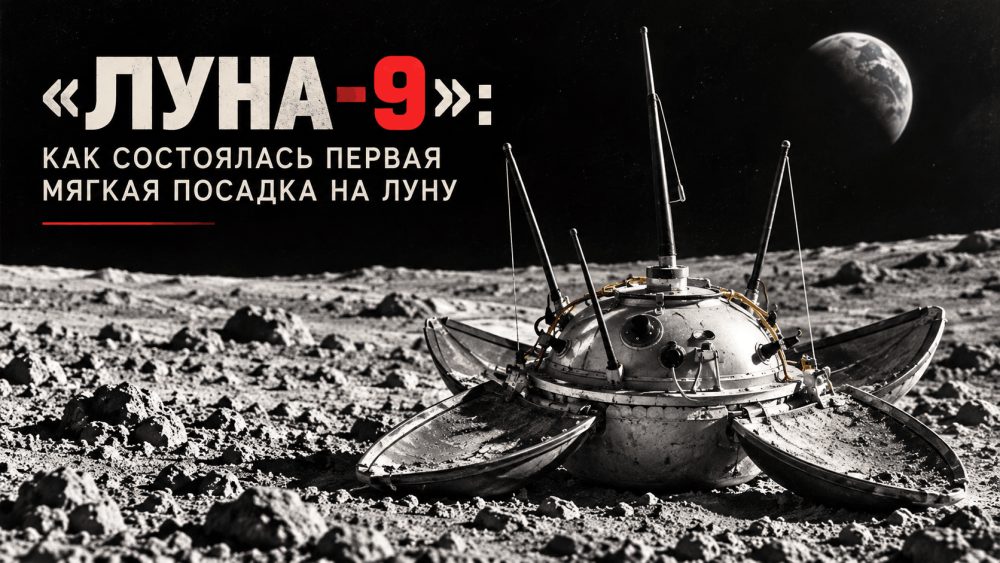
On 3 February 1966, the Soviet spacecraft Luna 9 placed a working capsule on the Moon. The capsule survived touchdown, opened and transmitted pictures of its surroundings. It was the first successful soft landing on the Moon, giving people a view of the lunar horizon from an instrument resting on the ground.
The achievement had a precise scope. Luna 9 did not carry a crew, drive across the landscape or return samples to Earth. Its job was to survive the descent and operate afterward. Completing that sequence turned a distant destination into somewhere a scientific instrument could work.
Why reaching the Moon was not enough
Within the Soviet space program, reaching another celestial body and landing on it were separate challenges. A probe could take pictures during a fast approach even if it would ultimately crash. A lander had to remove most of its velocity and protect its equipment through the final contact with the ground.
The Moon offered no substantial atmosphere for a parachute descent. Rocket propulsion therefore had to do the main braking. Yet slowing the spacecraft did not automatically make the final few metres safe: a remaining impact could damage instruments, leave an antenna poorly oriented or prevent a mechanism from opening.
Luna 9 followed a long sequence of unsuccessful attempts. In the NASA-published Deep Space Chronicle, historian Asif Siddiqi identifies it as the twelfth Soviet attempt at a lunar soft landing. That total includes spacecraft which never made a successful journey toward the Moon. It cannot be reconstructed simply by counting the numbered missions publicly named Luna.
This distinction matters when reading a list of space achievements. A successful mission number is a label, not a complete record of the development effort behind it. Launch failures and unsuccessful approaches were part of the same engineering problem.
A small capsule with a specific purpose
Luna 9 launched on 31 January 1966. During the final approach, the larger spacecraft performed the braking needed to bring a small landing capsule to the surface. An inflatable cushioning arrangement protected the capsule through touchdown.
Once on the ground, the capsule opened four petal-like sections. Its design helped bring the instrument package into a working position, allowing the imaging system to scan the surrounding landscape and the radio equipment to send information home. No wheels were needed for this first demonstration of surface operations.
The term soft landing should not be taken to mean that there was no impact. In this context, it means a landing gentle enough for the spacecraft to remain useful. Luna 9 absorbed the final contact with a protective arrangement around its capsule. Other landers used different combinations of propulsion, landing legs and shock absorption.
Separating those functions helps explain the mission: the spacecraft had to travel to the Moon, reduce its speed, protect the capsule and then establish a usable observing position. Success depended on every stage, not merely on arriving at the correct destination.
The landing site and mission dates
The capsule landed in Oceanus Procellarum, the Ocean of Storms, on the Moon's near side. Despite the name, this lunar sea is a broad dark plain, not a body of water. The station remained in contact for a short mission ending on 6 February.
- 31 January 1966: launch from Earth.
- 3 February: successful landing and the resumption of data transmission.
- Subsequent communications sessions: images of the nearby ground and horizon.
- 6 February: final contact with the spacecraft.
Landing and returning the first surface panorama were successive steps. Saying that the spacecraft photographed the ground at the instant of touchdown obscures what had to happen between them: survival, deployment and the start of surface operations.
What the pictures established
The panoramas revealed stones, shadows and uneven ground around the capsule. Their importance went beyond showing an unfamiliar landscape. A working instrument remained supported at the landing site, providing direct evidence against the idea that a lander would simply disappear into a deep layer of loose dust there.
That result was local. It did not show that the entire Moon had identical ground conditions, nor did it demonstrate an absence of lunar dust. A single stationary capsule could examine only a limited setting. Later landing-site decisions still needed additional observations and measurements.
It is useful to distinguish photographs taken during an approach, pictures from lunar orbit and panoramas recorded on the ground. They can all show the Moon, but they answer different questions. A wide view helps locate features; a surface view shows how a landscape appears beside the instrument. Luna 9 supplied the previously missing ground-level perspective.
Why Jodrell Bank received the pictures
Observers outside the Soviet Union also followed the spacecraft. Jodrell Bank's history describes its staff recognizing an image transmission and using a facsimile receiver borrowed from the Daily Express newspaper. The first reproductions had distorted proportions because the transmission did not match the receiver's usual format.
The episode illustrates the difference between receiving a radio signal and reconstructing an image correctly. It also provided independent evidence that the lander was transmitting from the Moon.
Luna 9 and the wider space race
The mission belonged to the sequence of Soviet achievements that had begun with Sputnik 1. Its purpose nevertheless differed from Yuri Gagarin's orbital flight. Robotic equipment could test a distant environment before people were able to work there.
The development of Soviet lunar probes was connected with Sergei Korolev, while the successful Luna 9 spacecraft was built by the Lavochkin organization. Remembering both helps avoid treating a long technical program as the work of a single person or a single launch team.
On 2 June 1966, the American Surveyor 1 also landed successfully on the Moon using a different descent arrangement. Comparing the two missions shows how engineers could solve the same broad problem in different ways. Luna 9 retains the historical distinction of being the first spacecraft to survive a lunar landing and return information from the surface.
Questions about Luna 9
Was Luna 9 a lunar rover? No. Its capsule stayed at the landing site. It did not drive between different locations.
Did it bring lunar material to Earth? No. The spacecraft did not have a sample-return system. Its results were transmitted by radio.
Were these the first photographs of the Moon? No. The distinction is that they were the first pictures transmitted from the surface following a successful landing. Earlier spacecraft had photographed the Moon from other vantage points.
Did the mission prove that a crewed landing was safe? It established one necessary condition: a working lander could be placed on the surface. It did not test every requirement of a human expedition or settle questions about every possible landing site.
Sources
- NASA: Deep Space Chronicle, Luna 9 entry, p. 53.
- NASA APOD: Luna 9 landing capsule.
- Jodrell Bank: the history of early space tracking.
- NASA: chronology of Moon missions.
- NASA: Surveyor 1 mission history.
Cover: original USSRborn editorial infographic showing mission dates. It is not an archival photograph or a technical drawing of the spacecraft.