Soviet Space Program: From Sputnik and Gagarin to Mir
The USSR launched the first satellite, sent the first human into space and built the first space station, but lost the race to land people on the Moon. The full story from the R-7 and Korolev to Mir.
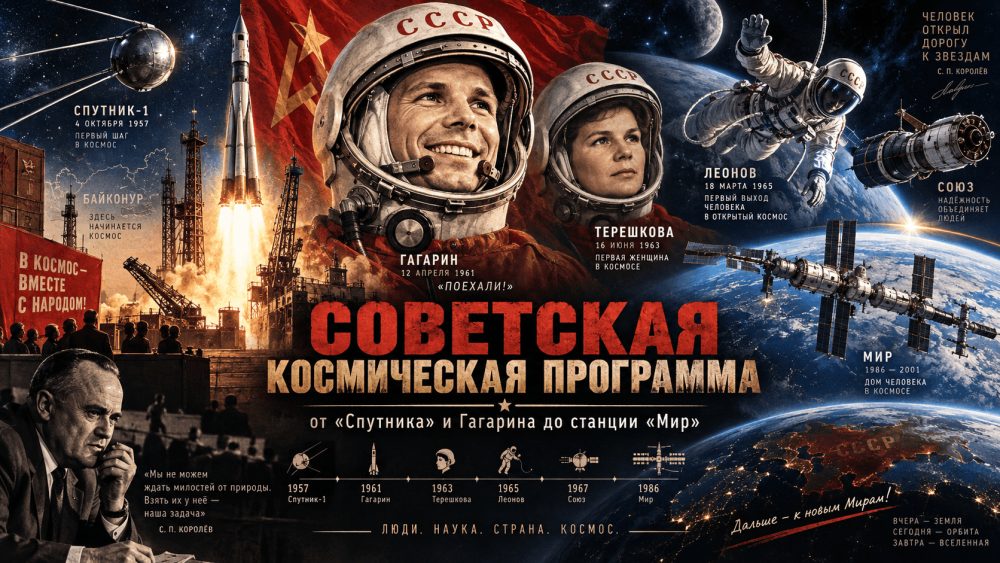
The country that put a radio signal in orbit
On the evening of 4 October 1957, radio operators around the world could hear a simple repeating beep.
The source was above them.
A polished metal sphere about 58 centimeters across was circling Earth. Sputnik 1 was the first artificial satellite, and within hours it transformed Soviet rocketry from a secret world of military test ranges into an international sensation.
Over the following years the USSR accumulated an extraordinary list of firsts: the first animal in orbit, the first human in space, the first woman in space, the first spacewalk, the first survivable landing on the Moon and the first space station.
But the Soviet space program was not a smooth parade of victories.
There were failed launches, dead cosmonauts, competing design bureaus, secrecy that hid setbacks, and a giant Moon rocket called N1 that never completed a successful flight.
That mixture of brilliance and failure makes the story more interesting than the usual list of records.
From Tsiolkovsky to military missiles
The intellectual roots of Soviet spaceflight appeared long before Sputnik.
Konstantin Tsiolkovsky wrote about rocket propulsion and space travel in the early twentieth century. During the 1930s, Soviet engineers experimented with liquid-fueled rockets and increasingly powerful engines.
World War II changed the scale of the work.
After 1945, both the Soviet Union and the United States studied the German V-2 rocket and made use of German expertise and documents. Soviet missile development soon moved beyond direct copies.
The central figure was Sergei Korolev.
For years his name was secret. Soviet newspapers called him only the "Chief Designer." Korolev led development of the R-7 intercontinental ballistic missile.
Its military origin mattered enormously.
The R-7 was powerful enough to place a useful payload into orbit.
Sputnik 1: 4 October 1957
Soviet engineers originally intended to launch a more sophisticated scientific satellite.
It was taking too long.
Korolev feared the United States might get to orbit first, so his team developed a simpler spacecraft: a metal sphere, batteries, antennas and radio transmitters.
It worked.
On 4 October 1957 an R-7 launched Sputnik 1. The satellite weighed about 83.6 kilograms and transmitted a radio beacon that listeners across the world could receive.
Scientifically, Sputnik was simple.
Politically, it was explosive.
If the Soviet Union could place an object into orbit, it had also demonstrated the power of the rockets behind the launch. In the nuclear age, that had obvious military implications.
The United States entered what became known as the Sputnik crisis. NASA was created in 1958.
Read more: Sputnik 1 and the beginning of the Space Age.
Laika: a triumph with a grim reality
Only a month later came another headline.
On 3 November 1957, Sputnik 2 carried the dog Laika into orbit.
She was the first living creature from Earth to orbit the planet.
There was no plan to bring her home.
For years, official Soviet accounts suggested that Laika survived for days in orbit. Later information showed that she died much earlier from overheating and stress.
The mission provided information about the response of a living organism to spaceflight, but it also raises obvious ethical questions when viewed today.
Read more: Laika, the first dog in orbit.
Luna: winning records without a crew
The Soviet robotic lunar program produced some of the most remarkable achievements of the early space age.
In 1959, Luna 1 became the first spacecraft to reach escape velocity and enter an orbit around the Sun. Luna 2 became the first human-made object to reach the surface of another celestial body.
Later that year, Luna 3 photographed the far side of the Moon, which can never be seen directly from Earth.
In 1966, Luna 9 achieved the first survivable landing on the Moon and sent images from the surface.
Weeks later, Luna 10 became the first spacecraft to orbit the Moon.
In 1970, Luna 16 returned samples of lunar soil to Earth robotically.
There is an important irony here. Soviet robotic missions were achieving extraordinary lunar results at the same time that the crewed Moon program was running into increasingly serious trouble.
Yuri Gagarin: 108 minutes that changed the world
The most famous Soviet triumph came on 12 April 1961.
Yuri Gagarin became the first human in space aboard Vostok 1.
His flight lasted 108 minutes. He completed one orbit of Earth and returned alive.
The Soviet Union suddenly had a perfect public face for its technological success: a young pilot with an unmistakable smile and a biography rooted in an ordinary family.
Behind the celebration was considerable risk.
The effects of weightlessness on a human were not fully understood. The flight was largely automatic. During reentry, the spacecraft's equipment and descent modules did not separate cleanly at first.
Gagarin eventually ejected from the capsule and landed separately by parachute.
Read more: Yuri Gagarin, the first human in space.
Valentina Tereshkova: first woman in space
Vostok 6 launched on 16 June 1963.
Its pilot was 26-year-old Valentina Tereshkova, a former textile worker and amateur parachutist.
She became the first woman to travel into space.
Tereshkova spent nearly three days in orbit and circled Earth dozens of times. The flight was both a technical mission and a powerful Soviet political symbol.
But it did not lead to continuous equal participation by women in the Soviet cosmonaut corps. Nineteen years passed before another Soviet woman flew in space.
Read more: Valentina Tereshkova.
Alexei Leonov: stepping outside
On 18 March 1965, Alexei Leonov left Voskhod 2 and became the first person to walk in space.
The achievement nearly became a disaster.
In vacuum, his spacesuit expanded more than expected, making it difficult to move and nearly impossible to reenter the airlock. Leonov had to reduce pressure inside the suit and depart from the original procedure to squeeze back in.
The problems did not end there. The crew later had difficulty with spacecraft orientation and made a manual landing far from the planned recovery zone.
Leonov survived and became one of the best-known Soviet cosmonauts.
Read more: Alexei Leonov and the first spacewalk.
Why the Soviet Union lost the crewed Moon race
After the early Soviet victories, the United States chose one clear target.
In May 1961, President John F. Kennedy committed the United States to landing a person on the Moon and returning him safely before the end of the decade.
The Soviet response was less unified.
The USSR had no single civilian space agency fully equivalent to NASA. Powerful design bureaus competed for projects, funding and political support.
Korolev's organization developed the N1 heavy rocket and a plan for a single cosmonaut to land on the Moon. Other organizations promoted rival systems and circumlunar missions.
Formal political commitment to the landing program came relatively late.
Then Sergei Korolev died unexpectedly in January 1966.
His death removed the one engineer with the authority and political skill most closely associated with the early Soviet victories.
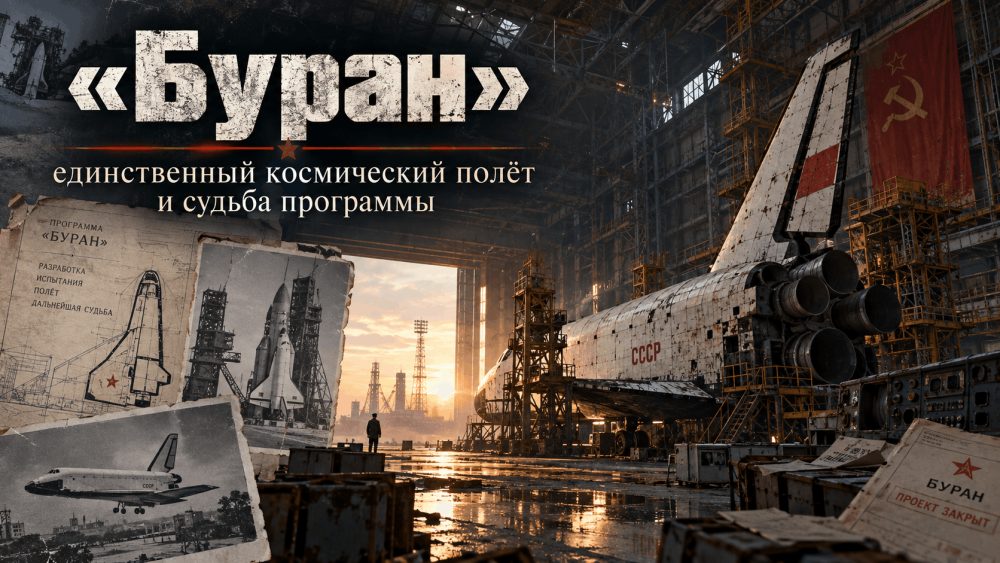
N1: the giant rocket that never worked
The N1 was intended as the Soviet counterpart to the American Saturn V.
Its first stage used 30 engines. That approach avoided the need for one extremely large engine, but created a difficult control and plumbing problem.
Between 1969 and 1972, four N1 test launches were attempted.
All four failed.
During the second launch in July 1969, the rocket fell back near the launch complex and produced a massive explosion.
Only weeks later, Apollo 11 landed Neil Armstrong and Buzz Aldrin on the Moon.
Once the United States had achieved the landing, the political meaning of the race changed. Soviet support for the crewed lunar program faded, and the N1 project was eventually canceled.
For decades, the USSR did not publicly acknowledge the full scale of its attempt to land a cosmonaut on the Moon.
Venus: where Soviet probes excelled
If the crewed lunar program failed, the robotic exploration of Venus became one of the strongest Soviet achievements.
Venus is an exceptionally hostile world. Surface temperatures are around 465 degrees Celsius, pressure is many times greater than at sea level on Earth, and the atmosphere is chemically harsh.
Early probes failed.
Engineers kept redesigning them.
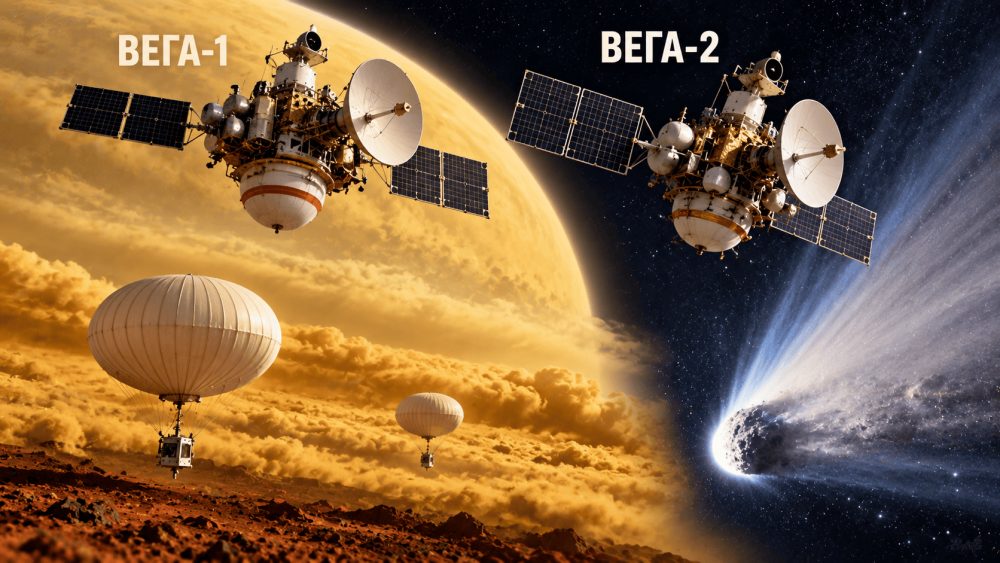
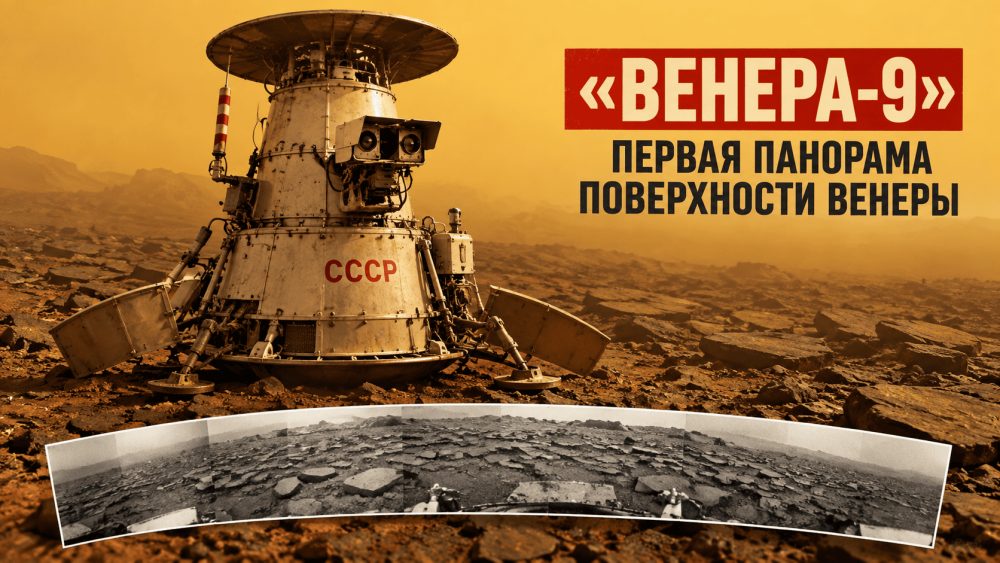
In 1970, Venera 7 became the first spacecraft to transmit data from the surface of another planet after landing.
Later Venera missions returned surface photographs and chemical measurements.
These missions receive less popular attention than Gagarin or the Moon race, but technically they were extraordinary.
Salyut 1: the first space station
After the Moon race, Soviet human spaceflight increasingly focused on long-duration operations in Earth orbit.
On 19 April 1971, the USSR launched Salyut 1, the world's first space station.
The first crew sent to it failed to dock properly.
The second crew, aboard Soyuz 11, successfully occupied the station for weeks. Their return ended in tragedy when the spacecraft depressurized and Georgy Dobrovolsky, Vladislav Volkov and Viktor Patsayev died.
The Soyuz system was modified after the accident.
Later Salyut stations allowed the Soviets to develop longer expeditions, resupply techniques, docking procedures and the practical skills required to keep people living in orbit.
Soyuz: the spacecraft that outlived the USSR
The first crewed Soyuz launched in 1967.
Soyuz 1 ended with the death of Vladimir Komarov when the spacecraft's parachute system failed during return.
It was a terrible beginning, but the basic design proved remarkably adaptable.
Soyuz evolved through repeated modernization and became the central crew transport system of the Soviet orbital program.
In July 1975, a Soviet Soyuz docked with an American Apollo spacecraft.
The Apollo-Soyuz Test Project was the first joint crewed space mission by the two superpowers and a memorable symbol of Cold War detente.
Mir: the Soviet orbital idea reaches maturity
The base block of Mir reached orbit on 20 February 1986.
Unlike early Salyut stations, Mir was modular. Additional laboratories and technical modules could be attached to the core after launch.
That made it possible to build a larger orbital complex over time instead of launching the whole station at once.
Crews lived aboard for months. Soviet cosmonauts set endurance records, studied the effects of long exposure to microgravity and learned how to maintain a large space complex continuously.
Mir then outlived the country that created it.
The Soviet Union disappeared in 1991, but Mir continued operating under Russian control. During the 1990s it hosted American Space Shuttle dockings and international crews.
The experience gained on Mir became an important technical bridge to the International Space Station.
Read more: The Mir space station.
Why the Soviet program was both brilliant and chaotic
Looking only at the early records can make the system seem almost perfectly coordinated.
It was not.
There was no single Soviet institution identical to NASA. Major design bureaus led by Korolev, Vladimir Chelomei, Mikhail Yangel and others could cooperate, but they also competed for military orders, funding and political influence.
Secrecy had a double effect.
It protected military technology and allowed surprise announcements of successful missions. It also hid failures and limited open discussion.
Launches that failed before a spacecraft received an official public name were often simply never announced.
A success could become a worldwide headline. A failure might remain buried in archives for decades.
The major Soviet space firsts
The list remains impressive:
- 1957: first artificial Earth satellite, Sputnik 1;
- 1957: first animal in orbit, Laika;
- 1959: first spacecraft to reach the Moon, Luna 2;
- 1959: first photographs of the Moon's far side, Luna 3;
- 1961: first human in space, Yuri Gagarin;
- 1963: first woman in space, Valentina Tereshkova;
- 1965: first spacewalk, Alexei Leonov;
- 1966: first survivable landing on the Moon, Luna 9;
- 1966: first spacecraft to orbit the Moon, Luna 10;
- 1970: first transmission from the surface of another planet, Venera 7;
- 1971: first space station, Salyut 1;
- 1986: launch of the Mir modular station.
That does not mean the USSR "won the space race" in some final, universal sense.
There was no single finish line.
The Soviet Union dominated many early milestones. The United States achieved the defining symbolic goal of the 1960s by landing humans on the Moon. The USSR then developed long-duration orbital stations into one of its strongest specialties.
What survived after 1991
The Soviet space system was divided among newly independent states.
Baikonur Cosmodrome was now located in independent Kazakhstan. Many major design organizations remained in Russia, while important aerospace industries also existed in Ukraine and other former republics.
Russia continued operating Soyuz spacecraft and Mir, and later became a major partner in the International Space Station.
Some Soviet technologies survived the Soviet political system by decades.
Soyuz is the clearest example. Its roots stretch back to 1960s lunar plans, yet descendants of the design continued flying in a completely different political era.
Frequently asked questions
When did the Soviet space program begin?
Its roots go back to prewar rocket research, but the beginning of the Space Age is usually marked by Sputnik 1 on 4 October 1957.
Who ran the Soviet space program?
There was no single director of the entire program. Sergei Korolev was the most important figure in the early era, but several major design bureaus worked in parallel.
Which country sent the first human into space?
The Soviet Union. Yuri Gagarin flew on 12 April 1961.
Why did the USSR fail to land a person on the Moon?
The crewed lunar effort started late, suffered from competition between design organizations and faced severe technical problems. The N1 heavy rocket failed in all four test launches.
What was the main Soviet success after the US Moon landing?
Long-duration space stations. The USSR launched Salyut 1 in 1971 and later built the modular Mir station.
Was Mir a Soviet station?
Yes. The Soviet Union launched its core module in 1986. After the USSR collapsed, Mir continued operating under Russian management until 2001.
Related articles
Sources
- NASA History, *Sputnik and the Dawn of the Space Age*: https://www.nasa.gov/wp-content/uploads/static/history/sputnik.html
- NASA, *Soviet Missions to the Moon*: https://nssdc.gsfc.nasa.gov/planetary/lunar/lunarussr.html
- NASA Science, *Deep Space Robotic Firsts*: https://science.nasa.gov/deep-space-exploration/
- NASA, *History's Highest Stage* (Salyut and Mir): https://www.nasa.gov/history/SP-4225/hhs/hhs.htm
- NASA, *Sputnik Biographies: Sergei P. Korolev*: https://www.nasa.gov/history/sputnik/korolev.html