Apollo-Soyuz: a handshake above the planet
Two spacecraft of two enemies docked in orbit, and a hand extended through a hatch over France. How the USSR and the USA flew to space together at the height of the Cold War, why Leonov brought tubes labeled "vodka," and why the ISS would not exist without this flight.
What this flight was
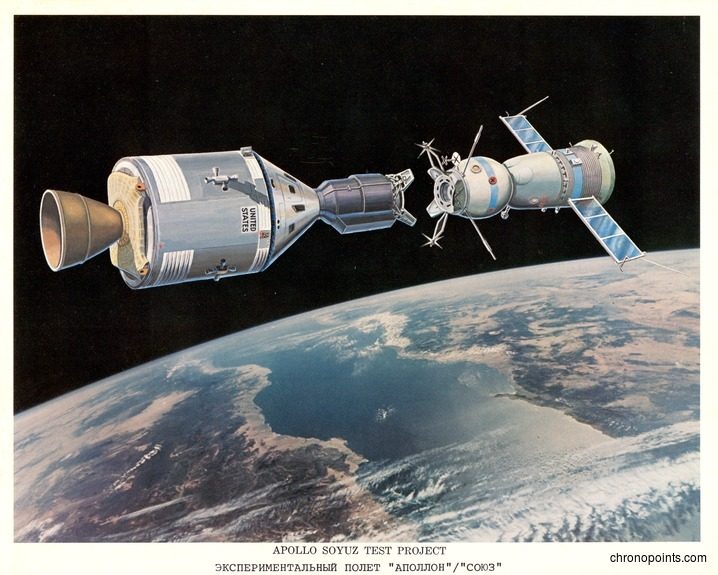
Apollo-Soyuz (in the USSR the project was named in the reverse order, Soyuz-Apollo) was the first joint space flight of two countries in history: on July 15 to 21, 1975, the Soviet Soyuz 19 and the American Apollo met in orbit, docked, and flew as a single complex for nearly two days. On July 17 the two commanders, Alexei Leonov and Thomas Stafford, shook hands through the open hatch.
The event's meaning went far beyond engineering. Two superpowers whose missiles were aimed at each other showed that they could dock spacecraft rather than warheads. For the Cold War it was the high point of detente; for spaceflight it was the beginning of everything we now consider normal: without the handshake of 1975 there would have been no Shuttle-Mir program and no ISS.
From the race to the handshake
In 1969 such a thing was still unthinkable: space was a racetrack, and each side kept score. But by the early 1970s the race had exhausted itself along with the budgets, and politics turned toward detente. In May 1972 Nixon and Kosygin signed the agreement on a joint flight. The gesture was political above all, but a practical logic stood behind it: if the two countries' spacecraft learned to dock, any crew in orbit could count on rescue by the other side's ship.
The engineers received problems nobody had solved before. The ships breathed differently: Apollo ran on pure oxygen at low pressure, Soyuz on a nitrogen-oxygen mix at nearly sea-level pressure; a direct transfer between them would have ended in the bends. The answer was a special docking module that worked as an airlock, carried into orbit by Apollo. The second problem was the docking itself: existing mechanisms followed the probe-and-cone scheme, and the eternal question of who receives whom carried an unpleasant political flavor. For this flight an androgynous unit called APAS was created, with identical petal-shaped plates on both sides: an engineering solution that was also a diplomatic one. Its descendants serve on the ISS to this day.
The people prepared too. The crews learned each other's languages and spent years training in each other's countries; Leonov later joked that Stafford spoke not Russian but "Oklahomski," with his indestructible accent. The lineups proved symbolic on both sides: the Soviet ship was commanded by Alexei Leonov, the first human to walk in space, with flight engineer Valery Kubasov, while the American crew of Stafford and Vance Brand included Donald "Deke" Slayton, an astronaut of NASA's first group who had been grounded by doctors back in the Mercury era: he waited fifteen years for his launch and flew at 51.
Two days as one crew
On July 15, 1975, the ships launched from opposite ends of the planet: Soyuz 19 from Gagarin's pad at Baikonur, Apollo from Cape Canaveral seven and a half hours later. Two days went into the rendezvous, and on July 17 the ships touched gently over the Atlantic. Three hours later, pressures equalized, the hatch opened. "Come in here and shake hands," Stafford called, and over the French city of Metz came the handshake watched live in both hemispheres.
Then came nearly 47 hours of shared life: crew transfers, joint experiments, meals in each other's ships, and a call from President Ford. In orbit the crews assembled a commemorative plaque from two halves, one carried on Soyuz and the other on Apollo, signed a joint document certifying the first international docking, and exchanged small flags and tree seeds; a United Nations flag that launched on Soyuz returned to Earth on Apollo and stands today at UN headquarters. There was also Leonov's famous prank: he handed the Americans tubes labeled "vodka" that turned out to contain borscht. After undocking, the ships performed one more practice docking and parted: Soyuz landed on July 21, Apollo splashed down on the 24th.
Not everything went smoothly, and we say so plainly. During the second docking test an accidentally fired Apollo thruster jolted the joined ships dangerously; Leonov later admitted that Soyuz had been a hair from serious damage. And on descent the American crew, because of a valve left open at the wrong moment, breathed toxic propellant fumes: Brand lost consciousness twice, and after splashdown the astronauts were treated in hospital. Space did not become safer just because the flight was friendly.
What remained of the handshake
The flight left two kinds of memory. The everyday kind: in the USSR a cigarette brand called Soyuz-Apollo was named after it, a joint product with an American tobacco company, and for a whole generation that smell was detente itself. And the historical kind: Apollo never flew again, this mission being the last of the great lunar program, and the two countries had to wait twenty years for their next meeting in space, the shuttle's docking with the Mir station in 1995. Detente ended with Afghanistan, but the handshake outlived the politics that produced it: the engineering ties, the docking standards and the very habit of talking survived all the way to the ISS.
Stafford and Leonov remained friends for the rest of their lives, more than forty years, families included. That may be the flight's most precise result: politics discharges and recharges, but a handshake stays a handshake.
Frequently asked questions
What was the Apollo-Soyuz flight? The first joint space flight of the USSR and the USA (July 15 to 21, 1975): the docking of Soyuz 19 and Apollo in orbit and nearly two days of joint crew operations.
When did the handshake in space happen? On July 17, 1975, about three hours after docking, over France. The hands belonged to the commanders, Alexei Leonov and Thomas Stafford.
Why did the ships need a special module? Their atmospheres differed: Apollo flew on pure oxygen at low pressure, Soyuz on a mix at nearly sea-level pressure. The docking module worked as an airlock and made transfers possible without decompression sickness.
What is an androgynous docking unit? The APAS mechanism, identical on both sides: no "active" and "passive" half. It was created for this flight, and its descendants are used on the ISS.
Who was in the crews? USSR: Alexei Leonov and Valery Kubasov. USA: Thomas Stafford, Vance Brand and Donald Slayton, who had waited fifteen years for his first flight and launched at 51.
What did the flight give spaceflight? Compatibility standards, experience of joint operations and a precedent of trust, out of which grew Shuttle-Mir and the ISS. For Apollo the mission was the last in its history.
Related
- Alexei Leonov: commander of Soyuz 19 and the man of the handshake.
- The Cold War: the confrontation at whose gentlest moment the flight took place.
- The Mir station: the two programs' next meeting, twenty years later.
- Yuri Gagarin: Soyuz 19 left Earth from his launch pad.
Sources
The facts in this article can be verified against authoritative sources:
- NASA, "45 Years Ago: Historic Handshake in Space": https://www.nasa.gov/history/45-years-ago-historic-handshake-in-space/
- Smithsonian National Air and Space Museum, "Apollo-Soyuz Test Project": https://airandspace.si.edu/stories/editorial/apollo-soyuz-test-project
- Space.com, "50 years after a historic handshake in space": https://www.space.com/space-exploration/apollo/50-years-after-a-historic-handshake-in-space-the-apollo-soyuz-test-projects-legacy-still-resonates
- Astronomy.com, "50 years since the 'Handshake in Space': The legacy of Apollo-Soyuz": https://www.astronomy.com/space-exploration/50-years-since-the-handshake-in-space-the-legacy-of-apollo-soyuz/
- TheCollector, "Apollo-Soyuz Test Project: A Soviet-American Handshake in Space": https://www.thecollector.com/apollo-soyuz-us-ussr-project/
The flight's incidents (the thruster misfire at the second docking, the Apollo crew's poisoning on descent) are described from participants' accounts and official materials.