Luna 1: A Missed Moon and the First Orbit Around the Sun
How Luna 1 missed its intended lunar impact and entered solar orbit, why it released a sodium cloud and what its scientific instruments measured.
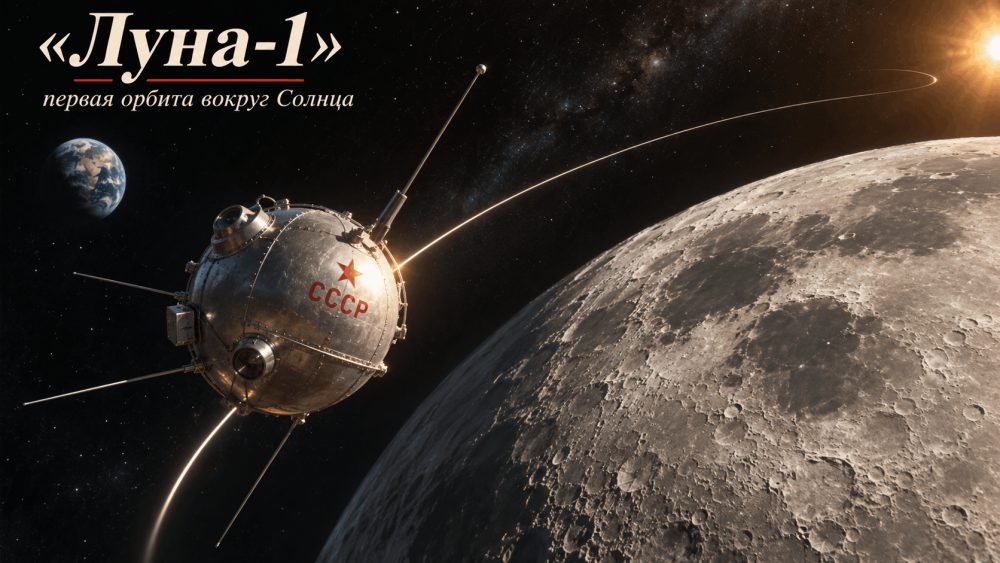
On 2 January 1959, the spacecraft later named Luna 1 lifted off from Baikonur. It was intended to strike the Moon, but instead passed it and became the first spacecraft to enter orbit around the Sun. Its history therefore combines an unfulfilled primary objective with a genuine first in space exploration.
The intended mission
NASA's Deep Space Chronicle identifies the spacecraft as Ye-1 No. 4, developed by OKB-1. Its objective was lunar impact. This was fundamentally different from a soft landing: the craft was not expected to brake at the surface and continue operating after touchdown. Entering lunar orbit was not the task either.
Three Soviet attempts in 1958 had ended in launch failures before the successful January flight. Luna 1 advanced beyond those attempts during its departure from Earth. Its upper stage supplied the velocity needed to travel out towards the Moon.
NASA historian John Uri describes the miss as the consequence of the upper stage burning longer than intended. Asif Siddiqi's chronology uses the broader description of a guidance-system problem. For an account of the mission, the firm outcome matters most: the planned impact trajectory was not achieved.
Why the flyby distance varies between sources
The spacecraft passed the Moon on 4 January. The German Aerospace Center's mission archive gives a distance of 5,995 kilometres. Deep Space Chronicle gives 6,400 kilometres, approximately 34 hours after launch.
These figures should not be quietly converted into one supposedly exact value. The accounts offer different estimates, so a distance of roughly six thousand kilometres is appropriate in a general description. The variation does not change the central event: no contact with the surface occurred, and the spacecraft continued into interplanetary space.
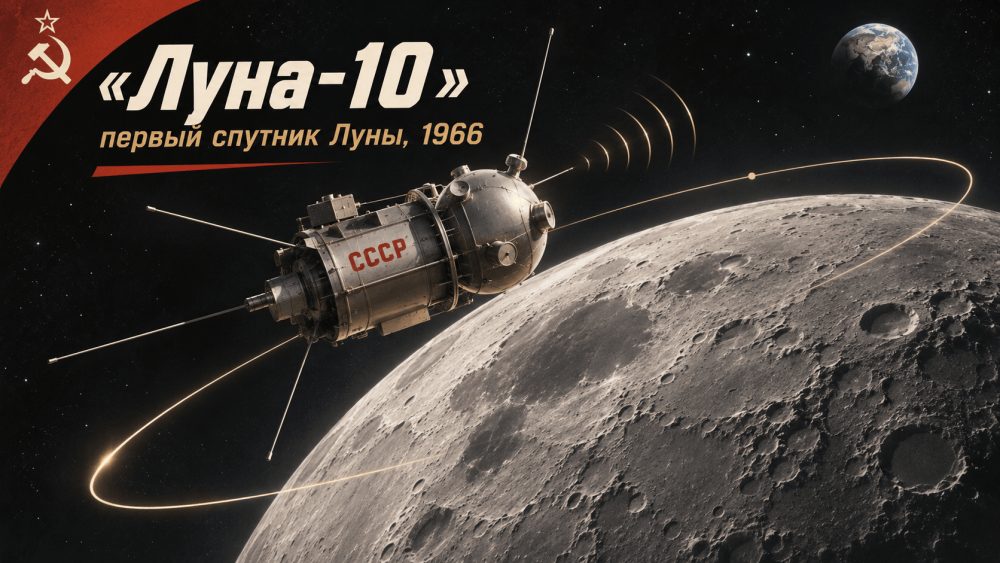
A flyby is also different from becoming a lunar satellite. Luna 1 passed the Moon once; it did not settle into repeated revolutions around it. That distinction separates this mission from later lunar orbiters.
The sodium cloud seen from Earth
Before the lunar encounter, the upper stage released about one kilogram of sodium. Astronomers on Earth photographed the resulting cloud. This was an artificial object used for optical observation of the flight, rather than a photograph of the Moon taken by the spacecraft.
Siddiqi dates the release to 00:57 Universal Time on 3 January and gives a distance of 113,000 kilometres from Earth. NASA's popular historical account instead gives approximately 74,000 miles. The purpose of the experiment can be explained without choosing between those inconsistent distance figures.
Radio communication and optical observation served different functions. Radio carried instrument results, while the cloud made a distant object visible to ground observers. Mentioning the cloud should not create the mistaken impression that Luna 1 transmitted lunar photographs.
A scientific spacecraft even without a landing
The instrument list included a magnetometer, particle counters, a micrometeoroid detector and ion traps. The craft could perform useful investigations while travelling. Measurements along its route offered access to an environment that observations from Earth's surface alone could not fully describe.
NASA's solar-science timeline places Luna 1 among the first direct measurements of the solar wind, the stream of charged particles from the Sun. It connects the observations made in 1959 with confirmation by Mariner 2 during its journey to Venus in 1962. This presents the finding as part of a developing body of evidence rather than an isolated event.
The flight also returned information on radiation and magnetic fields. A brief statement that no lunar magnetic field was detected should not be enlarged into a claim that the Moon has no magnetic phenomena of any kind. A particular instrument's observation and a complete description of a celestial body are different levels of conclusion.
Loss of contact was not a crash
Controllers maintained communication for approximately 62 hours after launch. NASA's account attributes the end of contact to depleted batteries. By then, the spacecraft had become an object travelling around the Sun.
A heliocentric orbit does not mean that gravity disappeared or that the craft left the Solar System. It describes motion around the Sun. Likewise, a transmitter can stop because its power supply runs out without the spacecraft having to strike anything or break apart.
This distinction is useful when reading mission summaries. The end of scientific operations describes the period during which observations can be received. It does not necessarily describe the end of the physical object.
The name Luna 1 was assigned later: NASA dates the retrospective naming to 1963. Contemporary accounts referred to a Cosmic Rocket. Researchers looking through newspapers may therefore need a different search term from the name used in modern mission lists.
Assessing the outcome
Two questions give a more accurate assessment than a single label of success or failure. Did the craft carry out its intended lunar impact? It did not. Did it reach a new kind of trajectory and obtain scientific observations? It did.
Later spacecraft separately tackled impact, photography of the far side, soft landing and lunar orbit. Keeping those objectives distinct makes the programme intelligible as a series of engineering steps. Luna 1 belongs at the beginning of that sequence because its missed target still produced a flight beyond Earth's immediate surroundings.
The cover uses three stages to summarize the mission. It is an original explanatory diagram, not a calculated trajectory or an archival photograph.