Luna 3: How the Moon’s Far Side Was Photographed in 1959
How Luna 3 photographed the Moon’s far side on 7 October 1959: the flyby, onboard film development, radio transmission and what the first images revealed.
On 7 October 1959, the Soviet Luna 3 spacecraft photographed the far side of the Moon. The pictures were indistinct, but they revealed terrain that could not be viewed directly from Earth. Taking them required more than reaching the Moon: the spacecraft had to expose photographic film, develop it automatically and transmit the resulting images home by radio.
The mission is easier to appreciate when those steps are separated. A camera far from Earth is useful only if its observations can eventually reach the people who need to interpret them.
Why the far side is hidden, but not permanently dark
The Moon rotates on its axis in approximately the same time that it takes to orbit Earth. As a result, roughly the same hemisphere remains directed towards us. Small variations in the visible region do not give terrestrial observers a direct view of the central far side. Building a more powerful telescope does not remove that geometric obstacle.
The hidden hemisphere still receives sunlight. It has its own cycle of day and night. This NASA Scientific Visualization Studio explanation shows the changing illumination of the far side and the differences in its terrain. “Far” describes its position relative to Earth; “dark” describes illumination at a particular time. The terms are not interchangeable.
The practical answer was to move the observer. Luna 3 carried its camera to a position from which the illuminated far side could be photographed. The mission changed the viewing geometry rather than overcoming it with greater magnification.
Launch, flyby and photography were separate events
Luna 3 was launched on 4 October 1959. It passed the Moon on 6 October and began photography the following day, looking back towards the illuminated surface after the encounter. The sequence is described in NASA's historical account of the 1959 lunar missions.
Three dates therefore belong in a short chronology:
- 4 October: launch from Earth;
- 6 October: passage near the Moon;
- 7 October: photography of the far side.
The launch anniversary is not the anniversary of the first exposure. Keeping them separate prevents a simple but consequential error in retelling the mission.
Only two years earlier, Sputnik 1 had demonstrated artificial satellite flight around Earth. The new experiment aimed to return visual information from the vicinity of another celestial body. A radio transmission now had to carry an observation of previously unseen terrain, rather than merely demonstrate that a spacecraft was operating.
A photographic laboratory without a photographer
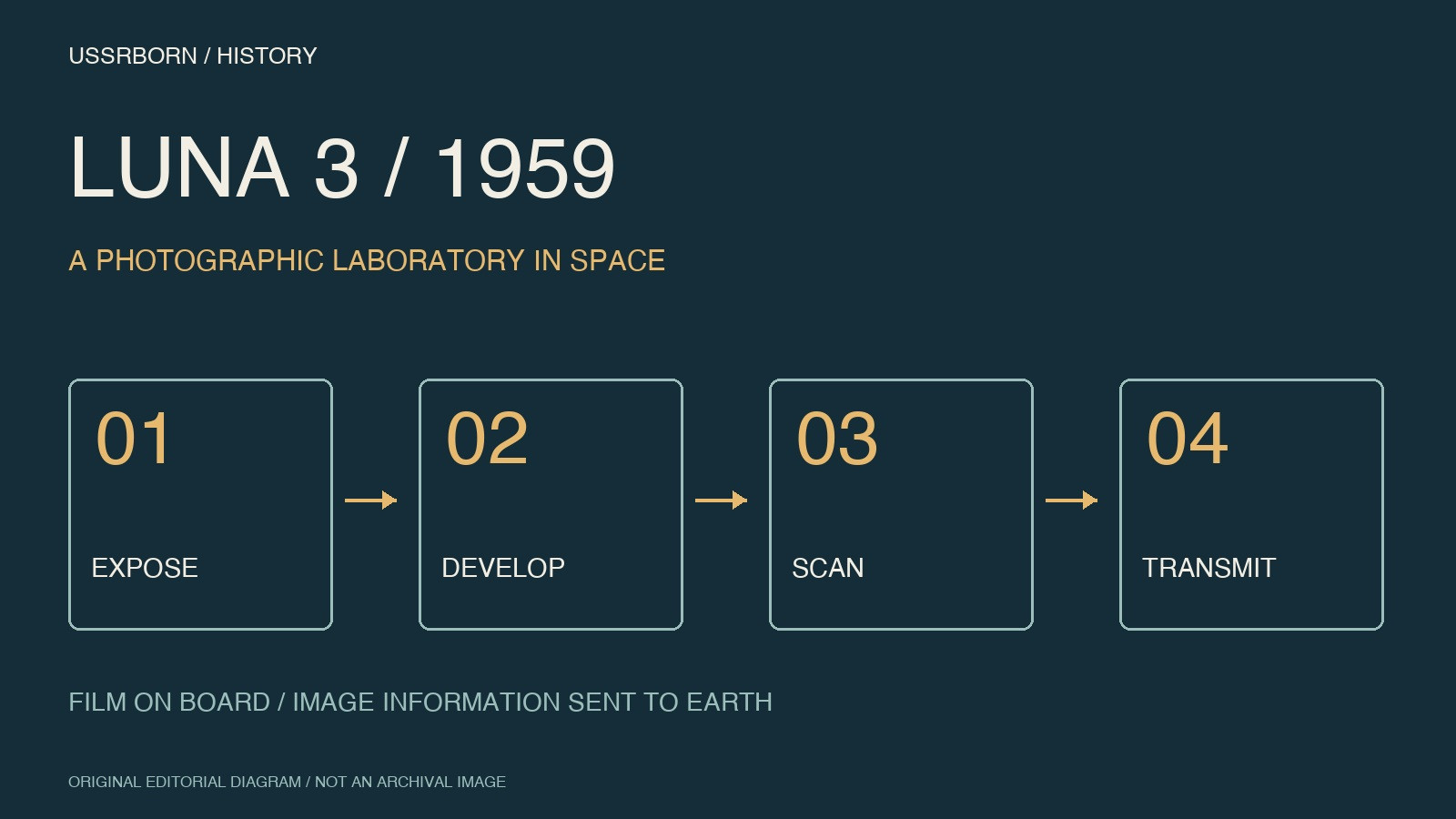
Luna 3 used photographic film. Light produced a latent image that had to be chemically developed before it could be read. On Earth, a photographer could perform that work in a laboratory. A distant spacecraft required an automatic system to carry out the process.
After processing, the images were scanned so that variations between lighter and darker regions could be represented by a signal. NASA's account, The Averted Side of the Moon, describes 35-millimetre film, automatic development, scanning and subsequent transmission to Earth.
The film itself did not have to be returned. What arrived was information describing the picture. A useful way to follow the process is to distinguish four stages:
- The camera forms an optical image on the film.
- Chemical processing makes that image available for reading.
- A scanner reads the image progressively.
- A radio link carries the resulting information to receiving equipment on Earth.
This is an explanation of the sequence, rather than a claim that the spacecraft worked like a modern digital camera. The distinction matters because each stage posed a separate problem. A successful exposure would have been of little scientific use if the image could not subsequently be processed or communicated.
Thinking of the craft as a remote laboratory also changes the meaning of “taking a photograph.” The experiment did not end when the camera operated. Its result became useful only when investigators received enough information to reconstruct and study the picture.
What the pictures revealed
NASA's description of the first far-side image states that the series contained 29 photographs and covered about 70 percent of the far side. The number of exposures should not be confused with the number of equally clear pictures received on Earth. Coverage and resolution describe different qualities of an observation.
A photograph can include a large area without showing every feature within it clearly. This is especially important when looking at Luna 3's grainy images alongside later lunar maps. They provided a first view, not a complete high-resolution survey of every crater.
Even the early pictures showed that the hidden hemisphere differed from the familiar face of the Moon. It had far fewer large dark regions, traditionally called maria, or seas. The term is historical; it does not indicate open bodies of water in the photographs.
The scientific value lay in replacing expectation with observation. Before an area is seen, its appearance can only be inferred. An image provides evidence that can be compared with those expectations, examined for large features and used to formulate more specific questions. Subsequent spacecraft could then supply clearer and more extensive observations.
It would be equally misleading to dismiss the pictures because they were blurred or to claim they answered every question about the far side. Their strength was that they opened a previously inaccessible field of direct observation.
A flyby was not a landing or a sample return
Luna 3 did not land on the Moon to obtain its photographs. Its achievement was remote imaging after a flyby. Later, Luna 9 addressed the problem of a soft landing, while Luna 16 returned lunar material automatically to Earth.
Those accomplishments belong to different missions. Combining them into a story about a single craft that photographed the far side, explored the ground and returned home would erase the engineering distinctions. Information in a picture can travel as a radio signal. A physical sample requires physical transport.
The distinction also explains why progress was measured in several different ways. Reaching the vicinity of the Moon, obtaining a useful view, surviving on the surface and bringing material back were separate experimental objectives. Success in one did not automatically supply the equipment or procedures needed for the others.
Within the broader Soviet space program, the flight belongs to the history of remote imaging. Its result should be judged against that particular objective, rather than the capabilities of later spacecraft.
How to judge a photograph from 1959
A comparison with present-day imagery makes the limitations of the first frames obvious. A more useful historical question is what new information could be obtained with the equipment available at the time.
Luna 3's result depended on a chain of achievements: reaching a suitable viewpoint, operating a camera, processing its film and returning the image information. The spacecraft made an otherwise inaccessible landscape available for inspection. Its photographs mattered because they provided the first testable view of that hidden hemisphere, even though much sharper views would eventually follow.