Mars 3: The First Soft Landing on Mars and Lost Contact
Mars 3 soft-landed on 2 December 1971, then fell silent seconds later. Its history separates an engineering first from an unfinished surface mission.
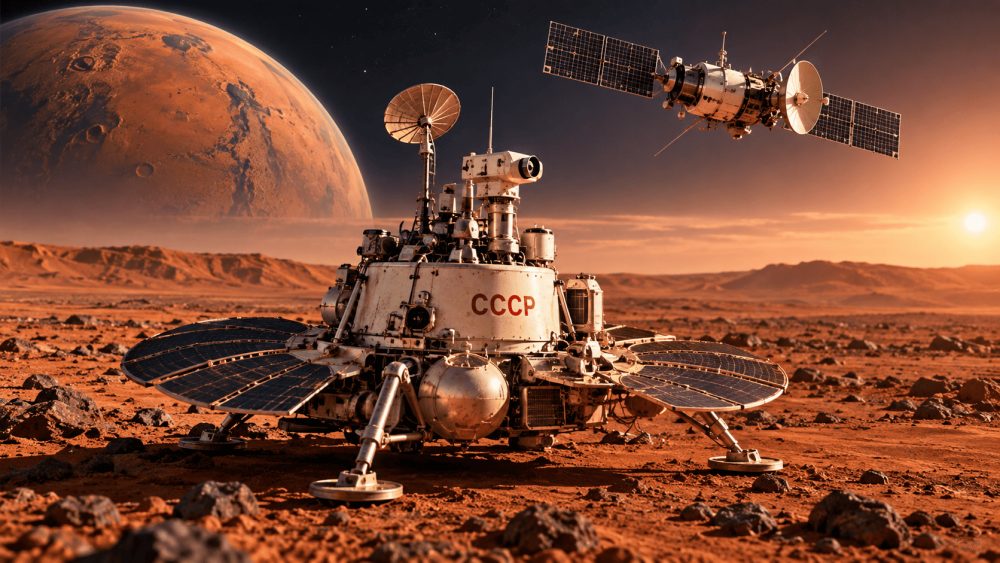
On 2 December 1971, the descent craft carried by the Soviet Mars 3 mission made the first soft landing on Mars. Its transmission ended seconds later. Both facts belong in the same account: a major engineering threshold had been crossed, but the planned investigation of the surface did not follow.
The answer to “who landed on Mars first?” therefore depends on the wording. Mars 2 reached the surface earlier by crashing. Mars 3 achieved the first soft landing. The American Viking landers began sustained surface investigations in 1976. These are distinct achievements, not interchangeable descriptions of a single event.
Why several missions left for Mars in 1971
NASA's exploration chronology lists the launch of Mars 2 on 19 May, Mars 3 on 28 May, and Mariner 9 on 30 May 1971. Their departure within a short interval reflects the geometry of interplanetary flight. Favorable opportunities depend on the relative positions of Earth and Mars; a mission cannot choose any date with the same consequences for its journey.
The Soviet vehicles combined orbiters with landing craft. Those components had different jobs: observing the planet from above and carrying out measurements after descent. This distinction is essential when assessing the mission. The loss of a surface station did not necessarily end the work of its associated orbiter.
Within the Soviet space program, an attempt to land on Mars extended the move from distant observations toward measurements made at the object itself. Experience at the Moon or Venus was valuable, but it did not make another planet's landing conditions identical. A successful design history was a starting point for the next problem, rather than a guarantee that it had already been solved.
Mars 2 and Mars 3 had different outcomes
Mars 2 arrived on 27 November 1971. Its descent craft entered the atmosphere too steeply and crashed. Five days later, the Mars 3 lander reached the ground softly. NASA's historical account places the landing in the region of Ptolemaeus Crater.
A named region is not the same as an independently identified piece of hardware at a precise location. Recovering a landing site in later orbital images requires another kind of evidence. A map label cannot, by itself, turn a predicted landing area into a confirmed position of the spacecraft.
The Mars 3 orbiter also encountered difficulties. A shorter-than-planned braking burn left it in a more elongated orbit than intended. Even away from the surface, the mission did not unfold exactly as designed. Its history is more informative when those separate outcomes remain visible than when the whole flight receives one undifferentiated label of success or failure.
Was the transmission 14.5 or 20 seconds long?
JPL's account of the search for the lander gives 14.5 seconds. NASA's 2021 historical overview gives 20 seconds. A careful description should acknowledge that difference rather than silently exchange one figure for the other or invent an explanation for it.
The robust conclusion is narrower: transmission lasted only a few seconds, contact then ceased, and a useful program of surface investigations was not completed. The difference between the commonly cited durations does not change that result. When a precise number is needed, it is sensible to identify the account that supplies it.
This is a recurring issue in the history of early exploration. A rounded figure in a general chronology may sit alongside a more exact-looking number elsewhere. Extra decimal places do not explain what interval was being measured or establish that two authors used the same starting point. Precision in writing includes knowing when the surviving summaries do not resolve that question.
The dust storm does not settle the cause
The arriving spacecraft encountered a planet-encircling dust storm that obscured the surface. It is a documented part of the mission's environment. It is not, on its own, proof that the storm caused the lander's failure. JPL explicitly describes the reason for the end of transmission as unknown.
The distinction is between a circumstance and an established mechanism. Two events occurring together can suggest a hypothesis. Demonstrating the hypothesis requires sufficient information about what happened to the equipment. In this case, the brevity of the contact limits the available diagnosis.
Nor should the loss of a radio signal be described as an observed explosion or visible destruction. Radio silence means that the available data link ended. Without additional evidence, it does not show exactly what physical event followed on the ground.
This restraint leaves the story incomplete in a specific way, but it also makes it more accurate. A clearly identified unknown is preferable to an explanation that sounds convincing only because the circumstances were dramatic.
The small rover that could not begin its work
The landing complex included a small surface vehicle known as PrOP-M. It did not carry out its planned deployment and investigation. Describing it as an operating Mars rover would confuse a device carried aboard a mission with a vehicle demonstrably working on the ground.
Comparison with Lunokhod 1 makes the difference clear. Lunokhod actually traveled across the Moon. Both projects belong to the history of planetary robotics, but their achieved capabilities were different. The performance of the lunar vehicle cannot be transferred to the Martian one simply because their intended roles sound similar.
The same principle applies to payload lists more generally. A list of instruments describes what engineers intended a spacecraft to do. Returned observations establish which of those ambitions became scientific results. They are complementary records, not substitutes for one another.
Possible hardware in later orbital images
In 2013, JPL published images of features that might be parts of Mars 3, seen by the HiRISE camera on Mars Reconnaissance Orbiter. Russian enthusiasts had searched the orbital imagery. Several candidate objects had sizes, shapes and a distribution consistent with elements of the landing system.
The announcement did not rule out alternative explanations. It should therefore be described as a report of possible hardware rather than a definitive identification. Enlarging a small feature in an image does not eliminate uncertainty about what the feature is.
This later search also illustrates how a mission can remain a subject of investigation long after it stops communicating. New observations may test an old account, but the confidence of the conclusion still depends on what the images actually resolve.
How to assess the achievement
The Luna 9 landing and Venera 7's surface transmission help separate the stages of a planetary mission: arrival, braking, touchdown, instrument operation and return of usable information. Mars 3 advanced beyond earlier Martian landing attempts without completing the whole investigative chain.
NASA's history of Viking emphasizes the limited surface science returned by the early Soviet attempts. The successful Viking operations in 1976 did not erase Mars 3's soft-landing first. Mars 3's first, in turn, did not provide the extended investigations achieved by Viking. A precise history has room for both statements.
Frequently asked questions
When was the first soft landing on Mars? The Mars 3 descent craft landed on 2 December 1971.
Why did it stop transmitting? The cause has not been established. A major dust storm was occurring, but that fact alone does not prove the failure mechanism.
Did a Soviet rover work on the surface? PrOP-M was included in the landing complex, but it did not complete a confirmed program of surface exploration.