Lunokhod 1: Driving the First Rover on the Moon
Lunokhod 1 explored the Moon under the direction of a team on Earth. Decades after its final drive, its passive reflector found a new scientific role.
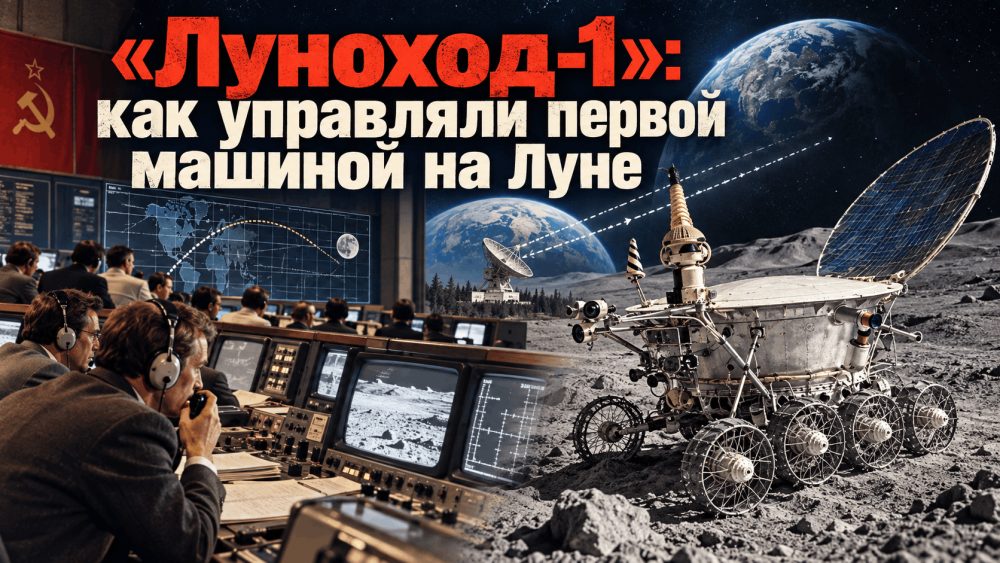
On 17 November 1970, an eight-wheeled vehicle drove down the ramps of Luna 17 and onto the surface of Mare Imbrium, the Sea of Rains. Lunokhod 1 became the first successful rover to operate on another celestial body. It could investigate an area around its landing site rather than remain fixed at one point.
People on Earth directed the vehicle. They examined transmitted pictures, assessed possible routes and sent driving commands. The expedition divided its work across space: the instruments and wheels were on the Moon, while a ground team made decisions about where the machine should go.
Why give a lunar lander wheels?
A stationary spacecraft studies the place where it lands. It can observe the horizon, test nearby material and transmit measurements, but a depression or group of rocks a short distance away may remain beyond reach. A rover can compare several locations.
After Luna 9's successful landing, mobility offered a further step in lunar exploration. Adding wheels required more than motors. The vehicle needed a view of the terrain, communication with its operators, a way to assess obstacles and enough energy for both travel and scientific work.
The route itself became part of the investigation. An instrument could repeat a measurement at different points, while photographs connected the readings with the surrounding landscape. Yet a scientifically attractive destination was useful only if the rover could reach it without losing the ability to continue working.
This is one reason a planetary rover cannot be judged only by the distance it covers. A short movement that provides a meaningful comparison can be more valuable than a longer trip without a clear observing purpose.
Luna 17 and Lunokhod 1
Luna 17 launched on 10 November 1970. Its job was to carry the rover to the Moon and make a survivable landing. Following the journey and a period in lunar orbit, it reached Mare Imbrium on 17 November.
Lunokhod drove from the platform using ramps and began its surface expedition. The two names therefore describe different elements: Luna 17 was the delivery spacecraft, while Lunokhod 1 was the mobile research vehicle.
In a short history of the Soviet space program, they may appear as a single entry. Distinguishing their functions explains the design. Hardware needed for the cruise and landing did not all have to accompany the rover across the ground afterward.
A vehicle designed around its instruments
The rover's body resembled a container with a hinged lid. Solar cells on the inside of that lid supplied energy during the illuminated part of the lunar cycle. Eight wheels carried it across the surface.
Its scientific equipment included television and panoramic imaging systems, an X-ray spectrometer, a device for investigating the mechanical properties of the soil and a laser reflector. Each answered a different kind of question: what did the landscape look like, what was the material made of, how did it respond to mechanical testing and where was the reflector relative to Earth?
The last task did not depend on continuously travelling farther. Some observations need a well-located reference point on the Moon. The usefulness of an instrument can therefore extend beyond the operating life of the wheels and radio system that brought it there.
Driving from another world
There was no driver inside Lunokhod's body. A team on Earth worked from images sent through the radio link. NASA's historical chronology describes a five-person driving team and the delay involved in receiving information and seeing the consequences of commands.
This was different from sitting behind a car's steering wheel. A driver on Earth sees the road continuously and immediately senses the vehicle's movement. A lunar operator had to act across a gap between observation, command and the arrival of updated information. Camera views also lacked some of the spatial cues available to a person standing beside the machine.
The practical response was cautious movement: assess a section of terrain, make a limited manoeuvre and check the result. Speed had to be considered together with risk. Preserving the ability to make the next measurement mattered more than crossing an unfamiliar patch as quickly as possible.
Lunokhod was a robotic mission, but that should not be confused with entirely independent driving in the modern sense. The working system included the lunar vehicle, communications equipment and people on Earth planning its progress.
How long did Lunokhod 1 operate?
The planned lifetime covered three lunar days; the rover worked through eleven. In this setting, a lunar day describes a long illumination cycle, not an ordinary twenty-four-hour Earth day. Calling the expedition an eleven-day mission without that distinction gives a misleading impression of its duration.
NASA's historical chronology records a journey of roughly 10.5 kilometres, more than 20,000 television images and 206 panoramas. These figures convey the scale of the work. They should not imply that every later summary or reconstruction of the route must use exactly the same measurement conventions.
The last successful communications session took place on 14 September 1971. Attempts to restore contact ended on 4 October. The two dates describe different events: the final successful exchange and the decision to stop trying. Both can therefore appear in accounts of the mission's end without representing a contradiction.
What the rover investigated
Pictures recorded the landscape and the arrangement of rocks. The spectrometer helped examine composition, while mechanical tests investigated the soil's physical behaviour. These observations went beyond describing a view. Ground conditions affect wheel traction, the stability of a landing vehicle and the operation of future equipment.
Lunokhod did not bring material back to Earth. Its findings arrived by radio, limiting the investigation to instruments carried aboard the vehicle. Mobility nevertheless allowed observations at multiple points instead of confining them to the immediate landing area.
As with any local expedition, the results described the terrain actually studied. Mare Imbrium was not a miniature version of every lunar environment. Building a wider picture required observations elsewhere and comparisons between measurements on the ground and images from orbit.
What happened in 2010?
In 2010, Lunar Reconnaissance Orbiter images helped determine the location of the vehicle that remained on the Moon. Researchers at Apache Point then obtained a returned laser signal from its French-built reflector. Thomas Murphy and his colleagues reported the result in a scientific paper.
The event did not mean that Lunokhod's old transmitter had restarted. The reflector is passive: it sends a portion of incoming light back toward its source without needing the rover to function as a powered vehicle. Timing the round trip of a laser pulse provides a distance measurement, and repeated measurements support studies of the Moon's motion.
This later use connected a Soviet expedition with a broader international scientific effort. Unlike the crewed meeting of Apollo and Soyuz, the connection here came through equipment that retained a scientific role long after the original expedition ended.
Frequently asked questions
Did Lunokhod 1 carry cosmonauts? No. It was a remotely directed research vehicle. Crewed missions such as Yuri Gagarin's flight and robotic rovers served different purposes.
Where did it travel? In Mare Imbrium, the Sea of Rains, on the Moon's near side.
Was it found and restarted in 2010? Its position was identified and its reflector returned laser light. Driving and radio transmissions did not resume.
Did the rover return to Earth? No. It remained on the lunar surface.
Sources
- NASA: Deep Space Chronicle, Luna 17 / Lunokhod 1, pp. 83-84.
- NASA APOD: Lunokhod: Reflections on a Moon Robot.
- T. W. Murphy Jr. and colleagues: Laser Ranging to the Lost Lunokhod 1 Reflector.
- NASA: how laser reflectors support lunar science.
Cover: original USSRborn editorial infographic. The symbols represent stages of exploration; no archival photographs are used.