Venera 7: The First Signal from Another Planet’s Surface
Venera 7 reached Venus on 15 December 1970. A faint transmission recovered from the recordings established the first working landing on another planet.

On 15 December 1970, Venera 7 became the first spacecraft to transmit information from the surface of another planet. The Soviet mission did not return a landscape photograph. Its decisive result was a faint radio transmission containing instrument data, identified through analysis of the recordings after landing.
The word planet is essential to that distinction. Spacecraft had already operated successfully on the Moon, Earth's natural satellite. Venera 7 extended the achievement to a world with a dense atmosphere, extreme surface pressure and heat that made sustained operation exceptionally difficult.
Why a Venus landing was different
Venus is similar to Earth in size, but its surface environment is profoundly different. NASA's modern planetary summary gives an average surface temperature of about 467 degrees Celsius and pressure roughly 93 times Earth's sea-level value. Those general modern figures should not be presented as the exact readings returned by a single spacecraft in 1970.
For a descending capsule, an atmosphere can be both useful and dangerous. It provides drag to slow the vehicle, but it also subjects the structure to heating and increasing pressure. Touchdown does not end the environmental challenge. Once on the ground, the instruments remain surrounded by a hot, dense atmosphere.
A lander's useful lifetime therefore depends on more than its batteries. The design must keep sensitive equipment in workable conditions long enough to collect and send data. A short successful transmission can be meaningful when the surrounding environment places severe limits on survival.
Venus exploration formed a distinct branch of the Soviet space program. Unlike Sputnik 1, an interplanetary probe had to complete a long cruise before attempting the brief operation that would determine the mission's main result.
Building for conditions near the ground
Earlier Soviet probes had supplied information about the Venusian atmosphere. Reaching the next stage required a capsule designed to survive farther down. The NASA-published Deep Space Chronicle describes Venera 7's protective design as intended to withstand pressures up to 180 atmospheres and temperatures up to 540 degrees Celsius.
These are design limits, not measurements made on Venus. Confusing the two changes the meaning of the evidence: a margin built into a spacecraft becomes an alleged discovery about the planet. The distinction is particularly useful when comparing historical accounts that place several different temperature and pressure figures in the same paragraph.
The early Soviet interplanetary effort was associated with Sergei Korolev, while Venera 7 was developed by the Lavochkin organization. The program advanced through successive spacecraft and design changes. It was not one unaltered machine repeatedly dispatched to a new destination.
From the August launch to the December landing
Venera 7 launched from Baikonur on 17 August 1970. Trajectory corrections adjusted its course during the cruise. On 15 December, the landing capsule entered the atmosphere of Venus. DLR's mission record places touchdown about 35 minutes after atmospheric entry.
The travelling spacecraft and the capsule had different functions. During the journey, the vehicle needed guidance, power and communications. The separated lander then had to continue through descent and operate on the ground. Calling both simply the probe can conceal which hardware actually reached the surface.
Unlike a lunar landing, a descent at Venus can make use of atmospheric drag and a parachute. That does not make the operation straightforward. The spacecraft must pass through changing conditions, and the condition of its descent system determines what happens during the final approach to the ground.
A signal recovered after touchdown
At landing, the clearly received transmission disappeared. Tracking recordings nevertheless preserved a much weaker signal. Later processing showed that information had continued to arrive from the surface for nearly 23 minutes.
One likely explanation is that the capsule tipped after impact, leaving its antenna in a poor orientation. NASA's historical account treats this as a probable explanation. It should not be narrated as though a camera had recorded the event. The reconstruction depends on the behaviour of the signal, not on a photograph showing exactly how the capsule came to rest.
The distinction is central to understanding the mission. Losing a strong signal in real time did not necessarily mean that the transmitter had stopped. Recorded observations allowed investigators to separate an apparent loss of the spacecraft from a much weaker continuing transmission.
What Venera 7 established
The mission's results are associated with a surface temperature near 475 degrees Celsius, with an uncertainty of about 20 degrees. Historical summaries also commonly give an estimated surface pressure near 90 atmospheres. The latter should be identified as an estimate of conditions, rather than represented as an unambiguous direct pressure reading from a working sensor on the ground.
The broader achievement was operational. Equipment survived long enough to transmit from an environment where earlier missions had not delivered that result. This supported the development of further surface investigations, while confirming that obtaining information from the ground was technically possible.
The short transmission did not describe every part of Venus. It provided neither a global terrain map nor a complete inventory of surface rocks. A mission can establish a major first while returning a limited dataset. Its importance does not require attributing later discoveries to it.
Why there are no Venera 7 landscape photographs
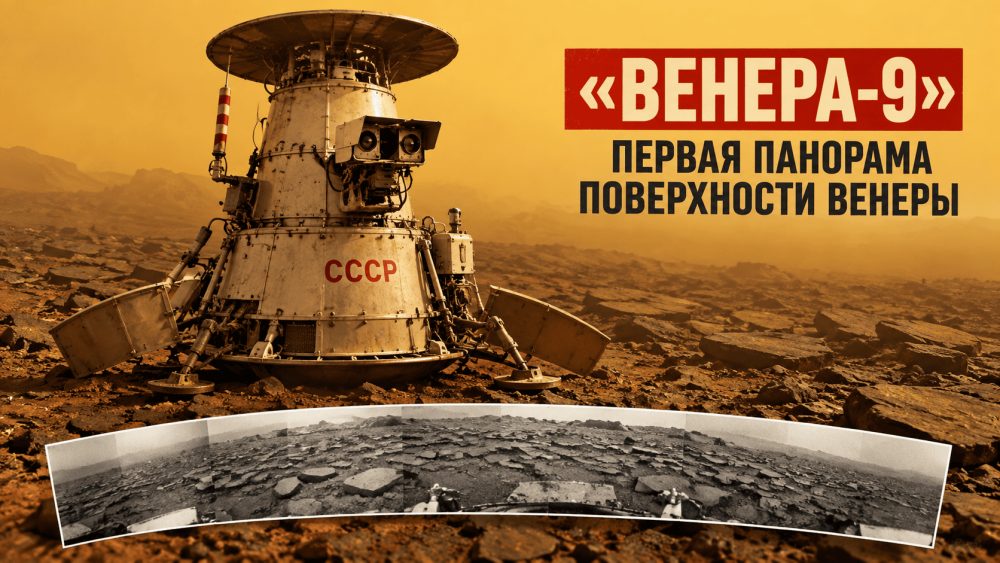
The first surface transmission and the first surface photographs belong to different missions. Venera 9 returned the first pictures from the ground on Venus in October 1975, followed by Venera 10. Those images came years after the 1970 landing.
Familiar panoramas of rocks on Venus should therefore not be captioned as photographs taken by Venera 7. The spacecraft and instruments were different. An illustration accompanying the earlier mission needs either an accurate historical identification or a clear explanation that it is a diagram rather than an archival image.
This is more than a matter of captions. Photographs can make a mission seem to have performed observations that its actual instrument package never supplied. Keeping the achievements separate makes the development of the program easier to understand.
How to judge a short surface mission
Nearly 23 minutes can sound brief when compared with the years of operations associated with the Mir space station. Such a comparison leaves out the conditions and the purpose of each vehicle. An orbital laboratory and a capsule on the surface of Venus faced fundamentally different problems.
The relevant question for Venera 7 is whether the equipment worked in the required environment and returned usable information. It did. The mission also demonstrates why preserving observations matters: the final result of an experiment may become clear during later analysis rather than during the first moments of reception.
Frequently asked questions
When did Venera 7 land? It landed on Venus on 15 December 1970, following its launch on 17 August.
How long did it transmit from the surface? Nearly 23 minutes. This is the post-landing interval, not the entire transmission during atmospheric descent.
Did it carry people? No. Venera 7 was an uncrewed robotic mission.
Why is it called a first if spacecraft had already landed on the Moon? Its distinction concerns transmission from the surface of another planet. The Moon is a natural satellite, and lunar landings are a separate category.
Sources
- DLR: Venera 7 mission record.
- NASA: Deep Space Chronicle, Venera 7, pp. 81-82; Venera 9, pp. 109-110.
- NASA: Venus facts and surface conditions.
- NASA HEASARC: chronology for 1970.
Cover: original USSRborn editorial infographic. The colour and circular Venus symbol are schematic; no archival photograph is used.