Venera 9: The First Panorama from the Surface of Venus
Venera 9 returned a black-and-white view of Venus on 22 October 1975. The panorama joined a brief surface operation with an orbital science mission.
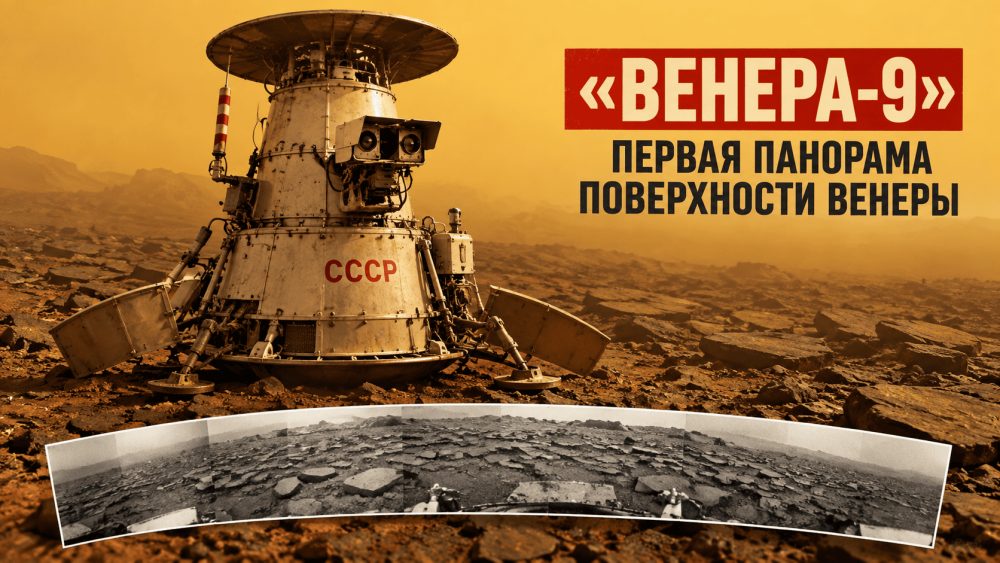
On 22 October 1975, Venera 9 returned the first image from the surface of Venus. Rocks, soil and part of the landing craft appear in a modest black-and-white view. By modern standards it may look limited, but it represented a new capability: researchers could examine a landscape on another planet from a camera standing on its ground.
Venera 9 was not the first spacecraft to land on Venus. Venera 7 had transmitted from the surface in 1970. The later mission's achievement is better described through its combined objectives: operating an orbiter at Venus and obtaining a panorama from the surface.
Why a landscape image was a major step
Venus is hidden beneath cloud cover. An image of the planet from outside its atmosphere and a view of stones beside a landing craft answer different questions. The first records the atmosphere in the observing system's chosen wavelengths. The second allows local surface forms to be inspected directly in visible light.
The image also depended on much more than a working camera. Venus has an exceptionally hot surface and pressure far above that at Earth's sea level. Instruments and a transmitter had to survive the journey through the atmosphere and remain able to operate after touchdown, even if only for a limited interval.
A mission like this is a sequence of connected tasks. The spacecraft must reach the planet, separate its descent system, lose speed, protect its equipment, form the image and transmit a signal that can be received. The photograph is the public-facing result of that whole sequence. It is not an isolated camera achievement detached from the rest of the engineering.
The value of the result is easier to see when these requirements are considered together. A lander that survived but could not communicate would leave researchers without its observations. A functioning camera would achieve little if its supporting electronics or data link were lost before the image reached Earth.
One mission, two working spacecraft components
Venera 9 launched on 8 June 1975. It consisted of an orbiter and a descent craft. NASA's Planetary Data System describes the orbiter as both a communications relay for the lander and a platform for investigating the cloud layers, atmosphere and surrounding space environment.
That division of work matters. A surface station examines a small area under severe local conditions. An orbiter observes from a different distance and carries instruments with purposes of their own. It should not be treated simply as packaging that ceased to matter once the descent craft separated.
Within the Soviet space program, such combined missions illustrate the move from a single dramatic milestone toward complementary observations. Touchdown remains significant, but its scientific value grows when local measurements can be considered alongside a wider view of the planet.
The components also have separate timelines. A duration quoted for the surface station cannot automatically describe the orbiter's work or the months spent traveling between planets. Keeping the components distinct prevents a common misunderstanding of short planetary mission summaries.
Reading the panorama
NASA's image description identifies angular and partly weathered rocks, some partly buried in soil. The bright feature along the bottom belongs to the lander itself. Portions of the horizon appear toward the upper corners, while the visible distortion reflects the imaging system used to construct the view.
Those details provide a starting point for looking carefully. Without the caption, a piece of hardware might be mistaken for an unusual natural formation. The image needs to be interpreted with knowledge of the camera's position and the method by which the panorama was produced.
A panorama is also not a global map. It records the neighborhood of one station. It shows that these materials and shapes occur here; it does not establish that the whole planet is an identical field of stones. Other landing sites and observations from orbit are needed to develop a broader geological picture.
This distinction between a local view and a planet-wide conclusion applies well beyond Venus. A dramatic first picture can dominate public memory precisely because there are so few comparable views. Its rarity makes it valuable, but does not make its field of view larger than it actually is.
Black-and-white images and later color views
Venera 9 and Venera 10 returned black-and-white panoramas in 1975. The color panoramas came with Venera 13 and Venera 14 in 1982. The European Space Agency's history of Venus exploration distinguishes those stages explicitly.
A vivid color picture labeled “Venus, 1975” therefore deserves a check of its provenance. It might be a processed or colorized version, an image from a later mission, or an illustration. Appearing on a space-related website does not make every color treatment an original measurement from the camera.
Black-and-white data can still be scientifically rich. Brightness differences, outlines, textures and the arrangement of visible objects all carry information. What the image cannot directly supply is a dependable color for every rock. Recovering colors would require additional evidence and clearly stated assumptions.
For a reader, the useful question is not simply whether an image has been processed. Almost any presentation involves choices. The question is which features come from the original measurements and which have been introduced to make those measurements easier to view or imagine.
What the 53 minutes describe
NASA gives 53 minutes for the lander's surface operation. That figure should not be confused with the duration of the interplanetary flight or the complete orbital mission. It describes the brief working interval on the ground during which the image was returned.
Limited operating time makes the order of observations and the reliability of transmission especially important. Information stored inside a silent spacecraft is not available to laboratories on Earth. Communications are therefore part of the experiment's ability to produce a scientific result, not merely a way to announce that the craft arrived.
The contrast with Luna 16 is useful. That lunar mission brought physical material back to Earth, whereas the Venus station sent measurements by radio. The chosen form of return determines what must be completed at the destination and what can be examined afterward by researchers at home.
Another planet is not the same as any other world
The phrase “first image from the surface of another planet” does not mean the first picture from any celestial body beyond Earth. The Moon is Earth's natural satellite. Luna 9 had returned lunar surface panoramas in 1966.
Careful terminology preserves both achievements. The lunar images are no less significant because the Moon is not a planet. The Venus image does not require an exaggerated claim that no earlier lander had photographed an extraterrestrial landscape.
It is equally important to distinguish an image made from orbit from one made after landing. A planet can be photographed long before a camera reaches its soil. Historical firsts become meaningful when the account says where the camera was and what it observed.
Frequently asked questions
When was the first Venus surface panorama received? Venera 9 returned it on 22 October 1975.
Was it a color image? No. The 1975 panoramas were black and white. The color views belonged to later missions in 1982.
What is the bright object at the bottom? NASA identifies it as part of the landing craft, rather than a feature of the natural landscape.
Did the entire mission last 53 minutes? No. That duration concerns the lander's surface operation. The journey and the orbital component have separate timelines.